
News Department, BBC News Ukraine
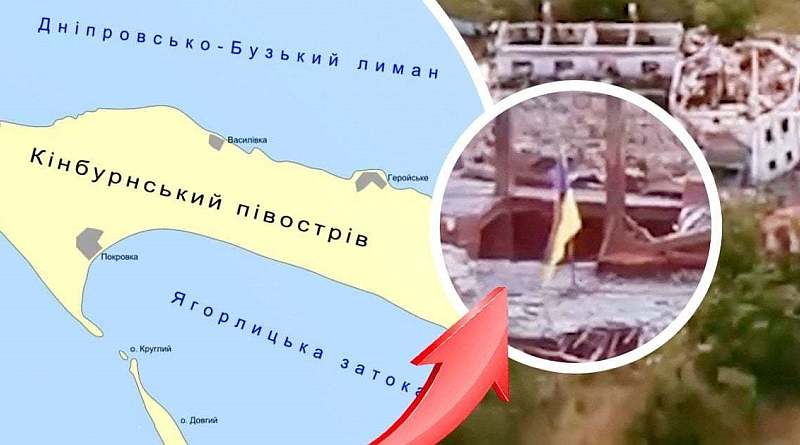
The Odessa operational-tactical group of troops showed a video in which the Ukrainian flag is flying on a building on the Kinburn Spit.
“As a result of a powerful fire attack, the Southern Defense Forces forced the occupiers to retreat from their positions, the evacuation of the surviving personnel is underway, and the occupiers are leaving their defense lines,” the statement said.
They did not specify whether the flag was installed by drones and whether there is an operation to land on this spit, but it is indicated that the military does not intend to stop.
“Our tanks will eventually reach Dzhankoy,” the statement says.
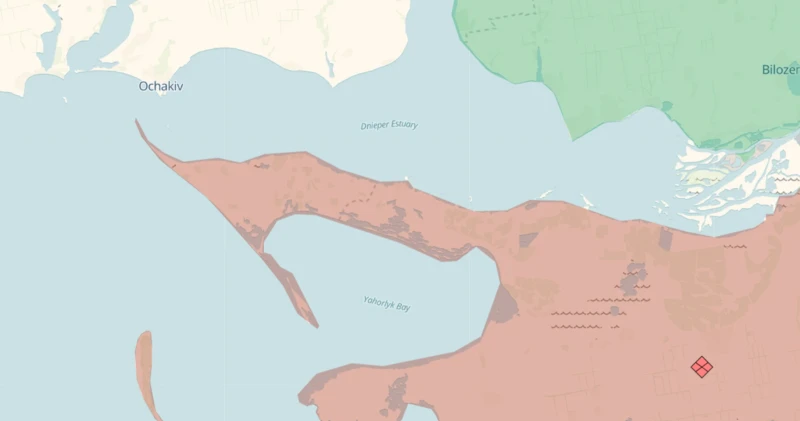
The Kinburn Spit is the last occupied area of Mykolaiv region, which is located on the left bank of the Dnipro and adjoins Kherson.
From it, the Russians could fire at Ochakiv, 5 km away, and even Odessa, 60 km in a straight line.
Even after the liberation of the right-bank Kherson region in the fall of 2022, the military said there might be an operation to liberate Kinburn, but after an unsuccessful operation in Krynychky on the left bank of Kherson, this did not happen.
Although observers indicated that the Armed Forces tried to conduct operations on the spit and attempted to liberate it.
In recent months, the Armed Forces cut off Russian logistics on the spit and tried to force them to leave it.
“We are now witnessing the process of destroying Russian logistics. This is a consistent process, not for the first year, not even months it lasts. But as of now, the Kinburn Spit is a zone of hostilities,” Navy spokesman Dmytro Pletenchuk told “Suspilne.”
The resource Deepstate also stated that there is no evidence of an active withdrawal of the Russians from the spit.
“The enemy continues to use the area for launching ‘Molnia’ UAVs towards Mykolaiv and Kherson and has other means in the form of EW and EOR. At the same time, the Defense Forces are trying to make the enemy’s stay and work as difficult as possible. There is no offensive on the Kinburn Spit, and the flag was dropped by a drone, which is simply a pleasant fact,” observers said.
Why the Kinburn Spit is important
This small sandy peninsula has repeatedly become a scene of bloody battles over the past 200 years.
Territorially, Kinburn belongs to the Mykolaiv region of Ukraine. But between the spit and the mainland part of the region lies the Dnipro-Bug estuary. It is the ongoing occupation of this sandy spit by Russian troops that prevents the Ukrainian authorities from declaring the complete liberation of Mykolaiv region.
This piece of Ukrainian territory was captured by Russian forces at the very beginning of the full-scale invasion.
The occupation of the Kinburn Spit allowed them to establish control over a significant area of the Black Sea and effectively block the ports of Kherson and Mykolaiv.
Moreover, the presence on the spit allowed Russian artillery to strike Ochakiv, a city where the base of the Ukrainian Navy’s special operations center is located.
Commander of the OTU “Odesa,” Colonel Denys Nosikov, in an interview with journalists on June 17, talked about the importance of liberating Kinburn.
“The issue of liberating the Kinburn Spit is very important. For me personally, this path through the spit is the road home, to my native Crimea, where I was born and raised. The time will come and we will return!” he said.
“Here, the enemy constantly tries to create problems. We neutralize 99% of their FPV drones with electronic warfare. But there are issues with fiber-optic drones, which we are also resolving. We are building anti-drone tunnels for reliable logistics,” the commander said.
The Ukrainian Armed Forces destroy their weapon systems daily — artillery of various calibers.
“As soon as it’s foggy or night, they try to bring in new systems, but literally within a week, we turn them into scrap metal. We have enough mid-range UAVs in our arsenal, the so-called middle strike. We inflict damage to the depth we need.”
He asserted that the Ukrainian Armed Forces have practically cut off Russian logistics on the spit.
“The supply of ammunition, food, and fuel is essentially halted. A soldier cannot fight without food and fresh water. Therefore, according to intelligence, they are currently evacuating.”
The Site of Great Battles
The fact is that before 2022, the Kinburn Spit was primarily a tourist destination, where a narrow strip (40 km long, 8-10 km wide) combined a national nature park, beautiful beaches, sands, and wooded areas.
But earlier this peninsula on the border of Kherson and Mykolaiv regions was known as the arena of fierce and bloody battles.
For a long time, this area was under the control of the Ottoman Empire. The name Kinburn itself comes from the Turkic words “kil” (hair) and “burun” (cape). The Turkish military built a fortress here in the 15th century and held it until the mid-18th century.
In 1736, the troops of the Russian Empire captured the castle and destroyed it. However, six years later, Kinburn was returned to the Turks under the Treaty of Belgrade in 1739 between the Russian and Ottoman Empires.
The unfavorable conditions for Russia were reconsidered 35 years later. A new treaty with the Turks returned a large part of the Black Sea region to the Russians, including Kinburn.
The Ottomans did not reconcile with this turn of events.
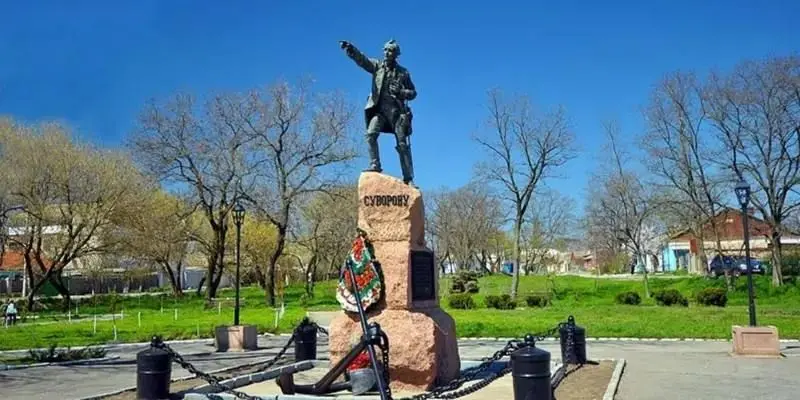
In the autumn of 1787, a Turkish fleet set off for the Kinburn Spit intending to drive the Russians out. The defense of the peninsula was overseen by the “mythologized” in modern Russia commander Alexander Suvorov.
He allowed the Turkish landing force to land on the western side of the spit near Ochakov, construct trenches and fortifications without hindrance, and then attacked them. Several assaults were unsuccessful, but on the third attempt, Russian troops were able to defeat the enemy.
Of the nearly 5,000 Turkish soldiers, about 300 managed to escape, Russian historians wrote. On the Russian side, around 450 were killed and wounded. The commander Suvorov was wounded twice.
This battle effectively became a symbol of the Russian Empire’s victory in the fight against the Turkish forces at sea. Although some historians criticized Suvorov’s decision to allow the Turkish landing on the spit, to build fortifications, and later unsuccessfully attempt several times with cavalry to dislodge them from their positions, which ultimately led to significant losses among the peninsula’s defenders.
Defeat of Russia
Less than 100 years later, the Russians were forced to capitulate at Kinburn.
During the Crimean War, Anglo-French naval forces drove them from this peninsula.
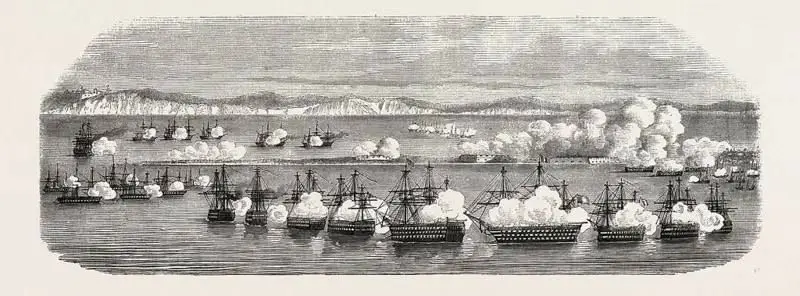
In October 1855, a joint fleet of British (49 ships) and French (31 ships) approached the southern and western shores of the Kinburn Spit and began shelling the Russian fortress on it and also landed troops.
The attacks from the Russian artillery in response were weak, as almost all shells fell short of the enemy ships, and even those that did hit caused little damage to the ironclads. Such heavily protected ships were a novelty at the time and were used for the first time in battle at Kinburn.
Conversely, the fire from the English and French was accurate and destroyed many fortifications on the Russian shore.
Later, part of the fleet approached Kinburn from the north as well, meaning the effective encirclement of Russian forces. The garrison commander, General Ivan Kohanovich, accepted the offer to surrender.
This decision caused a wave of public outrage in the capital of the Russian Empire, and both Kohanovich and the garrison’s artillery chief were later tried for a “shameful capitulation.”
This battle marked the end of Kinburn’s history as a fortified fortress. However, it did not deprive the peninsula of its special strategic significance for troops during subsequent battles.
For example, during World War II, troops of Nazi Germany and its allies tried to use the Kinburn Spit as a foothold for their forces. However, in December 1943, the Soviet Army expelled the enemy from the peninsula. The operation took 2 days.
“Thus, as a result of two days of fighting on the Kinburn Spit, parts of the 24th Guards Division completely defeated the enemy’s landing party, killing and wounding up to 700 people and capturing about 500, including 11 officers,” stated the report from the headquarters of the 2nd Guards Army.
What Was Before 2022
Nearly 80 years without hostilities turned Kinburn into a wildlife reserve. In 2009, this area was officially designated as the “Bíloḅerěžžia Śviatoslava” National Nature Park by a presidential decree.
Sviatoslav the Brave was a prince of Kievan Rus, known for his military campaigns against Byzantium. According to legends, his troops liked to rest during their campaigns on the territory of the Kinburn Spit.
According to the park’s deputy director, Pavlo Kholodniak, a large part of Kinburn’s protected nature suffered due to the war.
The reason was the regular shelling by Russian forces from this territory.
Notably, the peninsula was home to 4,000 species of animals, including 300 species of birds, which found Kinburn a convenient place for nesting and migration.
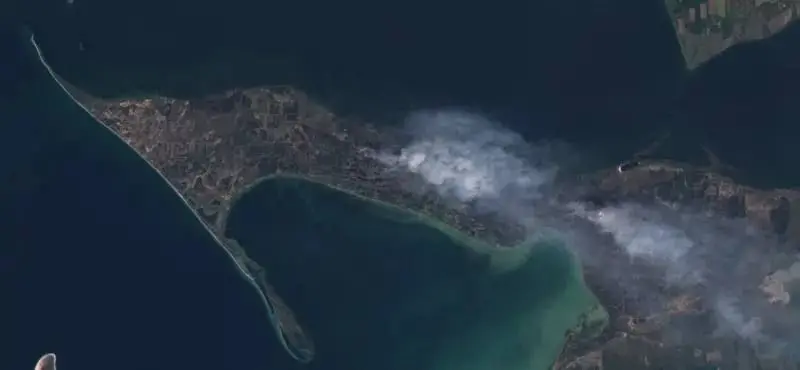
Constant shelling of the territory led to large-scale fires on the peninsula. According to Kholodniak, about 42% of the nature park was affected in 2022, which is 4,200 hectares of the territory.
Specifically, about 1,000 hectares of forest on Kinburn burned.
“This is a very heavy loss for us. The Kinburn Peninsula has never suffered such damage and has never faced anything like this,” emphasized the ecologist.
According to preliminary estimates, the damage in 2022 was approximately 100 billion hryvnias.
Collage: TSN
