
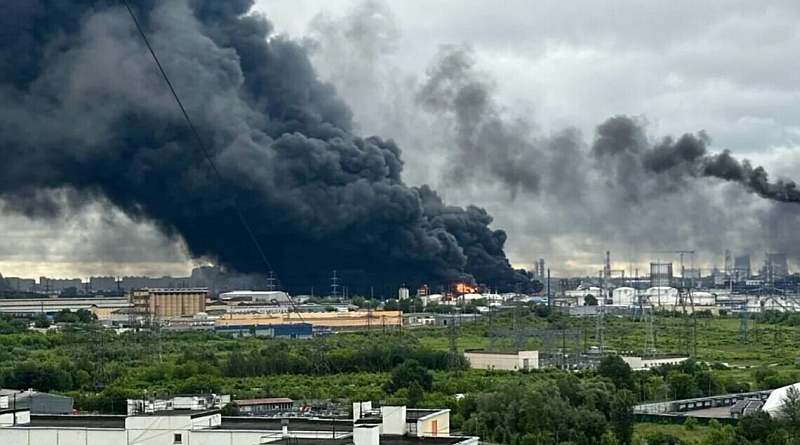
The Ukrainian Defense Forces finished off “Wild Berries” in a little over a month. On July 18, strikes first hit Kotovsk and Elektrostal. We completed the operation by Ukraine’s Independence Day. Shifting attacks to Ozon is a classic marker that the primary target has been gutted to a critical state. We do not scatter resources; we methodically cut out the enemy’s logistical bloodlines.
Wildberries got its share, now we have taken on the second most important trade artery of the Russians. Ozon’s shares have already plummeted by 20%, trading halted. Hello, VTB Bank.

What does this mean? That the Russian campaign of strategic bombing against the enemy is not achieving its goal. The Kremlin cannot knock out our “long arm”—hundreds of drones per day and 20–30 cruise missiles per week continue to hit their targets.
It’s clear that Wildberries has not been reduced to dust, but that’s not necessary. As an independent, highly profitable private business, this company has died. All that frantic fuss with merging with Russ Group and shooting near the office was a desperate attempt by Bakalchuk to find a “political roof” in the Kremlin and VTB Bank against growing debts and problems. And Kadyrov, to whom her ex-husband ran in a panic, is just agony and gangster squabbles over the remains of the pie. Now, after the strikes by “Furious” and FP-1, it’s a wounded carcass that will constantly demand billion-dollar subsidies from the budget, falter at every step, and drag the state-owned Russian bank VTB down with it.
Before the strikes: about 38–40 large distribution centers of class A/A+ with an area from 50 to 250 thousand square meters and about 150–200 small regional sorting centers. Minus and incapacitated: 18–23 facilities of varying severity, including critical giants like Podolsk, Elektrostal, Chekhov, Kotovsk, Krasnodar, and Nevinnomyssk. About 15–18 large hubs plus a peripheral network of small centers remain fully operational, which themselves cannot store and distribute large volumes, as they operate only as transit points.

There are critical nuances here — if only half of the monolithic warehouse complex of 150,000 square meters burned, the other half is flooded with tons of water from hoses, covered in toxic soot, de-energized, and deprived of air conditioning. Commissions seal the entire perimeter. Physically, 75,000 turned to ashes, but from an operational logistics perspective, all 150 are out of service.
The central hub has been decapitated. The main impact was on the Moscow suburbs and adjacent regions. Up to 60% of all gray imports, electronics, and high-liquidity goods converged in these strategic hubs. Warehouses beyond the Urals or in the North cannot compensate for the loss of the Moscow “ring.”
The delivery radius has increased 3-4 times. To deliver orders to places like Tver or Tula, the marketplace must now transport goods not from the destroyed Podolsk, but drive trucks from Kazan, Yekaterinburg, or Novosibirsk. This massively consumes diesel, clogs up trucks, and increases delivery time from 1 day to 4-7 days. The overload on remaining stock is enormous. The surviving 15-18 large hubs are now packed to 110-120% of their standard capacity. There are daily queues of trucks at the entrances, and inside chaos ensues with sorting and box losses.
According to official reports, the share of non-performing loans in the VTB group, which is the main financial driver of Wildberries, was 3.8% by the end of 2025. If translated into real money: their corporate loan portfolio amounts to about 18.6 trillion rubles, and retail occupies another 27-30%. The entire loan portfolio hovers around 25 trillion. This means that even before our strikes on logistics hubs, VTB already had about 950 billion rubles of officially recognized “dead” debts on their balance sheet. According to their forecasts, due to the war, high interest rates, and sanctions, the percentage of problematic loans in retail was expected to rise to 6-7% even without our strikes.
The destruction of warehouses in the Moscow region, Podolsk, Chekhov, and surrounding areas represents an immediate cash gap of approximately $2.5 billion in direct corporate loans. These loans are unsecured: the warehouses physically burned, and the marketplace is incurring colossal losses and requires restructuring. The stock that evaporated in the WB warehouses is estimated to be worth hundreds of billions of rubles—ranging from $3.5 billion to $8.5 billion. A significant portion of sellers were financed by VTB to purchase these batches. As soon as Wildberries cynically rewrote the offer and declared the drone raids a “force majeure,” thereby absolving themselves of responsibility, tens of thousands of sellers went bankrupt in a single month. They simply have nothing to pay their bills with, and the order pickup points are now being sold off at the price of an electronic book.
An ideal financial dilemma arises: the state-owned VTB is not repaid billions in debts by either the corporation for the burned warehouses or small businesses for the destroyed cargo batches, gray logistics, new warehouse rentals, and other cascading effects.
For VTB, a one-time injection of up to a trillion rubles of irrecoverable mass is a knockout. We remember that the growth of problem loans due to the interest rate and war does not stop. To cover such gaps in the balance sheet and not violate stability regulations, the bank will need emergency liquidity infusions. And since it is a state bank, it will be bailed out at the expense of the Russian printing press and budget.
Our campaign has already led to parts of the “Rubicon” being withdrawn from the front to intercept piston UAVs, to the allocation of hundreds of millions of dollars for air defense, interceptors, radars capable of detecting small targets, and to a sharp drop in the supply of drones and parts to units in the red zone.
In just a few months, our drones and their internal corporate cannibalism have collectively left about 100,000 people without means of subsistence around Wildberries alone. Each destroyed giant hub at the level of Elektrostal, Podolsk, or Chekhov means three to five thousand employees per shift. We hit them at over two dozen sites of various calibers. This horde of sorters, warehouse workers, packers, and electric car drivers physically has nowhere to work. Plus 30-50 thousand sellers. Plus management, repair workers, white-collar employees.
And this is purely the direct effect. We haven’t even touched on related parties: truck drivers on private contracts, producers of cardboard packaging, small sewing workshops somewhere in Ivanovo, or furniture assemblers, which were exclusively geared towards shipments to these burned warehouses.
Thus, 100 thousand people left without means of survival is still a very conservative and restrained estimate of the hole we’ve punched in their society.
And the cherry on top—a debt burden of up to $10 billion on the state. And this figure will grow due to delays, penalties, and falling stocks. In my opinion, not a bad eyebrow-raiser in three days, right?
In the foreground: The Wildberries logistics center in the city of Kotovsk, Tambov Region, Russia, August 26, 2026. Photo: Occupier Media
