
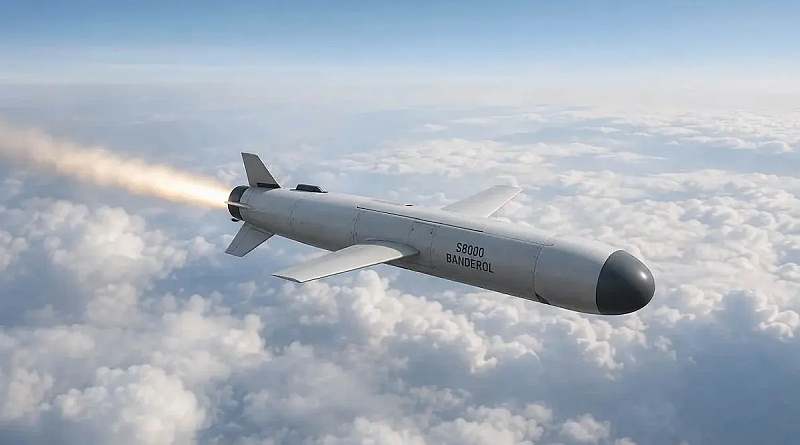
Finding an official and accurate number for the enemy’s use of “Banderoles” for September is very difficult. The Air Force Command usually reports the number in terms of individual attacks, not a monthly summary. Analysis of these reports shows three “Banderoles” shot down on September 2, six on the 6th, and one on the 12th. There were mentions of their use in a strike on the night of September 9 from the Azov Sea and on the night of September 11 from the Belgorod region. There are mentions of “Banderoles” hitting the Dnipropetrovsk region on September 2, 3, 5, and 6, and other episodes. The National Police building in Zhytomyr was also hit precisely by a “Banderole”.

What is “Banderol”?
There are many different assessments, but the most objective should be considered “a small-sized air-launched cruise missile.”
The ammunition occupied a free interval niche between cheap strike UAVs like “Geran-2” and more expensive air-to-surface cruise missiles of the X-39 class. The focus on mass production, low cost, and sufficient accuracy allowed the development of a precision weapon for operational purposes that does not require the use of operational-tactical or strategic aviation. The flight range of the “Banderol” allows aviation to strike from outside the air defense zone of action.
The developer of the S8000 “Banderol” is the company PJSC “Kronshtadt” (Dubna, Moscow region), (the “Kronshtadt” group, previously associated with “Transas” and AFK “Sistema”). The missile is approximately 5 meters long, with a body diameter of 30 cm, foldable wings with a span of 2.2 meters, a flight range of up to 500 km (depending on launch method and altitude), a speed of 550 km/h, but can reach 650 km/h, a warhead – fragmentation-explosive weighing 114.3 kg, of which 29.5 kg is solely explosive.
The “Banderol” airframe is very similar to the American AGM-158 JASSM, the navigation system is combined (satellite GLONASS/GPS and inertial systems, the signal is protected by a jamming-resistant eight-channel “Comet-M8” receiver). The engine is Chinese, a turbojet Swiwin SW800Pro-A95 (thrust up to 81.6 kgf, weight about 8.5 kg, fuel – aviation kerosene, with a tank of 50-65 kg. If anyone needs it – it’s available on AliExpress).

Despite the sanctions, foreign components are used in the missile: servos from South Korean Dynamixel or Robotis, batteries from Japanese Murata, a six-axis inertial measurement unit (IMU) with a MEMS motion sensor (three-axis gyroscope and three-axis accelerometer) made by InvenSense (USA), microcontroller produced by STMicroelectronics (Switzerland), and the RFD900x radio modem by Australian company RF Design.
The missile behaves in flight as a cruise missile should, but unlike the Kh-101 and 3M14 “Caliber”, the Kh-69 is capable of turning with a smaller radius while maintaining the typical low-altitude flight trajectory of its class relatives.
The production capabilities of JSC “Kronstadt” are 60-90 missiles per month. “Banderol” is positioned as a relatively inexpensive medium-range weapon: Western experts estimate the cost of the missile at $16,000, while Russian estimates range from 50,000 to 150,000, which is understandable – the budget won’t embezzle itself. However, it is definitely cheaper than Western counterparts such as Storm Shadow or SCALP-EG.

Officers directly involved in air defense battles say that today the enemy has three ways of launching “Banderols” – from the “Orion” UAV (also known as “Inokhodets”, the UAV carries one “Banderol”) produced by the same company “Kronshtadt”, from Mi-28n helicopters (up to four “Banderols” per sortie, usually two to four) and from ground launchers. Launching from a UAV provides the maximum flight range. Mentions of ground launches appeared in 2025 but spread alarmingly in 2026. They are compact, mobile, sometimes based on pickups or trailers. Ground launch requires a solid-fuel booster. Launch from helicopters follows the same method as UAVs, but with lower acceleration speed and launch altitude. Ground and helicopter launches provide a firing range of about 400 km.
The missile can be widely mounted on the pylons of Su-24, Su-34, Su-35 aircraft.
The main positional area from which “Banderols” strike Ukraine is Crimea, although launches have been recorded from the Belgorod, Bryansk, and Kursk regions. Typically, for massive strikes on our south (towards the Odesa, Mykolaiv regions, and further deep into Ukraine), the enemy uses mass launches from coastal areas over the Black Sea and from ground launchers in Crimea.
When the enemy finds it very difficult, the carriers operate from the coast of the Azov Sea, using airfields in the Rostov region (Zernograd) and Krasnodar Territory (Korenovsk), from where they either attack southern Ukraine or fly to Crimea, where they conduct bounce attacks on targets deep in Ukrainian territory. Recently, cruise missiles, including “Banderols,” moved towards Chornomorsk along the Black Sea coast from the Kherson region through Mykolaiv and Odesa, meaning the enemy maximizes the difficulty of detecting both the carriers approaching the launch boundaries (they need to climb as high as possible!) and the means of air attack on the routes.

The defense forces are persistently and systematically working to reduce the effectiveness of the ‘Banderol’, for which they visited the ‘Kronstadt’ plant in Dubna on May 28 last year. Strike UAVs ‘Lyutyi’ and FP (exactly which one is unknown) hit the new production workshop where ‘Orions’ and ‘Banderols’ are assembled. A massive fire was recorded inside the premises. The strike initiated further financial problems for the company: by the end of 2025, ‘Kronstadt’ declared losses of about 4.5 billion rubles, and in 2026 there were even reports of bankruptcy risks. But for now – 60-90 rockets a month…
Work is underway to eliminate carriers. Thus, on the night of June 23, the Unmanned Systems Forces struck the ‘Kerch’ airfield and destroyed three ‘Orion’ UAVs. On July 2, the GUR MO ‘Kabul 9’ unit launched a repeat strike on the ‘Kerch’ airfield and destroyed two more ‘Orions’. In July, the SBU ‘Alpha’ unit tormented the ‘Dzhankoy’ airfield for a week, where they destroyed relay transmitters for ‘Orions’, equipment and weapon depots of the 39th helicopter regiment of the 27th aviadivision of the enemy, which is the main operator of Mi-28n helicopters. Strikes were also made on the ‘Kirovske’ airfield (base number 2 after Dzhankoy), but details are unknown. The main efforts are focused on detecting and destroying the rare and expensive ‘Orions’.
To store, prepare, and launch ‘Banderol’ carriers, the enemy may also use airfields ‘Belbek’, ‘Kacha’, ‘Saki’, temporary and improvised sites, for example, in the Arabat Spit area. Our intelligence work is very extensive. It is said that in western Crimea there is no stone left unturned in search of the ‘Banderol’ or its carrier.
Cover photo: Occupant media
