
Olesia Zhihalyuk, BBC News Ukraine
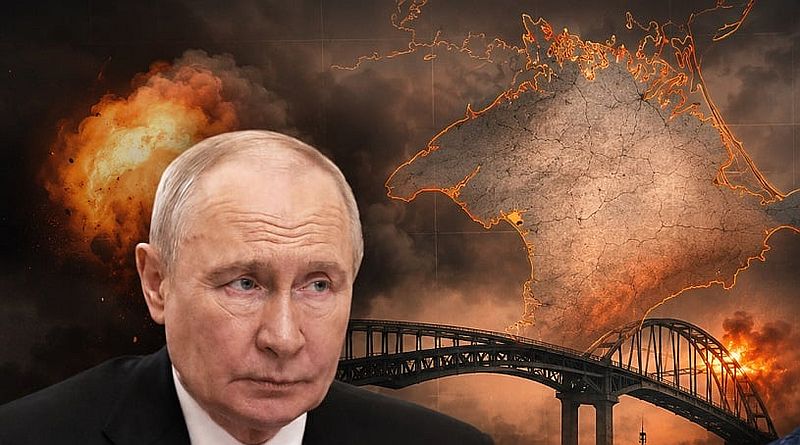
Newsweek outlined five scenarios of how Ukrainian strikes on occupied Crimea could change not only the situation on the peninsula but also impact the positions of Russian President Vladimir Putin.
According to the publication, Crimea, which the Kremlin has long called one of its main geopolitical achievements, is increasingly becoming one of Russia’s most vulnerable points.
The Atlantic and Independent also reached similar conclusions, writing about increasing pressure not only on the Russian economy but also on the political stability of the Kremlin.
1. Putin will turn Crimea into a fortress – but this will be costly for Russia
The most likely scenario, according to Newsweek, is further strengthening of the peninsula’s defense.
Following Ukrainian strikes, the Russian occupation authorities introduced a state of emergency, limited fuel sales to the civilian population, and the Kremlin-appointed head of occupied Crimea, Sergey Aksyonov, stated that gasoline would be supplied only to government services.
Meanwhile, in Sevastopol, restrictions were introduced on the operation of public transport, stores, and cafes, as well as a reduction in street lighting.
Putin himself was forced to publicly acknowledge the fuel shortage. He promised to increase supplies, accelerate the restoration of damaged infrastructure, and strengthen air defense.
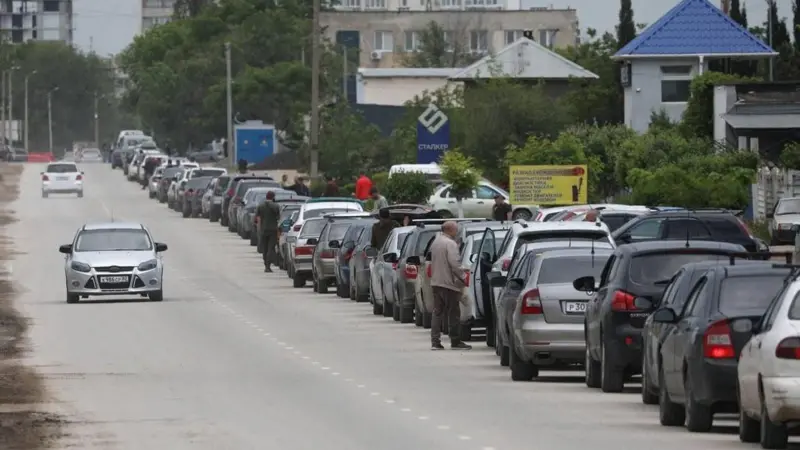
However, Newsweek notes that even such measures may only strengthen the peninsula’s defense but will not restore its usual way of life.
Restrictions for transport, business, and local residents, according to the publication, indicate that Crimea is gradually turning from a symbol of Russian “success” into a constant expense item for the Russian budget.
2. Ukraine may isolate Crimea without liberating it
The second scenario does not foresee an offensive by Ukrainian troops on the peninsula.
According to Newsweek, Kyiv only needs to continue striking Russian logistics.
The publication recalls that in early June, the Ukrainian Ministry of Defense reported that the R-280 highway, connecting Rostov-on-Don with occupied Crimea, is under Ukrainian fire control. It is via this road that Russia delivers fuel, ammunition, and military equipment to the peninsula.
If such strikes continue, Crimea may remain under Russian occupation but cease to be a full-fledged logistical center for the Russian army.
In other words, Moscow will formally control the peninsula but will increasingly lose the ability to effectively use it to support its troops.
A similar opinion is held by The Atlantic. The publication believes that strikes on oil depots, transport infrastructure, and communication facilities are part of a unified strategy. Its goal is not so much to reclaim territories but to weaken the Russian military machine.
3. The Kremlin may respond with a new escalation
The third scenario is described by Newsweek as one of the most dangerous.
The authors believe that increased pressure on Crimea will not necessarily make Moscow concede. On the contrary, the Kremlin might try to compensate for its problems with new massive strikes on Ukrainian cities.
The publication reminds that Putin has already stated on Russian television that Ukrainian attacks are allegedly aimed at dividing Russian society. He also rejected Kyiv’s proposal to limit mutual long-range strikes.
At the same time, Newsweek emphasizes that such escalation does not solve the problem of fuel shortages or the challenges of supplying Crimea. It only allows the Kremlin to demonstrate the toughness of its position to its audience.
4. Crimea will become the main obstacle to future negotiations
According to Newsweek, the status of Crimea might become the most challenging issue in any future negotiations.
Russia cannot relinquish the peninsula without serious political losses for Putin. At the same time, Moscow has still not achieved international recognition of the annexation.
The publication recalls that the UN General Assembly reaffirmed Ukraine’s territorial integrity back in 2014, and NATO still considers the annexation illegal.
Kyiv’s position remains unchanged.
“I am confident that our people in the temporarily occupied territories understand everything perfectly—in Crimea, Donetsk, and Luhansk regions. We do not allow Russia to use our land as a tool to prolong the war,” said Volodymyr Zelensky.
As Newsweek notes, it is possible that hostilities will cease at some point, but the issue of Crimea will remain unresolved.
5. Even without losing Crimea, Putin may lose trust
The last scenario concerns the internal situation in Russia.
The authors do not believe that problems in Crimea will automatically lead to Putin’s downfall. However, constant fuel shortages, queues at gas stations, and the need for emergency measures gradually undermine the Kremlin’s main political resource—the image of complete control over the situation.
According to the publication, the fact that Putin publicly acknowledged the fuel shortage for the first time is particularly significant. Typically, the Russian authorities try not to speak openly about the consequences of the war for their own economy.
Therefore, Newsweek believes that Putin does not necessarily have to lose Crimea for the peninsula to start working against him. It is enough for Ukraine to regularly demonstrate that maintaining Crimea is becoming more costly, challenging, and less reliable for Russia.
The war comes to Moscow
The conclusions of Newsweek are supplemented by The Atlantic, which considers Ukrainian strikes not only through the prism of Crimea but as part of a broader strategy of pressure on Russia.
According to the publication, drone attacks on Moscow and the Moscow region, the Space Communication Center in Dubna, and the Moscow Oil Refinery have several goals: to complicate the supply of the Russian army, reduce the Kremlin’s oil revenues, and show Russians that even the most protected areas of the country are no longer inviolable.
“The recent attacks on the Space Communication Center in Dubna and the large Moscow refinery are typical examples of Ukraine’s strategy to create unbearable conditions for the Russian leader,” writes The Atlantic.
The authors believe that the Kremlin faces a difficult choice: either maintain the export of petroleum products and face a fuel shortage within the country, or reduce exports and lose the revenues necessary to continue the war.
At the same time, the publication notes that these strikes are unlikely to quickly force Moscow to change course. But they have already undermined the perception that Putin is capable of fully protecting the capital, the economy, and Russia’s critical infrastructure.
The West is advised not to miss the moment
The Independent goes even further, stating that Putin is in one of the most vulnerable positions since the full-scale war against Ukraine began.
The publication highlights several signs: the fuel shortage acknowledged by the Kremlin, disruptions in airport operations, problems with military logistics, and signs of weakening public support for the war. The authors also consider Putin’s own statement about readiness for peace negotiations as indicative.
“Russia, as has been repeatedly stated, is ready for peace talks with Ukraine,” said the Russian president.
In the opinion of the Independent, such rhetoric indicates increased pressure on the Kremlin rather than its strength. Moreover, Russian officials Yuri Ushakov, Sergey Lavrov, and Sergey Ryabkov are increasingly expressing dissatisfaction with Washington’s change in position and the fact that the Trump administration no longer shows the previous level of support for Moscow.
In this context, the authors believe that Western allies should not return to negotiations on Russia’s terms. On the contrary – now, when strikes on Russian logistics and oil infrastructure are increasingly affecting the economy and political stability of the Kremlin, support for Ukraine should be strengthened.
The Independent also reminds that Russia is already conducting a hybrid war against European countries, using sabotage, information campaigns, and misinformation. Therefore, strengthening Ukraine, analysts believe, means not only supporting Kyiv but also reducing long-term risks for the entire West.
Overall, the publication concludes that the current situation could be a moment when Ukraine’s military successes are capable of influencing not only the course of the war but also changing the strategic balance around Russia.
Image on the cover: Glavred
