
Anastasiia Zanuda, BBC News Ukraine
According to the Ukrainian General Staff, on the night of July 5, units of the Ukrainian Defense Forces struck the “Hvardiiske” airfield in Crimea.
The “Hvardiiske” airfield is used for the basing of operational-tactical and naval aviation aircraft, ensuring combat flights, logistics, and maintenance of aviation equipment, the General Staff explained.
“The extent of the damage is being clarified,” the report states.
The automobile bridge over the Hruzkyi Yalanchyk River in the Huselnykove area and the bridge over the Kalmius River in the Staromariivka area of the Donetsk region were also struck.
“The enemy uses these facilities to transfer personnel, weapons, ammunition, and logistical resources,” the report states.
Geography Cannot Be Changed
With the increase in Ukrainian strikes on Russian-occupied Crimea, Western publications attempt to explain the significance of the peninsula personally to Putin, to the course of the war in Ukraine, and how it might end.
Strike after strike, the Ukrainian armed forces bring the war to Crimea, writes the New York Times.
Celebrating the capture of Crimea in 2014, President Vladimir Putin later called the peninsula an “unsinkable aircraft carrier.” Now, Ukrainian forces are conducting massive strikes with swarms of drones, seeking to turn it from a Russian-occupied fortress into a true nightmare for the Kremlin.
“The geography of Crimea makes it an invaluable military trophy but also a vulnerable target,” writes the NYT, and explains: the Kerch Bridge is its only direct connection to Russia, and Ukraine has attacked it before.
Ukraine has intensified attacks in recent weeks, trying to interrupt vital supply lines. The attacks began by targeting air defense systems and radar systems throughout the peninsula.
Ukrainian forces also damaged the power grid and fuel reserves, causing power outages and depriving Russian troops of resources.
All this has led to significant changes in life in Crimea—the strongest since Russia illegally annexed the peninsula in 2014.
Moscow has been fortifying Crimea’s defense for years: tripling the number of troops, deploying advanced air defense systems and coastal batteries, and packing the territory with missile launchers. Airfields have been filled with fighter jets and bombers, new ships have joined the Black Sea Fleet, and the $3.7 billion Kerch Strait Bridge provides Russia with a direct connection to Crimea.
However, none of this could change the geography.
Playing Cat and Mouse
“There’s nowhere to hide in Crimea,” the NYT quotes retired Lieutenant General Ben Hodges, former commander of the US Army in Europe. “Ukrainians have the ability to reach any place where air defense assets, logistical hubs, airfields, or command posts are located.”
Ukrainian attacks have revealed significant vulnerabilities in the Russian defense, which was designed to counter traditional missiles and aircraft, not a fleet of drones.
With the weakening of air defenses, Ukraine shifted its focus to supply lines.
Following strikes on ships and the halting of ferry services, Russia now relies solely on narrow land and bridge corridors. Ukrainian forces are working to cut them off.
Attacks on bridges have created a cat-and-mouse dynamic, with Russia rushing to repair damage and Ukraine striking again.
Alongside targeting bridges and railways, Ukrainian drones have been attacking trucks, fuel tankers, and trains over the month.
Strikes on fuel facilities and the power grid have caused massive blackouts in Crimea, prompting local authorities to declare a state of emergency. Fuel ran out at gas stations, and thousands of people have left the peninsula since the latest Ukrainian strikes began.
However, as noted by the NYT, although these attacks have forced some Russian troops to transition to defense, it may take weeks or even months to weaken Russia’s combat potential enough to force a retreat from positions in southern Ukraine.
Striking at Putin’s Myth
The deteriorating situation in Crimea creates serious practical problems for Russia’s military efforts in Ukraine. Equally importantly, it poses a direct threat to the carefully constructed Kremlin myth portraying Vladimir Putin as the great reviver of the Russian empire, writes Peter Dickinson, editor of UkraineAlert, in an article for the Atlantic Council.
Ukraine’s campaign of strategic strikes on Crimea and surrounding areas has been ongoing since early 2026, largely relying on a new generation of strike drones capable of operating deep in enemy territory. These medium-range drones have enabled strikes on both the routes connecting to the peninsula and on important targets within Crimea itself, as explained in the Atlantic Council article. Particular attention is given to the so-called “land corridor” through the occupied southern regions of Ukraine, serving as a vital artery connecting Crimea with the Russian Federation.
“This unprecedented drone blockade has proved to be very effective,” the article states.
The Crimean occupation authorities were forced to impose restrictions on public transport, street lighting, and power supply, while gasoline sales to civilians are now tightly controlled and were completely halted for a time at the end of June.
Military and Psychological Significance of Crimea
The blockade of Crimea has serious military implications for Russia. Since 2022, the peninsula has served as a key foothold and supply route for hundreds of thousands of Russian troops stationed in southern Ukraine, explains the Atlantic Council.
Although Kyiv is unlikely to have enough forces at present to launch a ground offensive capable of liberating Crimea, the innovative use of drones could make holding the peninsula as a major base for military operations untenable. This would undermine the Russian occupation of southern Ukraine and limit Moscow’s ability to strike Ukrainian cities.

The psychological significance of Ukraine’s blockade of Crimea is perhaps even greater, and it is hard to overestimate.
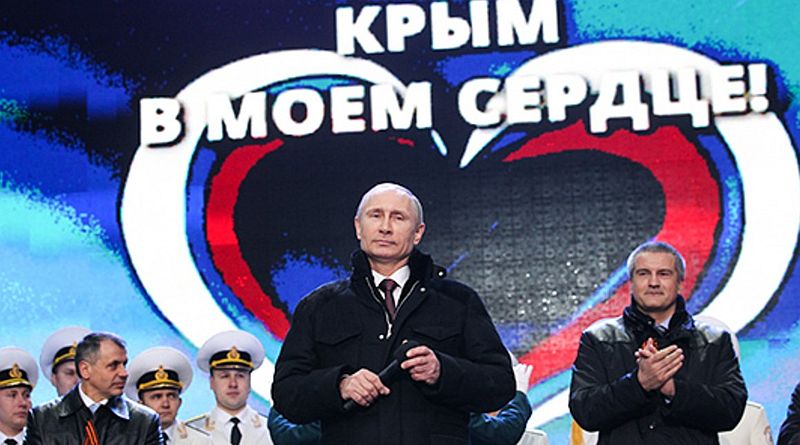
When Russia seized Crimea in the spring of 2014, it triggered a wave of triumph among the Russian public, leading to a rapid rise in national pride and boosting Putin’s approval rating to record levels.
This euphoria reflected the romanticized image of Crimea in the minds of Russians as a symbol of the empire, a place of Russian historical glory and a beloved resort for many generations. After the collapse of the Soviet Union, many people could not come to terms with the fact that the peninsula had become part of independent Ukraine.
Putin understood this emotional attachment and took full advantage of it. When the military seizure of Crimea unfolded in 2014, he initially denied all knowledge and insisted on Russia’s non-involvement in the actions of the “green men” in Crimea. However, once it became absolutely clear that the international community had no intention of intervening or imposing significant sanctions, he soon took full responsibility for the invasion and provided embellished accounts of how he personally coordinated the entire campaign.
“The stunning success of the Crimean operation clearly encouraged Putin and convinced him of the fundamental weakness of the West. This set the stage for everything that happened next,” writes Atlantic Council.
As the invasion of Ukraine expanded over the past twelve years, Crimea has become a central element of the imperial propaganda of Putin’s regime and a symbol of Russia’s return to great power status. At the end of 2014, Putin himself stated that this peninsula was “Temple Mount” for Russia.
The anniversaries of the occupation were celebrated with great pomp each year, and the construction of the bridge connecting Crimea with mainland Russia became a key infrastructure project for the Kremlin. When the bridge opened in 2018, Putin personally drove over the new structure at the wheel of a truck.
All this turns the current emergency in Crimea into a huge personal disgrace for Putin. Having formed the image of a heroic leader who returned the peninsula to its “native harbor,” he is now unable to prevent Ukrainian air strikes or ensure the provision of basic utilities. This already delivers a significant blow to his prestige. If conditions continue to deteriorate and the current isolated instances of evacuation turn into a mass exodus, the crisis will gain much larger proportions and may destabilize the situation within Russia itself.
Will there be retribution for Crimea?

Some suggest that in response to the unfolding disaster in Crimea, Putin will intensify attacks on Ukraine’s civilian population or start threatening Europe. Such a scenario, of course, cannot be ruled out, writes Atlantic Council.
However, the experience of the past four years suggests that when faced with humiliating failures, Putin is much more inclined to retreat quietly. In September 2022, he declared his readiness to use nuclear weapons to defend Russian-occupied Ukrainian territories and warned that he was “not bluffing.” However, when Ukraine exposed this bluff and liberated the Russian-occupied Kherson weeks later, no nuclear response followed.
Similarly, Putin often warned of terrible revenge if Ukraine dared to attack naval bases in Crimea, but when Ukrainian drones ignored him and sank or damaged dozens of Russian warships, Putin quietly withdrew the rest of his fleet from occupied Crimea to the relative safety of the Russian Black Sea coast.
The retreat of Russia’s Black Sea Fleet from Crimea was a stunning victory for Ukraine, which would have been unthinkable on the eve of a full-scale invasion. Yet, this landmark event was almost completely ignored by Kremlin-controlled Russian media.
This Kremlin censorship of Russia’s defeat in the Battle for the Black Sea is perhaps the best indicator of how Putin will respond if his influence over Crimea continues to weaken.
Instead of turning to nuclear weapons, he may instruct his propaganda machine to downplay the peninsula’s significance, seeking to completely change the subject.
“Crimea has long been considered Putin’s greatest victory, but now it risks becoming a symbol of his catastrophic imperial overstretch,” writes Peter Dickinson in the Atlantic Council.
In the image: Russian President Vladimir Putin and Crimea’s “prime minister” Sergey Aksyonov (right) at a rally on Red Square in Moscow on March 18, 2014, celebrating the “return” of Crimea. Photo: Occupier media
