
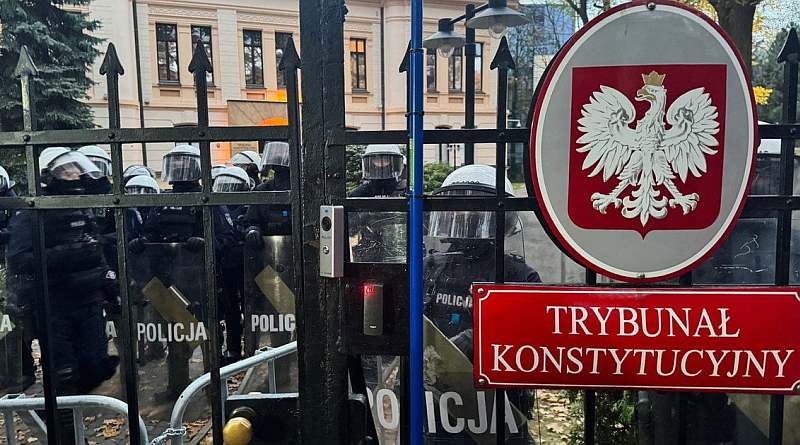

The political crisis surrounding the Constitutional Tribunal of Poland, which reached its critical point in the last days of October 2026, represents a complex intertwining of legal collisions, ideological contradictions, and long-term institutional problems.
On October 30, the longest-serving judge Anna Korwin-Piotrowska announced the temporary suspension of the head of the Constitutional Tribunal, Bogdan Swenczkowski, and his deputy from their duties for one month. The reasons cited were the blocking of work by new judges whose election is considered legal by the Sejm, and the inability to adopt the body’s budget. Since the end of 2024, he held the position of chairman, although the legitimacy of his appointment was contested by the new pro-European coalition led by Donald Tusk.
Swenczkowski categorically refused to recognize the decision of his suspension. While at the tribunal building, he publicly called the events a “coup attempt” and a takeover of the judicial body.
Representatives of the current government coalition, led by Prime Minister Tusk, stated the necessity of urgently restoring the rule of law and cleansing the judicial system of political influence, relying on the support of European institutions which for years criticized Warsaw for violations of democratic standards during the rule of the Law and Justice Party.
Prime Minister Donald Tusk repeatedly emphasized in his speeches that the state does not have the right to retreat from the principles of justice, literally stating: “We must return an independent judiciary to the citizens because, without respect for fundamental laws, it is impossible to build a strong and prosperous European republic.”
The right-wing opposition camp, led by President Karol Nawrocki, who on October 30 urgently interrupted his foreign visit to Senegal due to the crisis, insists that any attempts to remove current judges of the Constitutional Tribunal or reconsider their status bypassing established procedures undermine the very foundation of the constitutional order and create a dangerous precedent of legal nihilism.
The head of the Polish state harshly criticizes the actions of the ruling majority: “Any steps by the executive power aimed at exerting forceful pressure on constitutional bodies and the president destroy state stability and lead to the destruction of law and order.”
Mutual distrust between the government and the presidential apparatus has led to the blockage of crucial state decisions at the stage of practical implementation.
Supporters of radical reforms argue that compromise with individuals appointed with gross violations of the law in previous years is impossible because it would mean legitimizing past abuses.
Opposition politicians counter that the current cabinet of ministers exceeds its powers by adopting controversial decrees that ignore the existing provisions of the basic law. Such confrontation creates an atmosphere of deep legal uncertainty, which negatively impacts the stability of the state apparatus and reduces citizens’ trust in democratic institutions.
Meanwhile, independent lawyers note that exiting the current impasse requires exclusively seeking compromise solutions based on existing legislation, rather than revolutionary methods.
Since both opposing sides use the judicial system as a tool of political struggle, it is primarily the authority of the tribunal itself that suffers, which should serve as an impartial arbitrator in disputes over the interpretation of legal norms.
While politicians exchange mutual accusations of usurping power and violating the constitution, Polish society faces a long journey of restoring public consensus, without which the effective functioning of a democratic state remains impossible.
