
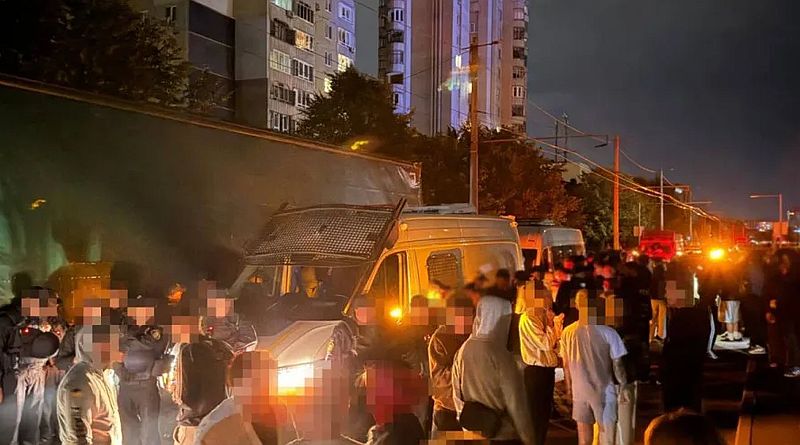

Almost everyone has already written about Lviv, and almost everyone in the genre of a verdict. Some judge the crowd, others the state, still others both at once. To burn off some negative emotions, this might help someone.
I will try a different genre, not quite traditional for Facebook. I will try to analyze it as a system. Because what happened in Sykhiv did not start in Sykhiv and, unfortunately for us, will not end there.
We know perfectly well that this problem is not new. In the fifteenth year, during the fourth, fifth, sixth waves of mobilization, people did not show up in large numbers, some villages met military recruiters at the entrance, and the then General Staff spoke openly about it. But back then, the system had a damper (something that dampens peaks/fluctuations in the system): the war was positional, the need for people limited, evasion didn’t threaten the front. The disease was already there, but the body could afford not to treat it, and since it was allowed, why bother? And it didn’t. The full-scale invasion removed this damper but did not create this problem.
Mobilization is a very special type of relationship between a person and the state.
This is nothing like a tax, because a tax is paid with money, and it’s much easier to part with money. Although, as we know from hundreds of cases, it’s still hard. But here the state asks for the body, time, and possibly life. Political science has long described what such an agreement rests on, and rightly so it’s called conditional: a person agrees to serve as long as two conditions are met.
FIRST: The burden is distributed fairly — people similar to me serve, not just those who couldn’t buy out.
SECOND: The state keeps its word — terms, rotations, returns.
It seems to me that no one doubts that both conditions in Ukraine have been destroyed. Destroyed long before the overturned car.
The list of destructive blows to this conditional agreement is truly impressive:
– Reservations that have become a market.
– Demobilization and related legislative packages that have been stuck in Parliament for years.
– Appointments for which there are no answers.
– Episodes of violence from both sides, for which no one has been held accountable — and which have taught each subsequent crowd that it’s possible, and each subsequent notification group that there’s no other way.
– Corrupt CCC leaders with property abroad.
– Volunteers from 2014 who have become hostages of their virtues and turned into “doomed to fight” all their lives.
When conditional agreement breaks down, nothing replaces it, but coercion remains in its place. And coercion has a simple arithmetic limit: those who enforce it are always fewer than those who are coerced. Further on is what is visible from reactions to the event, and this, honestly, worries me more than the event itself.
Within a day, a full spectrum of responses unfolded around Sykhiv: official statements, detentions, parallel “investigations” by public circles with their own identified culprits and executed verdicts, public threats from political organizations, bitter fatalism from people in uniform who write to comrades that there will be no loud trials and everything will be brushed under the carpet. Look closely at this spectrum. There isn’t a single actor — not one — who believes that justice will be served by the state. Neither those who are mobilized nor those who mobilize. Neither those who fight.
The position of arbiter in the country is effectively vacant, and a queue of private claimants has already formed for it — each with their own investigation, tribunal, and executive power. History has a name for this kind of order: rival rule. It can be networked, resilient, even heroic. It is never lawful. And every lynching — regardless of whose hands it is carried out by or in the name of what — is not a deviation from this order; it is its building block.
There is a deeper layer, explaining why a discussion on this is impossible. Let’s look at the language of these statements on social media and official platforms. On one side, vocabulary is used that turns people into animals and livestock. On the other, standardized narratives about hunters of men. The function of both lexicons is the same: to remove the opponent from the human species, to lift the internal prohibition on violence against them. This grammar never stops at words, and we know this not from textbooks.
Beneath it lies a conflict that is not legal at all. For one part of society, the military uniform is a relic: brothers were buried in it, mothers and wives washed it, its scent is remembered by families, and the hand of a civilian reaching to tear it off is blasphemy without any mitigation. For another part, the same uniform is the garb of an institution that people cross the road to avoid, and the claim for its untouchability sounds like a demand for the untouchability of the practices behind it. This is a clash of two symbolic orders around one object. The sides are not arguing about facts — they are arguing about what is sacred. Therefore, each new event, however it unfolds for one side, does not bring understanding closer but only provides both orders with fresh evidence of their own righteousness.
And so, it is time to name the problem. The name is not “evaders” and not “arbitrariness of the CCC” — both of these words merely indicate which side of the divide the speaker is on.
The name is breach of contract.
An unwritten but basic contract between a person and the state, which these years holds the front more reliably than any coercion. It has been broken over time, from both sides, and each participant has their own account of grievances, mostly justified. But it will also have to be sewn from both sides — and here there is no symmetry: the state in this pair is stronger, so the first stitch is on it. The responsibility on those who are part of the state apparatus in their positions is colossal, as the crowd has no tools for stitching. The state does.
These instruments are known, and none of them works alone:
1. Justice that judges symmetrically — both those who overturned the car and those who for years created people capable of overturning it: an asymmetrical court is worse than none, as it ultimately establishes the rule “law for the weak”.
2. Obligations instead of promises — service terms, rotations, reservations with dates and responsible persons: trust is restored not by a communication campaign but by the first fulfilled word.
3. Separation of functions — the army fights the enemy, the police handle internal order, and no soldier ever uses force against their own citizen, because the day this becomes the norm, no one can reverse it.
4. Working with the meaning of service: a society in which service is perceived as a punishment for those who couldn’t find a way out will not fill the army with any salary or contract, because the problem lies below money — in the layer where a person is either a subject of a common cause or a resource for extraction.
People who overturned the car will not be convinced by either a high payment or the right to choose a position. This is the most precise measure of the depth of the pit.
The car has already been set upright and towed to a lot, and volunteers will collect money from the concerned for a new one. With cars, it’s quick. With agreements, it takes longer, but it starts the same way — with a goal and gathering the concerned.
