
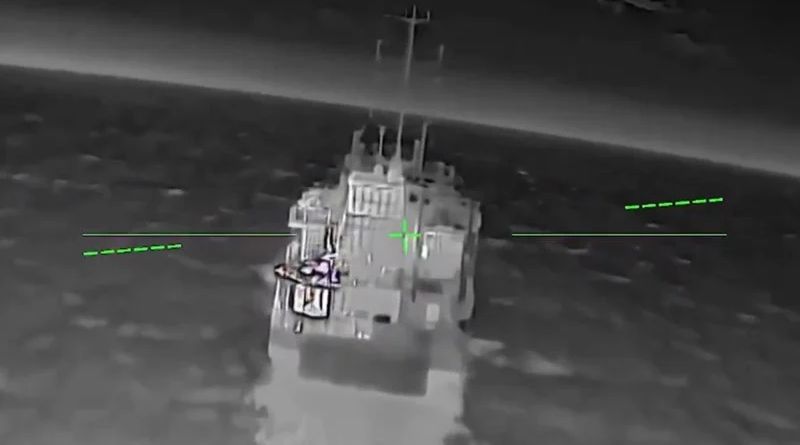
An average of 100–130 ships drift daily in the Sea of Azov. A significant portion are cargo ships, fishing vessels, tugs, and FSB patrols. A small portion are tankers. River-sea class ships are loaded in the Taganrog raid and then move to Crimea or transfer raw materials to large Panamaxes. It’s clear why they transport crude oil: a significant part of refineries in the European part of the Russian Federation are idle, and they don’t want to shut down production in Siberia.
The Sea of Azov currently acts as a transit route with two key flows starting from the north (from the mouth of the Don and Taganrog) heading south but with radically different goals. The first flow is military logistics. Tankers head southwest to the ports of the occupied peninsula. They carry light oil products (gasoline, kerosene, diesel) from Russian refineries to supply the occupation forces, fleet, and civilian sector.
The second flow is export currency. Other tankers follow the same route south, but their target lies further in the Black Sea. They carry crude oil and heavy oil products (fuel oil). Crimea is unnecessary for them because there are no processing facilities there; their goal is to pass under the Kerch Bridge.
The Bee and Queen Scheme
Where do these “Volgonefti” deliver crude oil? Not to India or China: river-sea class vessels are not designed for ocean storms; they would break in half.

Their route ends immediately beyond the Kerch Strait. In the area of the port of Kavkaz, in Taman or slightly further in the neutral waters of the Black Sea, so-called raid stations are organized for ship-to-ship transfers (STS). Huge ocean tankers (“Aframaxes” or “Suezmaxes” with a capacity of 100–150 thousand tons) from the same shadow fleet with gray insurance and turned-off transponders are anchored there. I believe there is helicopter and boat coverage to prevent attacks from “Magurs” and “Maluks”.
Small tankers (those same 7,000-ton project 15781 vessels), passing by the Kerch Bridge, approach these giants, moor side by side, and transfer crude oil into them. It takes 15–20 trips by the “babies” from Azov to fill one ocean tanker. After loading, the giant heads through the Bosphorus to Asia, bringing oil dollars to Putin. This is a bee and queen scheme. Presumably, it’s an attempt to bypass the battered terminals in the Black Sea region and export crude oil since storing in Tuapse is somehow not working, and the village of Volna has received it a dozen times already.
Turkey Hunt: Minus 40% of the Fleet in the Region
But under the Kerch Bridge, there are now queues even for the budget’s cash cows — the Russian Railways ensure the invasion army, and shipments are taking 25% longer to arrive due to the fuel crisis. That’s why the turkey hunt began — the destruction of tankers waiting in line to cross and trying to break through to Crimea.
In the Black Sea region and the Azov, approximately 35 “Volgoneft” tankers and 50 new RST/15781 tankers are in operation. It’s not precise to a comma, but the order of numbers is clear. It turns out that the entire active river-sea class liquid cargo fleet in southern Russia consists of 80–85 vessels.

If we consider only the liquid cargo fleet (tankers), in 96 hours we knocked out almost 40% of the small tankers and oil tankers in southern Russia. Both old vessels and new sides were hit: “Sanar-17” sank, and burnt-out wheelhouses and hull breaches were received by “Chelsea-6”, “Aura”, “Sonar-1”, “Ilya Repin”, “Venus-3”, “Penelope”, and the sanctioned Panamanian “Galiascar Kamal.”
Losing 40% of the specialized fleet in a few days is not just a problem, nor a crisis. It looks like this: they physically have nothing to transport fuel to Crimea right now, because the captains of the remaining 60% are simply afraid to take the ships out of Rostov ports due to the threat of being burned, and not all ships are guaranteed to be operational now.
This also affects export and the speed of processing “Panamax” vessels. Regardless of the extent of damage, even if a ship hasn’t burned out or sunk, this season, before storms and sea freezing, it won’t carry anything. Partially because RST/15781 repair facilities are overwhelmed with a series under construction. Ordering radar, radio, navigation systems, steering machine connections, a gyro compass, kilometers of cables burnt in the wheelhouse — that’s one thing. But repairing a ship and finding a crew willing to go to this region without combat and injury compensation is quite another.

Black Sea Fleet — Operation ‘Sink the Tankers’
And as usual, the Black Sea flotilla brings delight. In numerous videos, not a single escort ship in the convoy, not a single attempt to cover the old “Volgonefts” even with the fire of “Raptors” and interceptor drone crews from “Rubicon”. While the Black Sea Fleet saves its pennants, Russian business pays for the war with its burned vessels. The military simply abandoned the commercial fleet to fend for itself.
Billions of dollars, dissertations, threats of landing near Odesa and a full blockade, parades, and in the end — hiding behind mines and booms in Novorossiysk. For Ukraine, a better investment of Russian Federation money could not be imagined. And do you remember how they said in the RF that we would ask Moscow for permission to pass the grain corridor, otherwise we would be strangled by the blockade? In my opinion, God has a sense of humor.
Commercial Wrecks
To date, RF losses due to repairs, lost vessels and cargoes, and upcoming downtime amount to about 200 million dollars, and this is a conservative estimate. This includes lost budget revenues, bankruptcy of transportation companies or their dependence on the state budget, increased insurance costs, the need to transfer new vessels to the region.
Behind each burning tanker are very specific beneficiaries: companies like “Volgotrans” (owners of the destroyed and damaged “Sanari”), structures of the oligarch Lisin, or intermediary firms of the shadow fleet. For them, these 200 million dollars of direct damage are just the beginning of a domino effect that tightens a financial noose around their necks.
First, there’s an insurance collapse. No oil tanker operates without a policy. After 35 hit vessels, the Azov has de facto become a combat zone. Insurers either simply withdraw coverage or increase premiums for war risk dozens of times for each voyage, sharply changing the entire business margin.
Second, staffing issues and credit problems begin. Civilian Russian sailors are not kamikazes. To force a crew to leave Rostov in this “shooting range,” shipowners are forced to triple the tariffs. Simultaneously, banks are knocking on the door: part of the fleet is under lease, and when collateral is lying at the bottom or with a burnt-out bridge waiting for a half-year repair, a cash gap is guaranteed to drag the company down.
All these tankers on fire, queues stretching four kilometers under the bridge, fights over gasoline in Crimea, Belgorod without electricity and water, and another burning plant in Kapotnya are links in a single logistical collapse. The war is becoming an unbearable burden for Russia itself. The economy and fleet are being consumed just so a handful of aging bureaucrats can indulge their receptors with burned aquadisco experiences and trillions of rubles. However, resources and the budget are running out faster than their plans for the special military operation.
Cover image: Attack by Ukraine’s SBS on a Russian tanker. Photo: video screenshot
