
Disheartening summary of the week.
The authorities are rapidly dismantling the structures that could have been relied upon to achieve victory, and are instead rebuilding those the country, with the support of partners, has been trying to eliminate for a year—from protecting anti-corruption agencies to developing anti-corruption cases.
Fedorov was dismissed, and in his place, someone was appointed in a manner unknown to the Constitution and the laws—“acting.” Even the Head of the Verkhovna Rada was motivated to schedule a continuation of the session on August 18, undermining the remaining authority of the Rada. All to create conditions for manual control.
Instead of negotiations about a professional government of unity, the new prime minister was given an old set of used personnel, with whom he is supposed to work miracles.
The Pechersk Court prohibits journalists from publishing investigations into the dealings of the family of the director of the SBI; the overhaul of the SBI is being postponed indefinitely.
And before that, the “political” Security Service of Ukraine broke three Supreme Court judges to prevent the annulment of “sanctions” against Petro Poroshenko.
Veterans and military personnel on leave report pressure from law enforcement and security agencies.
Fire Point spotted around a hundred “flamingos” somewhere (where?) and talks about Mindich’s usefulness.
The American direction, amid Trump’s hesitations and ahead of important elections, might be entrusted to… Umerov.
Even in the foreign policy department—scandals surrounding corruption and petty schemes.
Also, Yermak was seen loitering around Syrskyi, who was “rescued” from Fedorov’s reformist attempts.
The circle seems to have closed. All the figures of the “Dynasty” are gathered and in charge. Dynasty strikes back.
Something’s darkening too quickly. We need to bring the dawn closer.
Still in maximum shock.
The question isn’t even whether this government achieved anything or not. Six months is no time at all for reforms. Finish at least one thing, and then evaluate.
But what a game, huh.
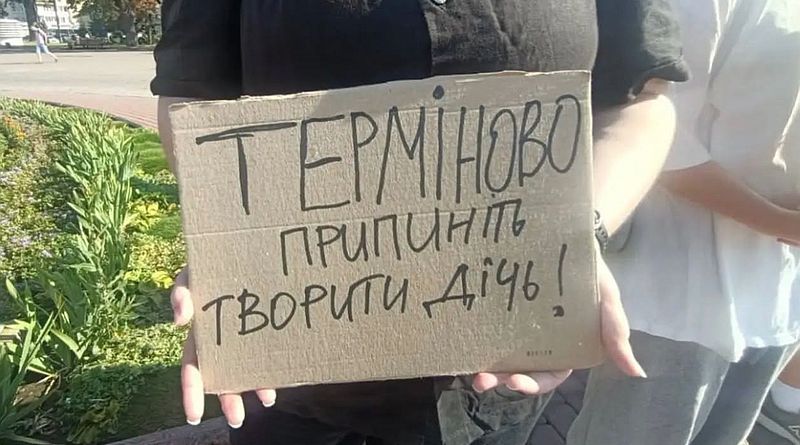
Dismiss the entire government because of the Ministry of Defense and instantly face protests and reports.
Svyrydenko “frankly failed in preparing for winter,” yet she gets an order.
So, Fedorov didn’t handle the TCC, huh? But the previous transfers of military commissars to the troops and the tales that “only veterans are in the TCC now” really helped us, right?
What didn’t Fedorov resolve with the TCC? Did the leadership demand the removal of special registration from the Ministry of Internal Affairs and force the police to look for those who haven’t been to the military commissar’s office for 12 years? To sort through everyone who suddenly wanted a second education and cancel the exemption for “strategic” circuses? Did he not want to or couldn’t? Oh, no, they say he simply has a conflict with Syrsky. Right, very logical. Because of the TCC, then.
“Act according to your conscience,” says Fedorov. Deputies are going to the Maldives.
“He remains in my team,” sounds from the podium. But you wouldn’t say that from the strict briefing.
War is the second or third matter; the main thing is that the right people sit where they need to. That’s what’s most frustrating.
But what a beautiful game. Communication with society, the thoughtfulness of decisions, like “he remains in my team.” Just taking off my hat.

The resignation of the short-lived defense minister seems like a result of a systemic failure. Volodymyr Zelensky himself explains what’s happening as a lack of unity: the conflict between Fedorov and the commander-in-chief of the Armed Forces, Oleksandr Syrsky, is no secret — both parties essentially speak about it openly.
However, the art of political management lies in the ability to reconcile the interests of necessary but incapable of independent agreement individuals, and not in the decision to dismiss one or even both of them.
Although for Zelensky, who is used to governing the country manually since 2019, using both a parliament devoid of subjectivity and a government that has become a department of his office, as tools of such governance, this is not so much a complicated but an unacceptable approach. And this is a consequence not of Zelensky’s will, but of the will of the Ukrainian voter who elected the president and his monomajority.

Among the military I have to communicate with, the attitude towards Syrsky ranges from extremely negative to, let’s say, forcedly neutral. Forcedly, because he is the Commander-in-Chief, and they are military personnel. I haven’t heard any positive feedback.
* * *
The attitude towards Fedorov is moderately positive to background positive. Some things have shifted for the better, some things haven’t gotten worse, as often happened before. So, in the end, there’s a small plus that just hasn’t had time to grow.
* * *
And everyone interested knows about the conflict. And everyone sees the old Soviet-style vs. the young digitalizer. And who does the esteemed Mr. President remove?
* * *
So even reputationally, dear Mr. President, this is a powerful “blunder.” Without explanations, without describing reasons, just wanted to – and removed. Military steps need to be explained to everyone because it looks like this: the filtering out of the intelligent and thus dangerous in favor of the dull and aggressive, but politically unambitious. This is, in principle, the aftertaste left: another “version of Zaluzhny” simply not allowed to grow. And when nothing is explained, believe me, someone will explain it without you.

Interesting things are happening.
For Zelensky, Mr. Syrsky is very important. Because he is a loyal soldier without political ambitions, he is not popular, not a competitor, and therefore Zelensky does not see a “new Zaluzhny” in him.
This built Zelensky’s trust in Syrsky, allowed turning a blind eye to the blunders of the General Staff, and giving more for loyalty than the position allowed.
But this created a power bubble, where the understanding of location was lost.
The commander-in-chief can eliminate various Borsuks/Drabats at will, but giving an ultimatum to change the defense minister to the supreme commander-in-chief is too much. Especially when it involves someone who started delivering results.
Moreover, Zelensky does not understand that Syrsky’s unpopularity, which is a safety for him, forms a general toxicity in the perception of the army’s high command, and one day it will explode. It will also affect his rating.
An explosion happened. It didn’t improve, as Fedorov directly stated things that essentially require the creation of a special commission to analyze actions that could negatively impact the country’s defense. The whole country heard this, and it can’t be silenced.
This could have been avoided if no one had set the ultimatum “Either me or him.” They could have simply worked together.
But more than anything, I’m amused by the former prime minister and ministers who were removed by the decision of the government of Svyrydenko to have a reason to remove Fedorov under an ultimatum. They all probably watch this whole mess and ask – what about us? 😆

For the third day, I have been observing the upheaval around the dismissal of Minister Fedorov. Overall, from the very beginning, it seemed that the issue was not about the minister, but about 1. The possible role of General Syrsky in the dismissal (possible, because we are still dealing with separate expert opinions of varying degrees of real expertise and bias, as well as public opinion); 2. The fact that they planned to appoint the Minister of Internal Affairs instead of Fedorov. Here, thank God, it didn’t happen. Simply because “You can shoot either like a policeman or like a soldier” (T. Clancy). More specifically, in the words of Mr. Viktor Pushkar, a military and a policeman are fundamentally different corporate cultures. Which coexist very poorly together.
But the removal of Klymenko from the race directed all the energy specifically against Syrsky. And here the question arises – why against him? Don’t rush with the facts – I’ve read enough of them.
And, in general, what I will write below is not about Syrsky and not even necessarily about the military. For one simple obvious reason – I am not an expert in military affairs and, moreover, I cannot even boast a thousandth of the awareness of the real situation to the extent that the general does. Simply because it is his position.
Therefore, this text is not about Syrsky. It is about his perception by the civilian general public in the context of our historical continuity and historical traumas. I remind you that this aspect does not negate all other factors – it only interacts with them.
1. First of all, Syrsky from the very beginning was “the one who replaced Zaluzhny” and, to complete the picture, he is an ethnic Russian. Already immediately after Zaluzhny’s dismissal, I wrote on Zbruch that both of these factors required great courage from General Syrsky to agree to the position of commander-in-chief in the conditions of an existential war against Russia. Because both can easily explode. And so it has exploded – frankly, I want to be a bad prophet.
The most interesting thing is that General Syrsky had a moment when he could, if not completely negate, at least significantly obscure both issues. This moment was the Kursk operation. In the described context—think about it—a general of Russian origin gave the order for the Ukrainian army under his command to move into Russian territory. And for the first time since, probably, the 17th century, a Ukrainian soldier steps onto Russian soil with all the consequences. But this chance was unfortunately lost. Both by the general himself and by the media. The latter, and almost the entire Ukrainian Facebook, was shaking in a paroxysm of post-genocidal hyper-excitation—”aaaaaa, we stepped onto the land of the almighty genocidal power, now we’re definitely doomed.” This was masked under the theme “why did we go there, it has no military sense.” I won’t discuss the military sense due to a lack of expertise and understanding; I’ll just note that half of the complainants had no better grasp of it than I did. But they should have had enough understanding of symbolism to catch such obvious things. So, this story is about more than just the general.
2. The story with “Skela” and Luchanov. I won’t continue the topic about the “timeliness” or “untimeliness” of this information appearing in the media space. I’ll focus on something else—both plots triggered reactions not only on their own merit—and they were indeed provocative, to put it mildly—but also due to repressive practices in the Red Army, which, despite the presence of many Ukrainians serving in it, was the army of a totalitarian state controlled from Moscow. Now, what the journalists revealed additionally resonated not only with those old times but also with quite current practices of the enemy army. It triggered everyone with latent memories of waves of terror and violence that inundated the lands the Red Army entered. There are plenty of examples, not only in Ukraine. And again, all this negatively correlates with the general’s origins.
3. It is now noticeable that to a large extent, the “against Syrsky” theme is pushed by an interesting group of people—relatively young individuals whose patriotism is unquestionable, known either for voluntary joining the army or active volunteering. But who often lack basic foresight and the ability to slow down at the turns. This already brings to mind the collisions between the hetmans and the Zaporizhian Sich—as well as, for example, the reasons for the problems of Vyhovsky and Mazepa. Remember—the Sich, which before Khmelnytsky was the armed support of contemporary Ukrainianness (with all necessary adjustments for the differences between the modern and early-modern era), after the creation of the Cossack state turned into a center of chronic internal destabilization, associated with a very short planning horizon, political naivety, superficiality, vulnerability to external manipulation, and a tendency to solve everything quickly and radically. The consequences were sad—especially at the moment of the Black Council, when the populist Bryukhovetsky became hetman thanks not only to Moscow’s support but also to the energy of the Cossacks. One can also recall the campaign of the Zaporizhian kosovyi Sirko on Crimea right after the victory over Moscow at Konotop.
Here I see the same scheme, where Fedorov, I fear, acts as a “shadow leader” (his age suits Syrskyi), who is gathering his own Black Council. After all, he has experience since 2019. And Syrskyi reacts as a high-ranking professional military officer should—whether in the guise of a 17th-century hetman or a 21st-century general. That is, strictly. Immediately tightening everything that seems a threat to the commandability of the army, which, I remind you, is at war. Because his professional experience suggests that the strength of the army lies in its structure, commandability, and clear division of duties and powers. Because “Not everyone is given to know everything and manage things.”
By the way, the argument about the non-interference of the military in politics is quite valid—because, on one hand, of course, the state was made by the military. And on the other hand, do you remember what “soldiers’ councils” were in Russia in 1917, and in Germany in 1918? And we do remember that autonomy often began with officers who, to use modern language, went into self-employment? I’m not even mentioning the possibility of a military dictatorship.
And it is worth remembering that planning operations is not for the ministry. It is the domain of the commander-in-chief. And their execution as well. Preparing for operations like “40 Days of Containment” does not take six months. Let me remind you, the famous “Web” was prepared for a year.
At this point, it is necessary to acknowledge the correctness of those who say we are dealing with a generational conflict, as well as a conflict of approaches. To complete the picture, both lines of conflict overlap and mutually reinforce each other simply because, in our conditions, the generational difference also means a difference in the depth of totalitarian trauma. Also, a difference in the power of the pendulum of that very trauma, further strengthened by age-related characteristics. On a concrete level, this means that the fervor of the protestors and the thesis about Syrskyi’s “Sovietness” and “rigidity” are not so much about him himself, regardless of real grounds, but more about our trauma from the constant need over seventy years to continuously control our compliance with formal signs to avoid falling under suspicion, which could lead to repression. The tension between the parties in this case is an effect of the shadow of genocide behind us, embodied in the inertia of fear “what if they return and repeat.”
Thus, Syrskyi found himself under the dual pressure—collisions between the “Black Council” and hetmanship, and generational confrontation, which correlates with the generational determinant of overcoming post-genocide trauma.
4. There is another aspect, which I would like to call existential tension. Its essence is that we talk a lot about rotations, mobilization, service terms, monetary support—and justifiably so. After all, the social status of a military person, and not only, is directly linked to material capability. But with all this, little is said about for what purpose? It would seem the answer is obvious—for the sake of independence and freedom. But even obvious answers need to be repeated regularly. To remember something, a person needs to repeat it seven times. To remember the fallen, we stop daily at 9:00. To remember whose state we are in—the flags and coats of arms in state institutions, and so on.
This is the same with the idea of victory and the meaning of our struggle – we must talk about it constantly. Otherwise, everything else may not help, no matter how much is done together. Because, for example, no financial support can replace lost comrades and relatives. Temporary things cannot heal the wounds from the presence of existential issues.
And here lies the problem, that the general is “not about that.” To be fair, his opponents are also not about that. The difference is that the general seems to belong to a group of people who do what they believe is necessary, expecting that the intelligent will understand, and there’s nothing to explain to fools. This comes with the obvious fact that there is much he is not allowed to reveal, and many things he will never have. Understanding the situation greatly depends on being informed. The problem is that it doesn’t work that way.
An even bigger problem is that not only the general doesn’t understand this, but also many who should by their profession. I’m referring to those journalists, activists, and communicators who write exclusively about problems and miscalculations, arguing either with the theme of “control over power” or with the need for “reason.” Sorry, but killing hope in this way is not about reason. At best, it’s about an unrecognized genocidal trauma. At worst, it’s about a stunning misunderstanding of the human need for hope and meaning, or about the dominance of personal political interests over state ones.
On this note, I’ll leave the discussion of political and military aspects to people who are more qualified and informed and remind everyone – this text is about the perception of the situation in the context of collective historical experience.
