
We live in a remarkable reality. Never before in modern history has the world been so wealthy, well-fed, well-dressed—and at the same time unhappy, lonely, and divided. Where did this collective unhappiness come from with its, without exaggeration, tectonic consequences for the world, and how can it be overcome? Perhaps this is the key question of our time.
“Now We Are All Soviet People”
In 2024, the famous British historian, Stanford and London School of Economics professor Neil Ferguson published an essay “Now We Are All Soviet People,” drawing parallels between modern United States and the late Soviet Union. His main thesis was that the world has entered a new “cold war” between the USA and China, but China in this tandem is the more energetic and consolidated force, while the USA plays the role that the USSR once played—a depressive giant entangled in its own problems and contradictions.
As an illustration, Ferguson used, among other things, the high American statistics of so-called “deaths of despair” (deaths caused by alcohol and drug addiction, chronic depression, and suicides). There are also indicators of Americans’ distrust of their own institutions and the state in general. To be convinced of the latter, in principle, you don’t even need statistics. It’s enough just to skim through social media pages—of both right-wing and left-wing Americans. Or watch their movies and series, where the role of the world’s main evil has long been firmly assigned to their own government.
Obviously, Ferguson somewhat dramatized. On the eve of the 2024 elections, as a conservative and Trump supporter, he needed a picture of American decadence, from which only a strong leader could save the country. And yet, there’s something in these parallels. And this something is not only statistical but also intuitive, on the level of feeling.
Why Do Nations Decline?
An indicator of a nation’s decline is when its own citizens stop believing in its mythology. Older people remember how it was in the late USSR, when the majority of the population developed and solidified a sense of persistent disgust for Soviet reality. Unfortunately, communication with Western societies of the modern era—both high and low, university professors and “blue-collar” workers, politicians and anti-globalists—generates something like déjà vu.
And it’s not only about the USA. The era of economic prosperity, multiplied by the atomization of society and social network algorithms, produced the same result in different countries. The children’s generation cannot find itself in the new world, and the parent’s generation is unhappy because their children are unhappy. But they do not blame themselves; they blame the politicians who built this new world and the political reality.
Western societies possess invaluable things: freedom, democracy, a certain measure of justice. But within just three decades, these things have shifted in public consciousness from the column of “the highest value” to the column of “so what, who cares?”
Resentment has descended like a heavy cloud on the West. People began to live by the principle “me first” and within one generation became unhappy (though not necessarily miserable) and filled with well-fed cynicism, which, unfortunately, is a sign of the times.
Besides “me first”, they readily embraced other postulates long and persistently sold to them by Hollywood, academia, and social networks. For example, that “the world is darkness” (everyone commits evil, just not everyone admits it) and that “there is no truth” (everyone has their own; the so-called “truth” is nothing more than an interpretation of reality). In our language, this worldview is called “Putinism.”
Original Sin
The revulsion of Europeans and Americans towards their political systems is undoubtedly generated by the systems themselves—their hypocrisy, narcissism, and ultimately, lack of self-preservation instinct. Although the main cynicism is displayed today by nationalist and far-right parties, the liberals deserve criticism first, as they created the crisis.
On one hand, the liberal world, in which we still live, modern man owes many positive things: the golden European era after World War II, a united Europe, social protection programs, the protection of minority rights, and more. Moreover, we Ukrainians must understand that if it weren’t for European liberals and centrists, Europe would have long abandoned Ukraine to Putin’s tank. Because European anti-liberal nationalists have largely long been entrenched in the camp of fans of Russia.
On the other hand, the liberal world has also spawned a lot of ballast. Primarily “cancel culture,” “culture wars,” and “identity politics,” whose main mission has been to drive a wedge between the societal majority and minorities. On social networks, it has spawned a whole layer of people, whom American commentator Bill Maher aptly called professionally offended—”professionally offended.”
For decades, like sharks hunting for blood, they circled the ocean of life in search of an unguarded word or an impolitic action, after which they emotionally destroyed people online, shredding their reputations. In short, “canceled” them. As a result, free societies have turned into a dictatorship of political correctness, which turns freedom into its opposite. And this has also become a sign of the era.
The Crisis of Liberalism is a Crisis of Pride
But most importantly, the liberal world, for all its positive traits, has been deaf to the desires of its own societies. And society did not want that much: common sense. Modern diversity, but not the erasure of their countries’ identities. Respect for the rights of sexual minorities, but not 60 “genders” and other madness. Environmental awareness, but not environmental fanaticism and a complete rejection of nuclear energy. Controlled and limited migration, but not Merkel’s “we will accept everyone!”
For example, the 2024 American elections would have been entirely different if the then-administration had done the necessary, obvious, and most importantly—legal thing: closed the border with Mexico to illegals. But they didn’t do it. Because they feared the “professionally offended” more than the law and their own voters.
Fear and arrogance—for this original sin, both Western societies and, unfortunately, Ukraine are paying the price. Because, in fact, the split of the liberal world is the split of our support.
Citizens feel aversion to traditional political parties because they have long lacked respect for the citizens. This, I hope, will change, but before that, we will have to see non-traditional parties, indifferent and disdainful of Europe, striving for power in many European countries, which uphold the “me first” principle and will do everything to destroy what was built after World War II.
Bulldozer in the Swamp
The political crisis in the West is a crisis not only for liberals but also for conservatives and nationalists. With the latter, it’s quite simple. They are opportunists, much like most politicians. Taking advantage of public resentment, they agreed and even eagerly volunteered to play the role of a bulldozer, which would destroy the tiresome political reality.
The problem is that neither the citizens nor the “bulldozers” themselves know what and how to build instead of what’s there. Moreover, at this stage in history, the interests of the “bulldozers,” who think they’re doing good for their countries, coincide with the interests of those who fiercely hate these countries.
Both the Western far-right and Putin’s Russia share a common goal: to break the existing political system in the West. Hence the mutual attraction, common priorities and rhetoric, and shared hatred towards Ukraine. Both they and the Kremlin aim to “drain the swamp.” The only difference is that for the far-right, the swamp is the current political class, while for Russia, it’s the West as a whole. But the “bulldozers” don’t dwell on this much. At this stage, they are allies and fellow travelers with Moscow.
Alternative of Decency
The far-right instinctively want to “clear the field” and return to the past. Where the word of a white person was law. Where each successive generation was wealthier and more successful than the previous one. Where everything was simpler. Internally, they probably suspect that things won’t be as they were, but again, to suspect doesn’t always mean to think and possess intellectual honesty.
Notably, in Germany, the role of the bulldozer has been taken up by a political force called “Alternative for Germany.” The symbolism lies in the fact that Vladimir Putin, the inspirer of “bulldozers” worldwide, has long and persistently profiled Russia as an “Alternative for Europe.” That is, a reality where everything is as it was. Where one can be an imperialist, homophobe, racist, aggressor, and not be ashamed of it. On the edge of Europe, Russia has emerged as an anti-Europe, and many Europeans have taken a liking to it.
But therein lies the weakness and transient nature—of both Putin and the various “alternatives” he promotes in the reality of decent countries. Without confrontation, they are nothing. The alternative to the cynical reality they propose is even greater cynicism. Starting from using “Christian values” to kill hundreds of thousands in Ukraine, to the aforementioned commandments of the “post-truth world”: that truth does not really exist and the world is actually dark.
This is not an ideology but a dark shadow of ideology. It may help win elections once or twice. But it will not ignite the hearts of Europeans for long.
After the Twilight
These “alternatives” lack substance. Resentment is their only inspiration. They are a walking emptiness fueled by the disappointment of people who have been displaced or sidelined in the modern world but will inevitably bring even more disappointment to them. These black holes quickly turn into white dwarfs. This doesn’t happen in space, but in politics, it certainly does. We’ve seen it in Hungary, where the shambhala of global anti-liberalism crumbled like a sandcastle. And in Austria, where the far-right began coming to power back in the 1990s—and were marked only by the loudest corruption scandals.
This darkness will pass. But the question arises: what will it leave behind? Will the “bulldozers” destroy the Western world? Will Niall Ferguson’s ominous predictions about the parallels between the old and new Cold War, the late Soviet Union, and the late West come true? And most importantly: how should Ukraine act at this crossroads between confused humanists and decisive bulldozer drivers?
The arrival of non-systemic parties in Western societies will be like the recent mudslide in Nepal: black, brutal, and swift. There will be destruction. There will be dirt. There will be dead bodies. And the same question as before will remain: how to fill the void in the soul of the West. And not just the West.
The Nature of the Void
Despite all technological breakthroughs, humanity today remains what it was two hundred or three hundred years ago: a large group of beings who have no answers to the main questions. Who are we? Why are we here? What will happen to us next? Consciously or subconsciously, these questions live in each of us, affecting both our actions and our happiness. In the face of death, atheists (almost) do not exist.
Like it or not, these questions are the cornerstone of our self- and world perception. For centuries, the only force that tried to answer them, albeit imperfectly, was the church. Then it came — the new world, which, in its pride, said it did not need the church. The paradox is that the basic components of this world (for example, the European Union) embodied precisely Christian values: forgiveness, the humility of the strong, their service to the weak.
We are used to looking at the European Union only as a functional and successful bureaucracy, but in fact, it is the most important political achievement in human history. It is a sign of hope that even after millennia of mutual bloodshed, the world of hatred and wars can turn into a world of forgiveness, a world of peace, a world without borders. This project is undoubtedly and obviously not only for Christians, yet Christian in spirit. And it could only have been born in the Christian world.
So why is it politically incorrect to say this out loud? Why can’t European Christians be proud that they have given the world hope? Why have the world’s greatest murderers, like Putin, and its most cynical monsters, like Orban, monopolized “Christian values,” while those who truly live and work by the commandments are afraid to mention them? Political correctness has separated the church not from the state, but from man, and indeed man from the church. And this too has become a factor in global loneliness.
The void in the soul of the West arose when faith left it. Perhaps it is worth trying to bring it back. And this is not about the return of clericalism, but about the return of the language of meaning. The language of good and evil, which resonates in human souls and which is something more than “me above all.”
The paradox of the European political world is that its far-right wing has emotional charge but no ideology, while the center has ideology but in a truncated, even bureaucratic form — and therefore does not spark emotion. Europeans could learn to ignite sparks from some American Democrats, who have made faith an integral part of their liberal program, gather a passionate audience — and quite possibly will have good results in November elections. The times of America as a source of inspiration for the world will return.
“Winter is Coming”
Amidst a potential political winter in Europe, Ukraine has become the place where the future of both the continent and the western world is being decided. Considering the global importance of the European project, it also influences the direction of world democracy. If the crisis of the West is a crisis of disbelief, then Ukraine is restoring faith and the sense of a frontier between good and evil. It reminds lonely, sad people with smartphones that their lives are not just about daily aromatic coffee and fresh croissants.
This is why emotions around the “Ukrainian issue” are so intense. People either admire Ukraine or fiercely and passionately hate it. For some, it is a symbol of hope; for others, it is the obstacle preventing them from merging with Russia, the “anti-Europe,” in a paroxysm of passion.
Nevertheless, looking back at the last four years, one can say: thank God for Europe in the world. Europe did not succumb to temptation, did not throw Ukraine under the bus, and acted in a Christian manner, albeit with its own interests at heart.
Yet, self-interest can differ greatly. It would have been easy for them to send some spineless European “mediator” to Moscow, who would fawn there and pretend to be concerned in Kyiv. How easy it would have been “in the name of world peace” to leave Ukraine defenseless and reap insane dividends from Russia for themselves and for European corporations.
The European economy would have benefitted. The media and social networks would have quickly found new, more pleasant topics. Life would have continued with a smooth, routine rhythm over the bones and blood of Ukrainian freedom (and aren’t there already enough bones and blood in European soil?). Conversations about war would have subsided for a while.
All that was required for this was to betray Ukraine. United Europe did not do this. It made a pledge and kept it. And this is another sign that united Europe is a fundamentally Christian space, no matter how much it denies it.
For Ukraine itself, things are both simpler and scarier at the moment. Scarier because of war, death, blood. Simpler because there is no sense of loneliness and the temptation of betrayal that loomed over us in 2022 in the form of the so-called “Istanbul agreements,” when we were alone, facing a brazen and seemingly invincible enemy. Today, four years later, the brazenness has somehow vanished from the enemy, as has the aura of invincibility. Today we are not alone. We have reasons and people to hold onto. Instead of the temptation of betrayal, we face the temptation of fatigue, but Ukraine will overcome it too.
We need to support those we hold onto: decent European and world politicians, decent Europeans. Over four years, the dividing line has become clear. On one side are opportunists and hypocrites, and on the other, Ukraine and liberal-centrist Europe, with all its ballast and problems. And if the western world is going through a crisis, we should not mock it but help it overcome it. Be respectful and honest. Understand that in the western world, Ukraine is both a student and a teacher.
And, despite everything, maintain faith. Because faith is now the most important thing. Perhaps the West will regain it one day.
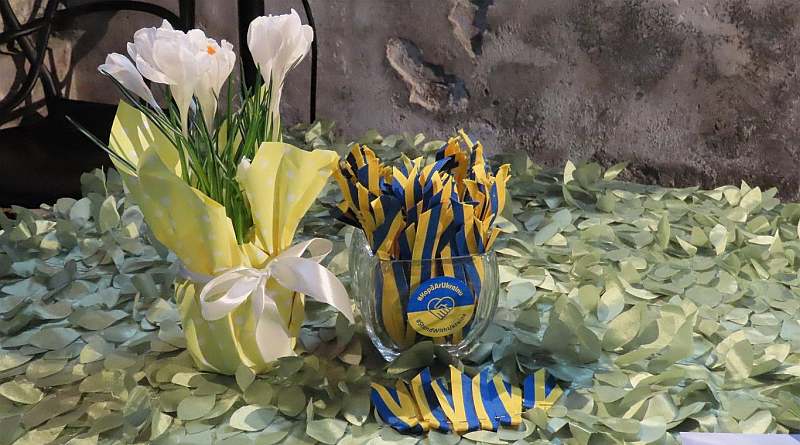
In the cover photo: Western support for Ukraine in Liepāja, Latvia. Photo: Latvian Public Media (LSM)
