
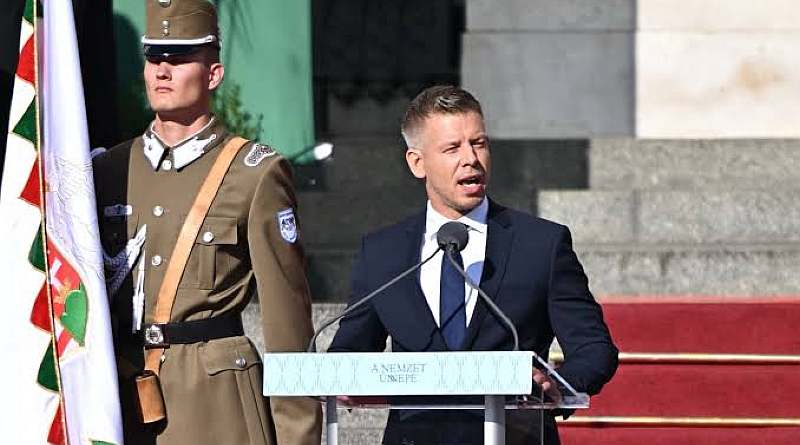

The Hungarian foreign policy strategy is undergoing fundamental changes. Recently, Prime Minister Peter Magyar signed a directive document that fully defines the official position of the Hungarian delegation at the upcoming 81st session of the United Nations General Assembly.
This step became a historic milestone for all European politics, as the Hungarian leadership officially recorded for the first time at the highest state level that the military actions of the Russian Federation against Ukraine represent a direct threat to the security of the Hungarian state itself, the European continent, and the entire existing world order.
The signed document demonstrates a principled break from the previous diplomatic line, as Budapest expresses uncompromising condemnation of Russian military aggression while simultaneously declaring unconditional support for the sovereignty and territorial integrity of Ukraine.
Hungarian diplomats emphasize that the conflict creates a critical danger for the large Hungarian minority that resides compactly in the territory of Zakarpattia.
At the same time, Peter Magyar’s government emphasizes the need for the speedy start of diplomatic negotiations, as only they can lead to the formation of sustainable peace and the provision of long-term international legal security guarantees for all participants in the process.
The foreign policy manifesto of the Hungarian government covers a wide array of key global crises, demonstrating Budapest’s ambition to synchronize its actions with transatlantic institutions.
Regarding the escalation of the conflict in the Gaza Strip, the Hungarian side takes a firm position, according to which the primary tasks are the protection of peaceful civilians, the unconditional recognition of Israel’s right to self-defense, the complete disarmament of the Hamas group, and a radical improvement of the disastrous humanitarian situation.
In the context of the confrontation between Israel and the Hezbollah group, Budapest insists on the necessity of fully restoring the sovereignty of the Lebanese Republic, which is directly linked to depriving all irregular armed formations of their military potential.
The Iranian issue also occupies a central place in the adopted directive, where Hungary clearly indicates the priority of exclusively diplomatic methods for resolution, aimed at preventing large-scale military escalation in the Middle East region.
Budapest uncompromisingly states the inadmissibility of Tehran acquiring nuclear weapons, emphasizing that the hypothetical closure of the Strait of Hormuz would create a catastrophic threat to global energy security, on which the stability of the European economy directly depends.
In the humanitarian and legal block of the adopted document, Hungary declares its unwavering commitment to protecting fundamental human rights and freedoms, with a special focus on supporting religious, national, ethnic, and linguistic minorities.
The cabinet of Peter Magyar simultaneously takes on commitments to protect the most vulnerable categories of the population, including women, children, and persons with disabilities, and intends to actively participate in the implementation of the global UN goals in the field of sustainable development, paying priority attention to the preservation of water resources and ensuring access to sanitation.
