
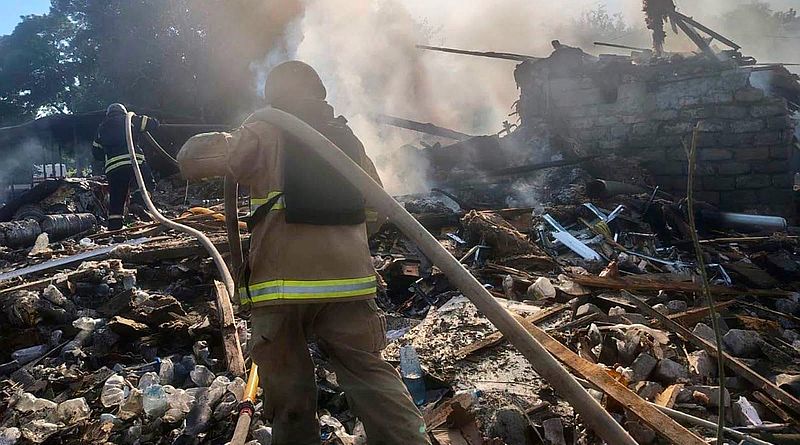
Oleksandr Kovalenko / Obozrevatel
In June 2026, Russian occupiers, strangely enough, moderately used kamikaze drones and decoy drones, even though they started the month with extremely active terror. As for missiles, the enemy intensified the use of ballistic means, nearly reaching a negative record.
This and much more is discussed in the new material of the joint project of OBOZ.UA and the group “Information Resistance.”
Missile Strikes
In June, Russia launched 200 missile means of destruction at Ukraine (slightly less than 222 in May), out of which 105 targets or 52% of the total were intercepted (similarly to May).
Throughout the month, Russian Occupational Forces (ROV) carried out two massive combined missile strikes on Ukraine, specifically on June 2 and 15. Thus, the gap between attacks increased from a week/one and a half weeks to over two weeks (considering that the enemy struck on the night of July 2) – indicating the enemy’s need to accumulate resources to prepare such strikes.
Speaking directly about the nomenclature of missile means of terror used by the occupiers, it looked as follows in June:
9M723/KN-23/5V55 – 105 missiles, 39 intercepted;
Kh-101* – 57/56;
3M22 “Zircon” – 16/6;
Kh-59/69 – 8/1;
3M14 “Kalibr” – 5/3;
Kh-47M2 “Kinzhal” – 2/0;
of unspecified type – 7 missiles.
* – no specific identification of subsonic cruise missile types, such as air-based Kh-101, sea-based 3M14 “Kalibr,” land-based 9M727/728 “Iskander-K,” so general data is published.
As we can see, the enemy continues to actively use ballistic means of destruction and was close to setting another record in this category last month. The majority of missiles that couldn’t be intercepted are precisely of the ballistic type. On the other hand, the interception of cruise missiles is very high at 95%.
Thus, in terms of the scale of terror, ROV did not show phenomenal results in the missile component category during June. Regular strikes on Russian enterprises involved in missile manufacturing obviously affect both the production of products and their accumulation, as well as the formation of ammunition for strikes. On the other hand, the intensity of the ballistic component has not yet shown a sharp decline and remains a leader in application.
As for the interval between the strike on the night of June 15 and July 2, this may indicate:
1) serious preparation by ROV for another massive combined strike and accumulation of ammunition,
2) insufficient number of launchers and carriers, as well as in some cases, insufficient production potential.
Drone Strikes
In June, Russian occupation forces used a fairly moderate number of Shahed-136/BM-35 “Italmas” kamikaze drones and “Herber”/”Parody” decoy drones against Ukraine – 5,749, of which 5,289 were intercepted, or 92%.
This figure is significantly lower than May’s absolute record of 8,150 strikes, although June began with a very intense use of UAVs. In just the first week, 2,136 were deployed, after which there was a decline.
Throughout the month, there were repeatedly raids with less than 100 weapons per day.
This may be related to the isolation of Crimea, logistical difficulties, and the delivery of drones to the peninsula, as well as the effective loss of the “operability” of several launch sites.
At the same time, drone production in Russia continued, and the accumulation effect is present. As of July 1, the UAVs had an accumulated resource of about 2,500 drones of a combined nomenclature and were fully prepared for a massive raid on July 2.
This does not mean that the enemy had/has the ability to launch them all at once, but indicates that there is no shortage in this category of terror means.
Raid on the Night of July 2
Since this summary for June comes a day after the new massive combined strike on July 2, I cannot fail to mention it.
First of all, the statistics of the means used by the enemy:
drones – 496, of which 476 were shot down;
9M723/KN-23/5B55 – 24/4;
X-101* – 34/32;
3M14 “Kalibr” – 8/8;
3M22 “Zircon” – 4/0;
X-59/69 – 4/4.
It is worth noting that despite the accumulated UAV munitions, this strike was not record-breaking in quantity but still has several distinctive features.
First and foremost, the enemy used one of the largest numbers ever of reactive kamikaze drones, modifications Shahed-238 and Karrar.
I cannot say that this indicates a transition of “Alabuga” and the “Kupol” plant in Izhevsk to primarily producing reactive kamikaze drones (to bypass and reduce the effectiveness of Ukrainian interceptor drones), but the fact remains that this was the most massive use of reactive terror tools.
On the other hand, the production of reactive drones in Russia is extremely energy-intensive. This product is not only more expensive but also more complex to produce due to Russia’s acute dependence on a range of foreign power components. It is possible that the reduction in intensity of raids in June may be linked to transitioning to reactive drone production and slowing general processes.
As for the missile component, it was entirely predictable. It also clearly indicates that the enemy not only relies on ballistics as the main means of terror but also, alongside expanding the use of these means, faces extreme difficulties with others. For example, with aviation X-101 and sea-based missiles – 3M14 “Kalibr”.
The Air Force deployed 10 strategic missile-carrying bombers Tu-95MS (7) with a potential launch of 8 missiles, and Tu-160 (3) – with a potential of 12 missiles each. Roughly speaking, the total launch with maximum loading of these carriers was supposed to be 92 X-101 missiles. 34 were used.
It should be noted that the launches were not carried out by 7 Tu-95MS strategists, but by four, but even with such a number, it comes out to 4–5 missiles per plane, though with full loading, three Tu-160 or four Tu-95MS would have sufficed for such a strike.
The issue is not so much a shortage of missiles as the critical wear and tear of these aircraft. They are intended to solve strategic tasks but have been performing tactical missions of terrorizing civilians for the fifth year.
And, of course, the biggest problem during target interception was ballistic missiles: out of 24, only 4 were shot down. The issue of intercepting ballistic attack means remains critically relevant for the Air Forces of the Armed Forces of Ukraine and poses a significantly greater threat, as well as a cumulative effect of destruction, than all other missiles used by the Air Force.
Conclusions
June 2026 in terms of Russian terror in the rear part of Ukraine was quite restrained, even though it is the month of the start of the Air Force’s summer offensive campaign.
Clearly, significant influence came from the strikes of Ukrainian Drone Systems Forces on Russian enterprises involved in missile production. Moreover, the paralysis of logistics significantly limits the capabilities of both delivering munitions to numerous launch sites and safely using them in the usual mode.
However, the moderate intensity of Air Force terror in June did not cancel the accumulation processes that pose a direct threat of another massive combined raid/strike. And this is not only about the attack that already took place on the night of July 2 but also about those that can be expected shortly – considering pauses of a week or two.
Nevertheless, the increase in pauses and the limited capabilities of the Air Force in terms of scaling terror are indicative.
Photo: SES of Dnipropetrovsk Oblast
