
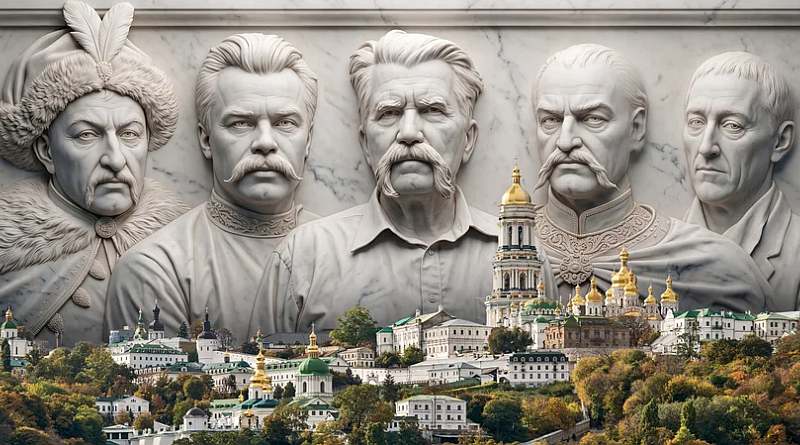
It will be like with many of our humanitarian projects: it will be implemented, hopefully successfully, with sincerity, understanding, and taste. Then it will become a usual part of the mental landscape: a shrine for some, a routine for others—which is what I fear. The Ukrainian pantheon deserves a better fate.
Everyone who is more or less familiar with the topic remembers the stages of promoting the idea of the Pantheon—from Hrushevsky’s almost unattainable dream to the initiatives of current activists and various circles of agreement and approval (including the separation of the pantheon project itself from the military cemetery) and, finally, the president’s June bill. All that’s left is to agree on whose mortal remains will represent the history of Ukrainian heroism and creativity. For instance, should Vasyl Kuk rest in the temple of memory alongside, say, Mykola Skrypnyk? And how will they lie next to each other?
Stop-stop! Are we saying “in the temple”? This is precisely the time to return to etymology. Πάνθειον, as is known, in Greek literally means “all gods.” In the 2nd century AD, a pagan temple was built in Rome to honor not one specific ancient god but all of them together: Jupiter, Juno, Phoebus, Minerva, Venus, Neptune, Diana, Vulcan, and others. At that time, the project had a quite specific political goal: to promote the idea of the divine nature of the emperor’s figure, nothing more. The idea was picked up by the French Convention (government) at the end of the 18th century: in the newly built temple of St. Genevieve, they placed the tombs of prominent compatriots: Voltaire, Rousseau (who was actually Swiss), and several figures of the French Revolution, whom now, except for Marat, nobody remembers. This decision also had an entirely understandable context for contemporaries: the revolution leaders were trying to fundamentally replace Christianity with the newly constructed cult of “Reason” and the cult of the “Supreme Being,” an initiative that did not take root, the temple was returned to the Church, and the next burial there took place fifty years later. In short, there is a palpable pagan undertone, which the freedom-loving French can afford.
And us? I’m not talking about the remnants of pagan customs in our daily life; they exist and should be preserved as part of collective continuity. But the phenomenon of official monuments in every city and village… Until recently, these were monuments to Vladimir Lenin and the Unknown Soldier. Now Taras Hryhorovych has firmly taken Lenin’s place, and he often not only situationally occupies the place of the communist idol but also becomes his functional substitute. But let’s remember: the European, and later American, monument to this or that prominent figure is a direct descendant of ancient statues of gods, as I have said and do not tire of repeating. Italians of the Renaissance began to imitate their direct Roman ancestors by erecting figures of their princes and military leaders in bronze and stone, no longer equating them with gods but with a hint that contemporaries understood. From the 17th-18th centuries, this fashion spread throughout Europe, including the Russian Empire, and the ancient trail got lost somewhere. Then on “one-sixth” another fascinating transformation occurred: instead of the forbidden religion, the Bolsheviks introduced a quasi-religious cult, and “monumental propaganda” (authors V. Lenin – A. Lunacharsky – I. Stalin) became an integral part of it.
Someone needs to be reminded that the activities of the Communist Party included so many religious practices that it wouldn’t be wrong to call the CPSU a church of the faithful. Indeed, the complex procedure of joining the party (baptism), exclusion from the party (anathema), periodic party meetings (liturgy), plenums (synod), congresses (council). It’s no wonder, as besides Stalin, there were many former seminarians among the Bolshevik leadership: Mikoyan, Podvoysky, Semashko, Shaumyan, and even Lunacharsky (no, he didn’t study in the seminary, but in his youth, he was close to the church). Regular ceremonial concerts on stage—in clubs, concert halls, theaters—resembled mysteries with a clear scenario, and those held outdoors, usually near a pertinent monument, were like a religious procession. And today, though the community of current believers might curse me, what is happening with the monuments is very reminiscent of the behavior of pagans who overthrew hostile idols only to establish their own. I have a special feeling for the monument to Kobzar in Kyiv, across from the Red Building, because during my university years, I learned that laying flowers there on certain days was dangerous for one’s career: he’d be expelled. In Soviet times, the mere act of honoring Shevchenko almost (well, almost!) automatically signified a certain political unreliability, which had to be compensated by additional demonstrations of loyalty. But in our times, nothing and no one prevents us from coming on a festive day together with an organized crowd, laying a wreath, listening to a trio of bandurists with instruments that have little in common with the authentic bandura, hearing “folk” songs that are new creations from the turn of the 19th and 20th centuries, admiring the blue-and-yellow ribbons and artificial flowers, and being imbued with the solemn pathos of the moment… A sort of Sunday mass… Worship…
It turns out that reverence requires certain skills, a culture of behavior and emotions, just like praying. The adherents of Lenin’s church worshiped his statues, as their ability and skill to pray had been taken away. For the rest of the world, it’s not a problem. Christians have long buried figures they were grateful to in churches. The more they were revered, the more honorable the church. Westminster Abbey in London, St. Peter’s Basilica in Rome, St. Vitus Cathedral in Prague. I was in Warsaw at St. John’s Cathedral and was stunned to see the southern wall entirely with tomb plaques and sculptures, including Stanisław Poniatowski, Ignacy Paderewski, Henryk Sienkiewicz, Krzysztof Penderecki, Józef Piłsudski, Roman Dmowski (by the way!). Later, I found out Piłsudski rests in Kraków’s Wawel, and Dmowski is actually in a family crypt, and here at St. John’s, there are only cenotaphs—symbolic burial monuments, a quite common Catholic tradition. Hence the meaning of the whole procedure: you do not come to the temple to pray to your idol, you come to pray to God for your favorite hero.
We truly need common heroes, we just don’t know how to interact with them. We must inevitably cultivate that state of respect that does not necessarily carry hysterical exaltation. Reverence does not automatically mean mystical suffering or lamentation. To remember is merely to recognize a pertinent figure as part of your worldview and emotional experience. And also gratitude. No more, but no less. Memory should not be confused with pain. For this, the atmosphere of the future or hypothetical establishment must be the opposite of what the disciples of liturgies at the monument envision. It is an intellectual and emotional effort on the part of every visitor, literally every visitor, aimed at feeling Ukraine as a community.
A book by Oleksiy Sokyrko, “Creators of History,” published last year by “Tempora,” immediately comes to mind. Several dozen figures of civilizational significance who contributed, consciously or unconsciously, to the formation of Ukrainian identity. Starting from Princess Olga and ending with Pavlo Skoropadsky, a second volume is obviously anticipated, and it will be the most intriguing, considering the current context. Among other things, it is necessary to decide on the sacramental question: does the burial under one roof of figures who were mortal enemies during their lifetimes signify future reconciliation? Are we ready to acknowledge that not all our common ancestors were equally right, while being our ancestors nonetheless?
Clearly, today it’s too early to talk about tolerance, reconciliation, acknowledgment of others’ mistakes and illusions. Everything is hanging by a thread. But if this project does come to fruition, if funds are found for it alongside money for interceptor drones and cruise missiles, at least it should be insisted that it becomes a place of unity, not of official agitation, a place for thinking and preliminary conclusions, not formal admiration of the past. Collective consciousness already consists of myths and legends; knowledge is the only counterbalance. A pantheon is for remembering and learning. And for those who wish to pray, there’s a church nearby.
Collage on the cover: NV
