
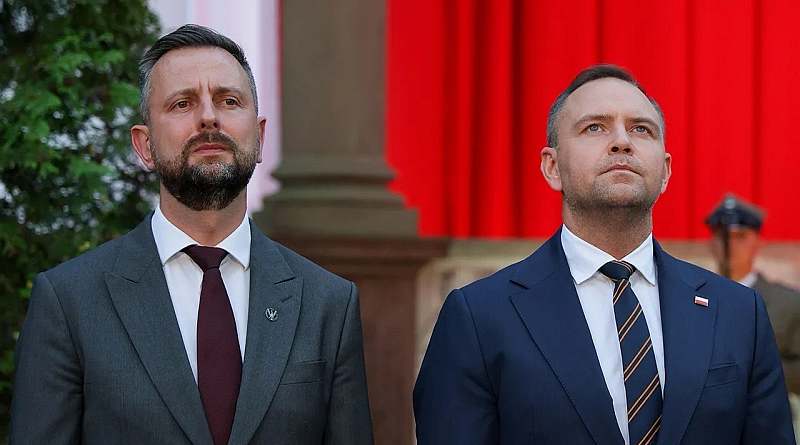

On September 18, a meeting took place between Polish President Karol Nawrocki, Deputy Prime Minister, and Minister of Defense Władysław Kosiniak-Kamysz, and Chief of the General Staff General Wiesław Kukuła. The top leadership of the country demonstrated a commitment to establishing the most coherent operation of state institutions.
The initiative for these consultations, previously announced by the head of the National Security Bureau Bartosz Grodecki, was prompted by a series of dangerous incidents directly affecting the security of Polish borders. Following the dialogue, the National Security Bureau is preparing recommended measures, as the integration of military and political solutions becomes a key condition for protecting state sovereignty.
The escalation of tensions was manifested in a series of incidents, among which the events on the eastern border and in coastal areas deserve special attention. Last Sunday, during a massive strike on Ukrainian territory, two Russian drones of the Geran-5 type fell near the Polish border, with one damaging a train locomotive on the route between Kyiv and Warsaw at the Yahodyn station, and the other hitting a gas station near the Dorohusk border crossing. A significant stir was caused by the discovery of an armed drone of the Gerbera-2 type by military hydrographers in the Baltic Sea near the beach at Rusinowo, whose explosive warhead was successfully neutralized right on the shore.
Additionally, an alert from the Government Security Center led to the evacuation of schools and government institutions in the Lublin and Subcarpathian voivodeships when a jet-powered unmanned aerial vehicle approached the border and eventually exploded four kilometers from the Polish territory.
Speaking in the Sejm after these incidents, Prime Minister Donald Tusk warned citizens that in the coming months, the most likely scenario anticipates the occurrence of extremely serious situations that will require society to be deeply prepared to undergo severe trials.
According to Polish intelligence, Russia’s aggressive strategy includes hybrid strikes using missiles and drones against countries supporting Ukraine, with such incidents potentially appearing accidental to paralyze the readiness of NATO allies to fulfill their obligations.
As direct threats from Russian officials regarding the likelihood of direct confrontation only increase the risks, Warsaw perceives what is happening as a comprehensive challenge for state institutions.
Under the current circumstances, Warsaw is forced to systematically reconsider approaches to national defense, as traditional methods of airspace control cannot fully neutralize modern hybrid threats. Since increasing risks require strengthening the resilience of critical infrastructure, it is necessary to implement advanced public warning systems and enhance coordination across all services.
Nevertheless, regular analysis of the situation conducted by the National Security Bureau in conjunction with military command allows Poland to lay a foundation for long-term resilience in the face of external threats.
On the cover: Deputy Prime Minister and Minister of National Defense of Poland Władysław Kosiniak-Kamysz, on the right – President of Poland Karol Nawrocki.
