
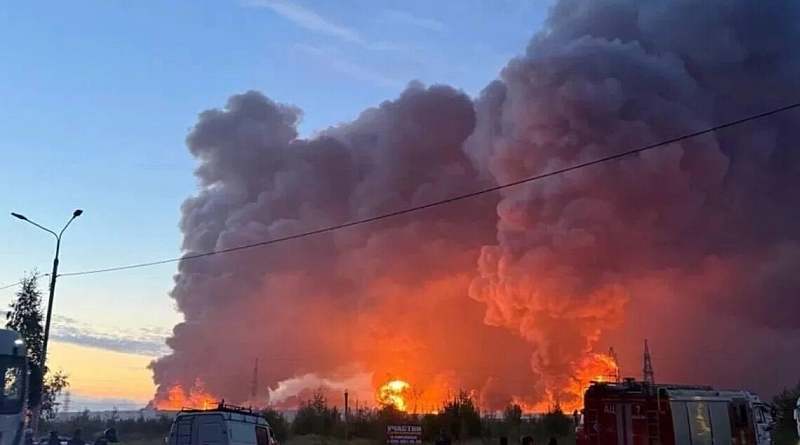

Information on current Russian losses due to sanctions as of 13.09.2026.
1. Ukrainian drones continue to attack Russian refineries.
– On the night of September 13, Ukrainian drones attacked the oil infrastructure of Russia in Tatarstan and Krasnodar Krai. Facilities in Nizhnekamsk and Slavyansk-na-Kubani were targeted.
– A series of explosions occurred in Nizhnekamsk, with local residents reporting drone flights and Russian air defense activity. Preliminary data suggests the target might have been the Nizhnekamsk oil refining complex, which includes the large “TANECO” refinery.
– Explosions were also heard in Slavyansk-na-Kubani, Krasnodar Krai. Preliminary reports suggest drones hit the local refinery, after which a fire broke out at the plant. There are also reports of possible damage to a thermal power plant.
2. St. Petersburg faces a record gasoline shortage after the shutdown of the region’s largest refinery.
– The situation with gasoline in St. Petersburg sharply deteriorated after the shutdown of the Kirishi “Kinef” oil refinery, the city’s primary fuel supplier. Kilometers-long queues formed at gas stations, and some stations ran out of gasoline.
– As of September 11, the share of gas stations in St. Petersburg where gasoline could be bought without a queue fell below 40%. In August, this figure was about 90%. Nearly every second gas station had no gasoline available.
– Problems began a few days after Ukrainian drone attacks on “Kinef” — the largest refinery in the northwest of Russia and the second largest in the country.
– On August 30, the plant halted processing after both primary oil processing units were damaged. The enterprise produces about 2 million tons of gasoline and 7 million tons of diesel fuel annually.
3. Payment crisis in Russia is growing: overdue business claims exceed 1.6 billion rubles.
– Payment discipline of businesses in Russia is worsening. About 70% of invoices are paid on time, while every fifth contract is overdue by up to 60 days, and another 5–8% of invoices remain unpaid for over two months. By the end of the first half of 2026, the total volume of overdue supplier demands exceeded 1.6 billion rubles.
– Small businesses have been hit hardest by payment issues. In the second quarter, the share of overdue payments in this segment increased by 2.6–3.4 percentage points.
– About 40% of entrepreneurs surveyed by RSPP named payment delays by contractors as a factor significantly restricting their operations.
– Payment delays create a chain reaction: a company that does not receive money from a client delays settlements with its suppliers, who in turn cannot pay their own contractors on time.
– As a result, a shortage of working capital spreads along the entire chain.
4. Russia will allocate $2 billion to cover losses from Ukrainian strikes.
– The Central Bank of Russia will additionally invest 165 billion rubles, or about $1.96 billion, into the capital of the state Russian National Reinsurance Company this September. The funds are intended to help cover losses from attacks on Russian enterprises.
– The decision was made following a sharp increase in risks to Russian economic infrastructure. Ukrainian strikes on refineries, warehouses, and other industrial facilities have led to a sharp increase in demand for insurance and rising insurance payouts.
– After international reinsurers exited, the key role on the Russian market was assumed by the state reinsurance company, owned by the Central Bank. It is under US and EU sanctions.
– Russia is forced to spend nearly $2 billion just to support the insurance system of its own economy against the consequences of the war. With the departure of Western reinsurers, an increasing portion of risks and losses falls directly on the state.
5. A British insurer found a loophole in sanctions and continues to insure tankers with Russian LNG.
– British insurance company NorthStandard continues to insure three tankers transporting Russian liquefied natural gas, despite the expanded sanction powers of the UK.
– This involves the gas carriers Clean Planet, Clean Ocean, and Clean Vision of the Greek shipping company Dynagas. They continue to transport LNG from Russia’s “Yamal LNG” project. The vessels are already under British sanctions, but new restrictions on maritime services do not apply to previously concluded insurance agreements.
– In May 2026, the UK expanded sanction powers to restrict maritime services, including the insurance of ships transporting Russian LNG.
– However, these rules do not have retroactive effect, which allowed NorthStandard to continue providing insurance coverage for the three gas carriers.
