
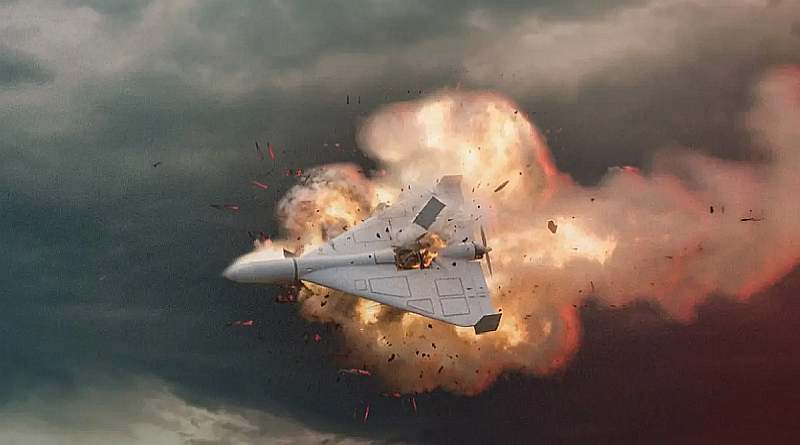

While the alert is ongoing, I will share my thoughts on the reactive Shaheds, since everyone has already spoken.
These days I have seen several opinions on the internet about the state of affairs with reactive Shaheds, some overly simplified, some manipulative, and some quite professionally presented. I will try to gather my opinion on this.
First of all, someone sent me a post by a critic of interceptor drones. He writes, “See, the reactive Shaheds flew, and the interceptors can’t do anything to them, I told you all these interceptor drones are crap.”
Well, the major can’t handle basic logic, what can you do. There are people who seek out negativity and rejoice in it because it’s an opportunity to declare “I told you so!!!”. But the fact is that reactive Shaheds are precisely the modernization of an existing system, because interceptor drones “killed” the old, cheaper, and more mass-produced “Shaheds”. In just one year, interceptor drones made attacks with regular “Shaheds” economically ineffective, because too many of them are shot down by cheap interceptors. You might remember Kyiv a year ago, how it was overrun by regular “Shaheds”, and only four interceptor crews (and several dozens of SAM crews) were defending it, what an outcry there was, and compare it with what was accomplished in a year. But some still didn’t see it, well, such experts.
Also saw criticism that there was no preparation for reactive “Shaheds”. This is a simplified perception, after all, reactive “Shaheds” have existed for a year and a half and have been relatively successfully shot down all this time, there are plenty of videos online of reactive Shaheds being shot down by anti-aircraft drones and other means, and even in today’s situation, anti-aircraft drones, according to statistics, shoot down 15% of reactive Shaheds, and the development of improved anti-aircraft drones has been ongoing as well. So it’s not that anti-aircraft drones don’t shoot down reactive Shaheds, but that they don’t do it enough, because it is necessary to achieve a rate of about 40% to break the new war economics, where countering the strike tool as a whole will be much cheaper than the cost of the strike tool. But why did this happen, if the existing system learned to handle ordinary Shaheds, what happened with the reactive ones?
Let’s try to figure it out.
1) Tactics.
New reactive Shaheds fly at an altitude of 3500+ meters, which limits the range of tools that can counter them. Anti-aircraft complexes with auto cannons (such as the Gepard and its analogs) and MG groups with machine guns do not reach them. MANPADS in the MG groups also do not reach reactive Shaheds at high altitudes.
This means there are three effective countermeasures: aviation (excluding helicopters, only jets), SAM systems, and anti-aircraft drones. Excluding helicopters, mobile air defense groups, and gun-based anti-aircraft systems significantly impacts the efficiency of the entire system, which was evolutionarily configured to interact as a complex. Now this system needs to be optimized, changed, and strengthened where it is effective. Work is underway on this.
2) New Device: Geran-4.
Previously, we mostly dealt with the Geran-3 with a jet engine. But it was just a Geran with a jet engine fitted, which couldn’t fly very fast or maneuver at high speeds because its fuselage couldn’t withstand it, and it could accelerate only over short distances, making it fairly easy for interceptor drones to shoot down.
Geran-4 is a different device with little in common with the Geran-3. The Chinese helped Russia with the corresponding engine and a mass batch. This model is much more expensive than a typical Shahed, closer to our “Peklo” or “Ruta.” By the way, the Russians have big problems intercepting our jet drones, so the problem is mirrored, although in my opinion, ours have much better specifications.
The appearance of the new Geran-4 in large quantities was a sharp evolutionary step, and the system, which handled mostly slower Geran-3 drone attacks, stalled.
3) Radars.
Everyone seems to shout about the need for interceptor drones but forgets that the main component of the system is not the drone, but the radar. Radars are still in deficit, Western manufacturers are contracted, Ukrainian ones are also jam-packed with orders, and several are currently developing their tactical radars, but all this takes time. To effectively counter the jet Shahed, it needs to be detected earlier and not lost over larger areas, which requires more radars and coverage of larger areas. Previously, we mostly “shuffled” radars across areas to achieve better efficiency. How to better position the existing number of radars to better counter the jet “Shaheds” is a big question and a substantial coordination task.
4) Evolution in Control Systems.
The jet Shahed is just one of the means in the drone-missile barrage. There are other devices involved—decoy drones, reconnaissance drones, and strike-controlled “Shaheds.” The evolution of mesh networks has made this system more effective and better at employing jet Shaheds. And here the question arises—have we done enough in EW to counter mesh networks? But this is more a question for Flash.
5) The System.
The system is currently undergoing reconfiguration because it was evolutionarily learned to counter slower targets. And it effectively learned this just a few months ago. From detection to information transfer to posts, to countermeasures, to reaction time in different situations, to the possibilities of employing jet aviation, covering areas with means that have now suddenly become ineffective, meaning that these gaps urgently need to be filled with effective means, and many other complexities. Changes will heavily depend on the availability of necessary means and the professional capabilities of the leadership responsible for specific defense areas, and how much jet aviation work sectors can be extended to these areas.
What conclusions can be drawn from this?
We see the next step in the evolution of Russian means and another challenge for our air defense to intercept targets moving en masse at altitudes of 3500-4000+ meters and at speeds of 350-500 km/h, with the understanding that these speeds and altitudes will continue to increase. There is also an understanding that we need to focus on Geran-5 as the enemy’s basic strike means and counter it in the future, which is already a very complex intercept target that is not limited to border areas and can fly much further. Therefore, the system must counter not the Geran-4, but the Geran-5, while also shooting down all other targets participating in drone attacks, as the involvement of classic propeller drones has not been canceled. This is quite a challenge.
Ukraine needs to enhance its capabilities to counter such threats. For the first time in the world. However, nothing new.
 |
 |
Photo: ArmyInform
