
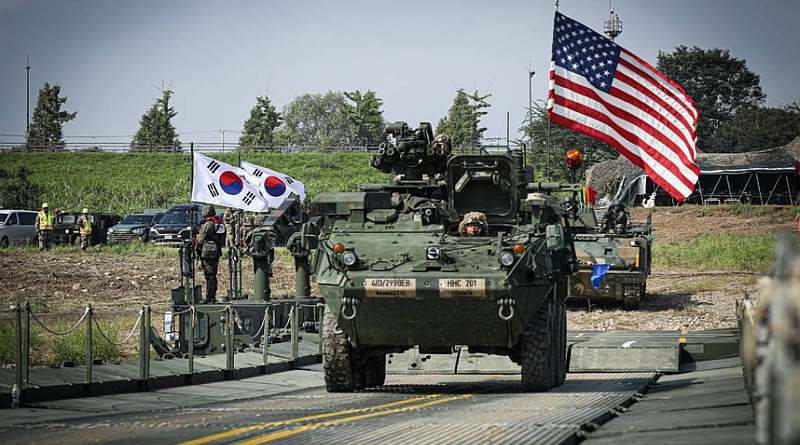
Last week, U.S. President Donald Trump ordered the Pentagon to reduce joint military exercises with South Korea just hours before they were to start. Among other reasons, he cited the cost of the exercises and complained that Seoul refused to help with U.S. efforts to denuclearize Iran. Previously, the U.S. had to withdraw Terminal High Altitude Area Defense (THAAD) interceptors from South Korea to use them in the Middle East.
Research by the Heritage Foundation notes that the Trump administration also sharply reduced the number of U.S. naval passages through the Taiwan Strait — by about 56% compared to the Biden administration period. The number of Freedom of Navigation Operations (FONOP) conducted by U.S. military ships in the disputed waters of the South China Sea also decreased.
Public opinion has also shifted: a Pew Research Center survey conducted across 36 countries and released earlier this year showed that the positive perception of the United States has dropped by double digits in both Indonesia and South Korea over the past year, and in much of Europe and the Asia-Pacific region, seven out of ten (or more) people now view the U.S. negatively. In partner countries like the Philippines and South Korea, positive ratings are now at or near their lowest levels since Pew began surveys in 2002.
“Trump is certainly not executing a ‘pivot to Asia’—if anything, he is pivoting towards the Middle East. But if the United States reduces its military presence in South Korea or its commitments to it, this doesn’t necessarily mean a similar move elsewhere in Asia. South Korea is unique: it is potentially capable of defending itself without major U.S. assistance, and American forces are primarily there to deter North Korea, not to deter or defend against attacks from China,” notes U.S. historian and foreign policy analyst, senior fellow at Carnegie Endowment for International Peace, Stephen Wertheim, to Tyzhden.
According to Joshua Kurlantzick, senior fellow for Southeast Asia and South Asia at the Council on Foreign Relations (CFR), changes in military cooperation between the U.S. and South Korea may signal a broader shift towards a more pragmatic and conditional U.S. military presence in Asia—where Washington remains committed to its alliances but increasingly adjusts the scale of its military involvement according to its own strategic and political priorities.
“I believe this is already happening, and Asian states are clearly very concerned about the U.S. reducing its defense umbrella in Asia, at a time when China is expanding its military capabilities, increasingly with the help of Russia,” he tells Tyzhden.
As South Korea, Japan, and other U.S. allies in Asia become less certain about the extent of future American military involvement, they are likely to increase their defense budgets.
“South Korea and Japan might potentially consider the possibility of developing their own nuclear deterrents and also aim for greater military cooperation with other countries in the region, which is already happening — more cooperation between South Korea and Japan, more cooperation among several states and Australia, more cooperation with India, and so on,” says Tyzhnya Joshua Kurlantzick.
The South Korean case demonstrates not so much a possible American withdrawal from Asia, but rather a change in the very logic of the U.S. military presence abroad. Whereas previously American troops in allied countries were primarily seen as a long-term element of deterrence and stability, Washington now increasingly evaluates their presence based on its own strategic priorities, costs, and partners’ contributions. In this model, the alliance remains, but its military content becomes more conditional. This makes the Asian experience relevant for Europe.
European capitals have long feared that the United States might reduce its military presence on the continent. In May 2026, NATO Secretary General Mark Rutte stated that in Europe, significant reductions of American forces are widely expected, and on August 27, Reuters reported that the Pentagon is conducting a major review of the deployment of U.S. troops in Europe. This is expected to be completed in the fall and involves preparing at least four options for the future American military presence.
According to Joshua Kurlantzick, similar logic, as seen in trends in Asia, is already shaping the U.S. military presence in Europe, and European countries are already adapting to this reality.
“European allies of America should already be wary that the Trump administration might reduce the U.S. military presence in Europe, regardless of what happens in Asia. The Pentagon has announced a review of the force deployment structure, specifically focusing on Europe, and has signaled that reductions will occur. At the same time, if conducted responsibly, this process could create an opportunity for Europe to gain greater autonomy in the realm of European defense and reduce its reliance on Washington. This is the direction European defense should move in, regardless of what Trump does, and regardless of who replaces him as President of the United States,” notes Tyzhnya Stephen Wertheim.
At the same time, the current changes do not mean an automatic dismantling of American alliances. The U.S. remains a key military force in NATO, and their nuclear, intelligence, space, and high-tech capabilities are difficult for European countries to quickly replace. The question is rather how willing Washington will be in the future to maintain the current scale of this presence and on what terms.
For European allies, the problem, however, is not so much in the possibility of reducing the American contingent but in the change of logic by which Washington will determine the extent of its involvement in European security. If the American military presence increasingly depends on Washington’s own strategic priorities, the contribution of allies, and the cost of their defense, Europe will no longer be able to conduct long-term planning based on the assumption of a constant American resource.
This means the necessity of creating capabilities that will allow European states to act even with less involvement from the USA. Therefore, the current American pressure may ultimately accelerate a process that Europe has been trying to avoid for years: transitioning from a security model largely built around American guarantees to a system where Europeans themselves bear a greater share of the responsibility for the continent’s defense. The question, therefore, is not only about how many American troops will remain in Europe, but about how prepared Europe will be for a situation where Washington remains its ally, but not necessarily its main military guarantor.
Photo: Sgt. Scott Sparks/U.S. Army
