

It is too early to summarize August results, but there is a reason to highlight the core hybrid plot that the Russians have prepared for the fall and for which they will try to gain Washington’s support.
The torpedo fashioned in the Kremlin is called very simply – the illegitimacy of Ukrainian authorities. Yes, again.
This was once again prompted by the Deputy Head of the Russian Foreign Ministry, Mikhail Galuzin, who has been frequently giving interviews and making speculations about negotiations.
The context looks like this.
Russia allegedly wants peace, but it is interested in “comprehensive agreements” and “elimination of the root causes of the conflict.” For this, a “legitimate government” is needed. That means elections in Ukraine.
It is easy to trace that the Russians use the legitimacy issue in a flickering mode. Putin himself has repeatedly stated that he is ready to meet with President Volodymyr Zelensky. Then he changed his position. Then turned it 180 degrees again.
Now they are building such logic.
To ensure a pause for elections, Ukraine must leave the Donbas. To organize an election campaign, temporary management under the aegis of the UN with the participation of the USA, Europe, Russia, and someone else must be established in Ukraine. One of the tasks: block military aid.
Then the newly (re)elected president and parliament will be able to implement “comprehensive agreements.”
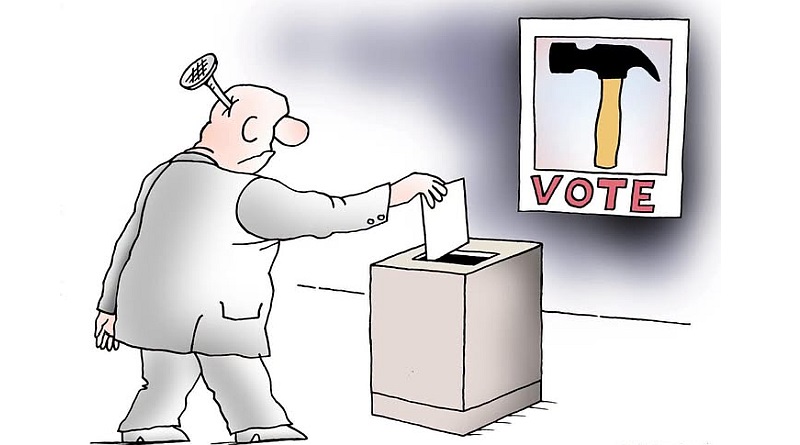
In summary: there is a maximally specific and measurable plot – Donbas in exchange for elections.
Attempts to terrorize Kyiv and other cities of Ukraine are one way to incline the population to discuss this scenario.
The formula of Russian terrorists is this: do you want to end the suffering and get the desired elections to change the hated government – give away the crumbs of Donbas, which are ruined anyway and are not needed for three hundred years.
Several rhetorical questions immediately arise.
We take the list of potential presidential race leaders. Who among them looks morally ready and technically capable of implementing the Russian ultimatum? In my opinion, no one.
Then why does Russia need these elections?
Is it so that instead of a president whose legitimacy they dispute, they face a leader elected within a universally recognized process? And potentially with a tougher position? Where is the logic?
The logic is absolutely transparent and is based on the fact that Russia does not have a “candidate” in the presidential elections in Ukraine.
Therefore, Russia’s goal is the absence of a universally recognized legitimate winner and subsequent chaos. This can be achieved in several ways.
First, launch an election campaign but do not allow it to finish by staging some provocation and breaking the truce.
Second, complete the voting so that a significant part of the country and/or army does not accept the result.
The immediate consequence of the absence of a universally recognized leader is that the army stops obeying orders.
The idea of “external management under the aegis of the UN” (which the UN leadership did not accept) is a plan for zoning Ukraine, only in profile.
What is the next step for the Russians? It is easily identified.
Even if we assume that some Russian ideas (in the form of proposals from the US, Vatican, or Dalai Lama…) will be accepted by the Ukrainian authorities, they cannot be implemented within the current Constitution of Ukraine.
The piquancy is that amending the Constitution is a complex process that is technically impossible to implement in our conditions. However, it is technically possible to adopt a NEW Constitution. Inquire how the current Constitution was legally established, and everything will become clear.
For these purposes, the president is needed basically only as a law signer. And the main action is in the Parliament.
This is where two thematic stories emerge that can be tracked: the rhetoric about elections as a public scarecrow and the reformatting of parliament as a shadow measurable process.
In the current situation, real LEGITIMATE changes in power are possible only through parliament. No other way.
I do not envy the current deputies, frankly. I can quite imagine a situation where it will be necessary to massively come out in defense of the parliament.
Illustration: Alexander Dubovsky
