
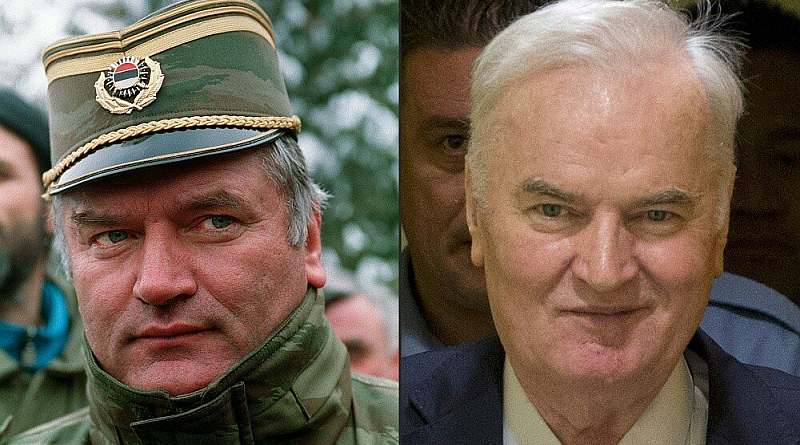
On days when Russia continued systematic shelling of Kyiv and other Ukrainian cities, when air raid sirens sounded literally every hour, when shopping centers and residential buildings were ablaze, the former commander of the main staff of the Bosnian Serb Army, Ratko Mladic, died in The Hague.
This was a predictable end. No one intended to release the old killer even before death, because the crimes he committed did not warrant clemency. And perhaps the most important thing now is that Mladic died precisely when it became clear that all these crimes were a rehearsal for another scale of murders that Russia is now committing on our land. Yes, formally Moscow did not support Ratko Mladic and his formal chief, the president of Republika Srpska, Radovan Karadzic (still alive and in prison). Russia also did not help its long-term ally, the de facto master of the Bosnian Serbs, Slobodan Milosevic – handed over to international justice in a short period of attempts to establish true democracy in Serbia, he also died in a prison cell of the Hague Tribunal.
But Russian intelligence was already involved in the processes on the land of the former Yugoslavia, already perceiving the Yugoslav war as a testing ground. They were already helping to evade responsibility for those who were ready to fulfill their terrible whims. From Srebrenica, which became a bloody prelude to our Bucha, from the siege of Sarajevo, which became a prelude to the shelling of Ukrainian cities, to the hunt for people in Kherson, to the missile and drone strikes on residential areas, and to the arrest of Mladic and his transfer to the Hague Tribunal, it took 15 whole years.
All these years he did not particularly hide – at least during the period when his real boss, Milosevic, remained in power in Serbia. He was not removed from the Serbian army – precisely the Serbian, not the Bosnian Serb army, meaning he remained a respected military pensioner. All this time, according to already published documents, the FSB knew where to find him, moreover, it created all the opportunities for him to maintain freedom. If it weren’t for Belgrade’s desire to find common ground with Brussels and start the real process of European integration, Mladic would have died unpunished.
But it’s worth knowing something else. Zoran Djindjic, the Prime Minister of Serbia who organized Milosevic’s extradition, was soon assassinated. His party colleague Boris Tadic, who became the president of Serbia and organized the extradition of Karadzic and Mladic, turned into a political marginal. And Milosevic’s former propaganda minister, who seemed like a radical and liar even against the backdrop of the dictator himself – Aleksandar Vucic, came to power in Belgrade, whom our president was literally embracing just a few days ago. Vucic, a true political creature, perfectly understands that most Serbs continue to consider Mladic a hero and a victim, stubbornly ignoring the blood on the killer’s hands. And therefore he tells his compatriots about the injustice of international justice, therefore he proposes to bury Mladic in Serbian soil, therefore he is outraged that the bloody general was not allowed to die at home.
So the punishment took place. And this is important. But the society’s awareness of its responsibility for the crime, or at least the emergence of a desire to distance itself from the crime, did not occur. And this means that The Hague did not fulfill its main function – it did not become a vaccine against the emergence of new Mladics, against new wars, against new ethnic cleansings. Everything can still repeat again and again.
And for us, this is the most important conclusion for the coming decades. You can achieve justice for the criminal – but you cannot change the country and society if the citizens themselves do not desire such changes. The Serbs, unlike the Russians, had opportunities, politicians, and international support – and none of it helped. And this means that now – and possibly for decades – we and the Russians will have different heroes and different victims. We have those who stopped them. They have those who killed us. And even if we repel them, and if we suddenly achieve justice for the criminals and some of them die in captivity, not in their own beds, it will only intensify the sense of injustice and thirst for revenge in Russia.
This Damocles’ sword will hang over our heads, over the heads of our children and grandchildren even after the war. It’s important to just remember this – and not relax, and not let either devious strangers or greedy and stupid ones of our own deceive us again.
