
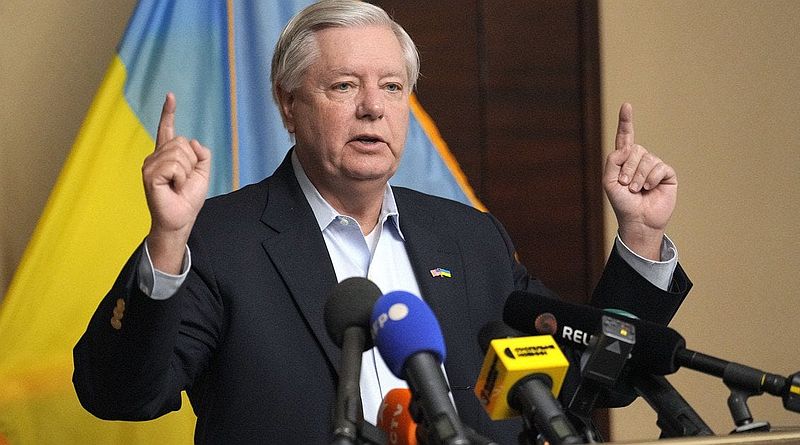
In light of the unexpected death of Senator Lindsey Graham, the law he promoted practically for the past year, if soon passed, will certainly not be called a new sanctions law, nor a law on pressure on Russia, but Graham’s Law. And it will appear as the political testament of one of the most extraordinary American politicians of recent decades.
This law will demonstrate the approach Graham has espoused since he managed to establish close friendly and professional relations with Donald Trump. On one hand, it reflects the position of the senator, who always believed that dictatorships must be spoken to in the language of force because they do not understand diplomacy. That is why the idea of the law is to significantly limit Russia’s energy capabilities and, most importantly, create serious problems for those who continue to buy oil from the Kremlin. On the other hand, it retains political and diplomatic initiative for the president. It is Donald Trump who will decide when and how to apply tariffs to countries that will violate the articles of this law.
At first glance, this is more a declaration than a real threat. Hasn’t the President of the United States essentially already lost the most crucial tariff war of his life? So why should countries that are buyers of Russian oil pay attention to new threats of tariff imposition?
But the very existence of this tool will already act as a harbinger of paralysis. It’s one thing to face already imposed and planned tariffs that need to be fought against. It’s entirely another to face the threat of such tariffs being imposed. And a clear understanding of what might lead you into another round of tariff war with the United States. The reason is the purchase of Russian oil. And this will mean that refineries in the Global South will invariably lose their contacts and contracts with Russia. In India, this is already happening—without any Graham’s Law. And the adoption of such a bill will only strengthen the desire of Indian oil companies to reduce their dependence on the Russian oil market. Especially since Russian oil was never pivotal in the Indian market—it was more of a premium product that allowed the purchase of cheap oil, its conversion into oil products, and sales to the West for dollars and euros. If this possibility ceases to exist, Russian oil becomes especially unnecessary for India. And this is true for almost every country—except China, for which purchasing Russian oil also has an important political accent. But even here the question arises: will Beijing insist on this point if real threats to its economy arise?
Thus, this scheme is only to intensify the problems that will form in the coming months on the Russian oil market. If Ukraine continues to strike Russian refineries, it will increase the amount of oil Russia wants to sell on the world market. And it’s crucial that it is unable to sell this oil. This will mean inevitably reducing oil production itself. Right now, we are talking about a fuel crisis. But to the oil refining crisis should be added an oil production crisis. Moreover, such that Russia cannot restore its oil and refining industry in the next decades.
This is actually the best path to peace for humanity, not any negotiations and compromises. Russia without money is a country that can be dealt with. Russia with money is a dangerous aggressor threatening humanity. The senator was one of those who understood this pattern of development of the Russian state and society perfectly.
Therefore, Russia needs to be deprived of its refining industry by strikes on Russian infrastructure. Russia needs to be deprived of the opportunity to sell oil through strikes on oil ports and through the imposition of sanctions on countries that continue to buy this dangerous commodity, or at least through the threat of possible tariff imposition for such countries. It is necessary to bring the matter to the reduction and then to the final cessation of oil production in the Russian Federation. Russians need to be forced to deal with the problems of their own country and its intensive development, rather than solving the problems of extensive development through aggression, war, murder, robbery, and violence.
This is Graham’s Law.
