
This important international event will likely go down in history as special, under the sign of the “White Eagle.” The decision on the location for the traditional international conference on Ukraine’s recovery was not made immediately. A week before it was held, Polish President Karol Nawrocki announced the withdrawal of the Order of the White Eagle from Ukrainian President Volodymyr Zelensky. As Nawrocki later explained, “Kyiv’s actions crossed the pain threshold for Poles.” Ukraine’s response was swift – Volodymyr Zelensky visited a “Nova Poshta” branch and sent Poland’s highest award back to Warsaw.
The days leading up to the conference were filled with buzz and speculation about Zelensky’s participation in the event in Gdańsk, Poland. In the end, everything was settled: the Ukrainian delegation was led by Prime Minister Yuliia Svyrydenko, and all other high-ranking officials and participants from other countries arrived and worked successfully on numerous panels.
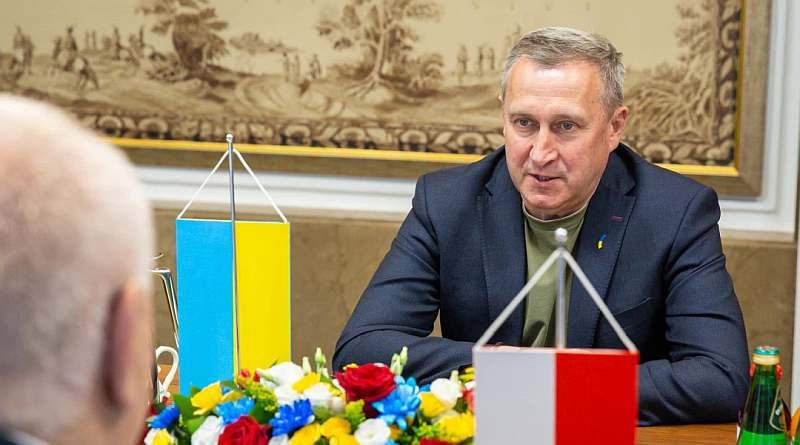
Has the Gdańsk conference become the turning point after which emotional moves and actions will give way to balanced approaches and truly national, rather than political interests or ambitions? This question is discussed with Andrii Deshchytsia, former Minister of Foreign Affairs of Ukraine, who was also the Ambassador to Poland and is present at the conference location, sharing not only his impressions but also his thoughts on the state and prospects for normalizing Ukrainian-Polish relations.
– So, despite the difficult atmosphere that developed beforehand and various speculations, the international conference on Ukraine’s recovery successfully started. What is the atmosphere in Gdańsk and in the conference halls?
– I would say that there is an atmosphere of very intensive work here. There are many people at the conference, the setting is businesslike and constructive, and participants, in my opinion, are open and active. Obviously, many questions arise and are discussed, regarding what to do in the political and diplomatic arena, but as for business, everyone here is set to cooperate.
– So, a good start. But we cannot overlook the prehistory, the events that took place before. This conference will evidently go down in the annals as special, marked by a scandal at the highest level. Unfortunately, that’s how it turned out. What is your impression from the event, did this incident and the sharp deterioration in relations between the two heads of state affect what was planned and what is being done in Gdańsk?
– I can’t say it’s completely gone unnoticed. Of course, many people, at least among those I’ve spoken to here, have mentioned it. These include Ukrainian officials and business representatives, including weapons manufacturers with their stands here. Everyone – the public sector, government officials, politicians, Ukrainian experts – all claim that it would have been better without all those statements or actions made beforehand.
Nevertheless, it seems to me that a pragmatic approach prevails: let’s do something, it happened the way it did, but let’s try to continue cooperating because it’s in the interests of both countries. What the consequences of those actions and statements will be, especially from President Navrotsky, is hard for me to say at the moment, as one must remember that here, at this conference, supporters of the Polish government have mainly gathered, I mean from the Polish side.
And these are representatives of the constructive part of Polish society, ready to continue cooperating with Ukraine. The more radicalized part, representatives of the right-wing political scene, are not present here; they are in opposition to the Polish government. It’s hard to predict how cooperation or contacts with them will develop after the actions and statements made on the eve of the conference.
– Polish Prime Minister Donald Tusk said that President Zelensky’s refusal to participate in the conference is seen as a “gesture of de-escalation of tension”. Of course, Zelensky’s participation would have added more substance and weight to the event, but we must recognize that such conferences – and this is already the fifth during the full-scale war – are organized and held by the governments of Ukraine and the host country. Moreover, as far as I remember, Zelensky did not participate in all wartime conferences, at least he was not in Lugano, in London too; he addressed via video link, but presidential participation is not mandatory, not a “must”.
So, let’s approach this pragmatically and focus on the outcomes. For me, the main political outcome was the answer to whether the conference on Ukraine’s recovery in Gdańsk will help restore the strategic political partnership between Ukraine and Poland.
– Attention must also be paid to the other participants of this conference, because besides Ukrainian and Polish representatives, there are many of our Western partners. They assert that it is important the conference is taking place, and it is a good signal to the whole world supporting Ukraine. Obviously, it would be good if President Zelensky was present, but if he isn’t, we still have partners to cooperate with, meet with, and discuss future plans.
And this, I believe, is the most important aspect of organizing such conferences and events. Will this conference specifically help accomplish something, realize projects in Ukraine? We will see, of course, in the future, but negotiations are already underway here, politicians and businesspeople are meeting, agreements on cooperation are being signed, aid to Ukraine, investments in Ukraine, and this is already a good start for such projects in Ukraine.
Regarding Ukrainian-Polish cooperation, as I have already mentioned, many participants of the conference are mainly gathered around the Polish government, which is positively inclined towards cooperation with Ukraine. Therefore, we can say that Ukrainian-Polish cooperation, if based on the representatives and participants of the conference present here, has good prospects for development. I think it’s important to showcase some successful examples of such cooperation, which could then serve as a platform for building and spreading to the political right in Poland as well.
– As reported by the media, even before the official opening of the conference, both public and official events took place in Gdańsk. In particular, a civil forum was held. As I understand it, such a forum should also provide some signals and impetus from civil society not only to the governments but also to the entire community – both Polish and European. A meeting of the Ukrainian-Polish interparliamentary assembly was also held. What was said at these events about the current situation and the future of relations between the two neighboring friendly countries?
– It seems to me that despite several decades of intensive work by historians, politicians, experts, and religious figures who have developed various forms of cooperation between Ukraine and Poland and have attempted to somehow resolve this historical dispute, both Ukrainian and Polish societies still do not fully know everything about their neighbor.
Therefore, we probably need to work further on explaining to Polish society the role of the UPA during the struggle for Ukrainian statehood during and after World War II, what it represented, because in Poland the idea of the UPA is quite generalized and is mostly presented in a negative light.
On the other hand, we ourselves do not know the full history of the UPA well and cannot fully present this tragic page of World War II to our Polish partners.
Concerning these events of World War II, up to the Volyn tragedy, as the Poles say, there are various approaches, and it is necessary to talk about this at both formal and informal meetings of public organizations, politicians, deputies, and parliamentarians, since this issue, it seems to me, is one where both sides are not fully aware of how these pages of history are covered in the society of the neighboring country.
We need to work on bringing these positions closer. I don’t think this can be achieved here at this conference, but we need to start somewhere to gradually develop educational work about our past. Ignorance, in fact, breeds such categoricity in assessments and sometimes accusations based on an incomplete picture of those events.
– I completely agree, more work needs to be done in this area. However, war is not the best time to talk about the past and the lessons of history when the future is uncertain – if there will be a future and what it will be like. So, this needs to be done, but there is a time for everything. Now is the time to defeat the enemy and rebuild Ukraine. This doesn’t mean that everything else should be put on hold, but we have priorities.
But let’s return to the conference and its official panel, where high-level participants, heads of state, governments, and Ursula von der Leyen spoke, announcing the first tranche of a large loan for Ukraine, along with other important statements and announcements. What are European politicians saying?
– First of all, politicians are calling for restraint in statements regarding historical past. Representatives of both Polish and Ukrainian businesses have been speaking about this earlier. Statements from the Polish Business Council and the Ukrainian-Polish Chamber of Commerce call for calm and continued cooperation.
Politicians, in turn, are urging the continuation of efforts, supporting Ukraine in joining the European Union. Yet, the even more important task is to end the war and secure Ukraine’s victory, as all other steps will be less important if we lose this war.
There seems to be an understanding of this, but sometimes it seems our Western partners, even in Poland, feel more secure than we do: they are members of the EU and NATO, they see Ukraine holding back Russia, and they can modernize their armies in more, so to speak, comfortable conditions, not under the pressure of necessity, but systematically. And they do not always fully understand our priorities, sometimes losing sight of the fact that it is most important for us to end the war, to win, and to prevent Russia from further controlling Ukraine. I think this imbalance also causes the priorities between Ukrainians and Western partners, including Poles, to be a bit different, and unfortunately, we have to remind them that we are at war. The war continues, and this must be taken into account.
– As always, various events take place within the conference. For instance, Ukraine’s Energy Minister Denys Shmyhal announced the fourth meeting of the coordination group on Ukraine’s energy issues, Energy Rammstein, in Gdańsk. What else has happened or is planned?
– Panels are currently being held regarding the five main dimensions present at the conference. One of the agenda items is the issue of security and military cooperation, which is extremely important for Ukrainian manufacturers and our partners, as it involves not only helping Ukraine but also joint production. Parliamentary events also took place, involving meetings between Ukrainian and Polish MPs, which I think is also very important.
– Lastly, I wanted to ask: is the Ukrainian community noticeable in Gdańsk, is there a Ukrainian presence? Are any cultural events being held?
– Yes, of course. Ukraine and Ukrainians’ presence here is, in my opinion, very significant and impressive, as Ukrainians are very active, open, and noticeable. Many events are also happening at the level of youth organizations. For example, I attended a meeting of a foundation where young people who are interning in Poland, Ukrainian students, gathered, and they are quite positively inclined and see their cooperation with Poland.
That is, the Ukrainians who arrived here present themselves in a very positive light. There were certain concerns due to the atmosphere on social media on the eve of the conference, but upon arriving here, everyone is very pleasantly surprised by the attitude towards them from the organizers and from the people in Gdańsk, in hotels, in transport, with very positive sentiments. Ukrainians, in my opinion, show themselves as a worthy and promising European nation on par with other participants of this conference.
– As far as I know, among other things, in Gdańsk, “Ukrinform” together with the Polish Press Agency (PAP) organized a joint photo exhibition; I sincerely invite you to visit it and show it to all your friends and guests.
I understand that Ukrainian participants do not need to be urged to do everything possible in Gdańsk to restore political dialogue at the highest level, as it should be between Ukraine and Poland. We all hope that Gdańsk will be a turning point, after which, instead of increasing tensions, there will be a return to normal interaction, as it should be. Of course, I have great doubts that the current president of Poland will ever receive a Ukrainian award, but still, I would like the presidents of the two friendly countries to find a way to overcome the difficult situation and meet. Such an opportunity will arise soon, as the NATO summit in Ankara is approaching. What are the expectations?
– I think there needs to be some understanding. Obviously, this will not be easy at the level of the current presidents. But nevertheless, there are other tools and diplomatic channels that should be involved because I am convinced that we need to cooperate with Poland, and we need to have good relations with Poland.
Poland should be our partner, our ally, and I think that the disputes or discussions that exist certainly create certain barriers, but we will be able to overcome them if we approach them constructively.
I also think that this is what our European partners, our Western partners expect, because they do not fully understand what is happening between Ukraine and Poland: we do not need you to quarrel. I think these are correct calls, I think that with the help of our Western partners, it will be possible to resolve the disputes that have arisen.
– We have no other choice, we must live together, fight together, win together. I am sure that this is how it will be.
Glory to Ukraine!
– Glory to the heroes!
