
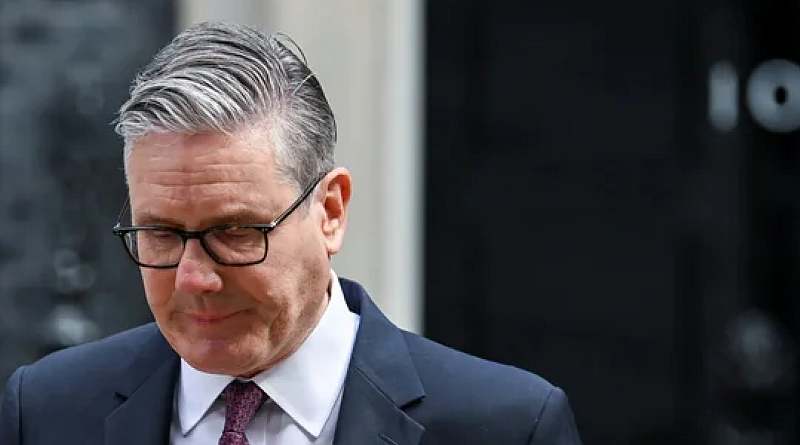
The end that came on Monday was inevitable. Sir Keir Starmer, the much-troubled Prime Minister from the Labour Party, who resisted calls from senior party members to resign for two months, announced in an emotional address on Downing Street that he was stepping down as head of the government and party leader.
A successor has yet to be chosen, but all expect Andy Burnham, the former Mayor of Manchester, to take the position in the next few weeks. Until then, Starmer will serve as interim Prime Minister. He will participate in an important NATO summit in Turkey, where he will urge European allies to continue providing strong support to Ukraine—despite his government’s failure to agree on a new defense budget for the UK. Starmer will attend meetings with European Union leaders to attempt to bring the UK closer to the EU, ten years after the historic Brexit vote.
Starmer’s downfall—just two years after Labour’s confident victory in the general elections—is both a personal and political tragedy. The UK will be changing its seventh Prime Minister in the last 10 years amid unprecedented political turmoil in a democracy once considered the most stable in Europe.
Meanwhile, Italy, previously mocked for frequent government changes since World War II, now has one of the most stable governments: Giorgia Meloni has held high office for over four years. Starmer will also become one of the Labour Prime Ministers who served the shortest term in the last hundred years.
What went wrong?
Starmer came to power during a period of enormous challenges. The UK’s economy was ravaged by the COVID-19 pandemic, high inflation, low productivity, slow growth, and more recently, the shock of rising energy prices due to the war in Iran. However, Starmer—straightforward but rather colorless former head of the public prosecutor’s office—failed to demonstrate leadership qualities or offer voters a compelling vision for putting the country back on the path of development.
He was a dull speaker, and unlike Tony Blair—a former successful Labour Prime Minister who held office for 10 years—he lacked a clear policy of change and renewal. He made decisions slowly and was afraid to take necessary but unpopular measures to reduce the UK’s growing national debt, cut social welfare spending, and promote business-friendly policies. Primarily, he refused to confront the numerous new left-wing MPs who demanded traditional Labour Party policies of increasing social benefits for pensioners and low-paid workers. He backed down in the face of resistance to plans to cut winter fuel subsidies for pensioners, and continued in this manner. Every time the government proposed unpopular measures, Starmer backed down. He appeared weak in the eyes of his party, voters, and government colleagues.
In addition, Starmer made several fatal mistakes. From the beginning, he was criticized for recklessly accepting as a gift from a wealthy supporter of the Labour Party glasses and clothes for his wife, which seemed like minor corruption. He also allowed Rachel Reeves — the Chancellor of the Exchequer — to propose a disastrous budget for the first year, introducing a new salary tax, and angering farmers with an unpopular proposal to tax family farms higher.
But the biggest mistake was appointing former high-ranking Labour Party minister Peter Mandelson as ambassador to Washington. Mandelson was a close friend of the notorious American sex offender Jeffrey Epstein. Starmer was warned about this candidate’s past connections, but he did not listen and insisted on sending Mandelson to Washington. When the scandal broke, Mandelson was dismissed, and Starmer was forced to apologize. Starmer’s advisers resigned one by one, stating that the Prime Minister was incapable of making decisions. It took more than a year before he implemented the Supreme Court’s decision that only biological women are legally considered women, and transgender individuals do not have the right to use women’s restrooms and private spaces.
Until the very end, even after the resignation of several government ministers, Starmer insisted that he would lead the party in the next general election. However, Labour became extremely unpopular in the country, and Starmer’s ratings fell to the lowest level in history. In the local elections in May, Labour candidates suffered a crushing defeat in cities across Britain. The unions, which usually fund the Labour Party, stated that they do not want Starmer to lead the country after the next general election in 2029. The government increasingly faced challenges from the right-wing party Reform UK, which is rapidly gaining popularity, and the ‘Greens’, who have become very radical left-wing, calling for increased taxes on the wealthy and greater support for Palestinians.
Little is known about Burnham — a former deputy minister in the last Labour government who left politics and established himself as a very successful and popular mayor of the relatively affluent northern city of Manchester. Friends call him the ‘King of the North’, and he seeks to limit London’s influence and strengthen other regions of the country. Burnham defeated the working-class-favored Reform UK in local elections and makes no secret of his ambition to become Prime Minister. He was sworn in as a member of parliament in Westminster just hours after Starmer’s resignation announcement.
Currently, no one else has announced their intention to challenge Burnham for the leadership of the Labour Party, and those who called for Starmer’s resignation have stated they would support a new candidate. However, without internal party elections, the country will learn little about his policies. His appointment will simply be a “coronation.” Among businesspeople, there are fears that Burnham is too left-leaning and lacks a clear vision on how to collaborate with private business to stimulate economic growth. The biggest challenge facing the country is the economic crisis. Burnham has promised to adhere to budget constraints and not increase the national debt, but has not said how he will fund defense spending or the reforms he plans to implement.
The only area that will remain almost unchanged is foreign policy. Starmer has mostly managed the complex challenge in relations with President Trump. He has also been a staunch supporter of Ukraine, an active proponent of NATO, and one of President Zelensky’s fiercest allies.
However, most voters are not interested in foreign policy—they are more concerned with issues of wages and inflation. Burnham has no experience in foreign policy or meetings with European allies. He is likely to continue supporting Ukraine’s resistance to Russian aggression but probably will not increase the UK’s defense budget, as all military leaders insist.
Like other European leaders, Burnham will find it difficult to deal with Trump, who, with his typical arrogance, declared that Starmer failed by mishandling immigration and energy policies. Burnham will not interfere in Trump’s war in Iran. However, he has been repeatedly warned about Russia’s ongoing provocations against NATO and specifically the UK (recently, a Russian warship fired on a British private yacht in the English Channel). British policy on Ukraine will not change—though it won’t be a priority, as Burnham focuses on revitalizing the sluggish UK economy, tackling illegal immigration, and lowering the cost of living.
British voters are acutely aware that frequent changes of prime ministers have created the impression that the country is out of control and ungovernable. This causes frustration and ridicule from the UK’s allies, especially America. If Burnham intends to restore Britain’s influence in the world, he will need to act quickly and decisively, not shying away from unpopular decisions when he settles into the official residence of the Prime Minister at 10 Downing Street.
