
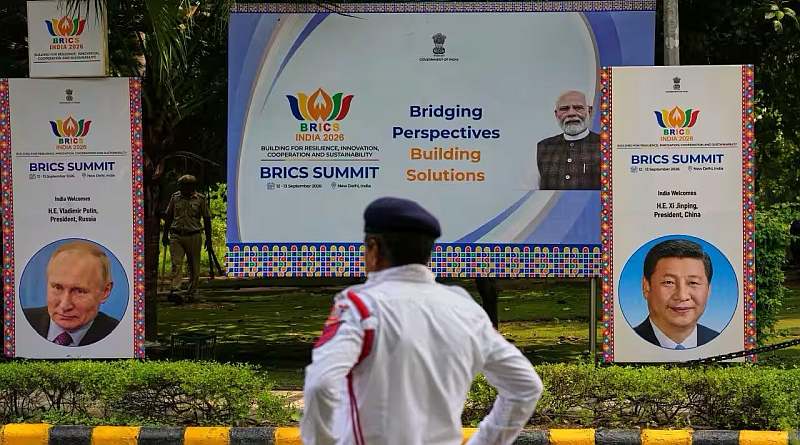

The current BRICS summit in the Indian capital clearly demonstrated the deep political divide, which is gradually intensifying between a confrontation-driven Moscow and the pragmatic leaders of the Global South. While the Russian leadership tries to turn the developing economic union into an ideological battering ram against Washington and Brussels, key participants of the bloc openly prefer to maintain a beneficial balance in their complex foreign policy strategies. The growing dissatisfaction of pragmatic Indian and Chinese BRICS members with Putin’s behavior is becoming increasingly apparent.
Full-scale hostilities on Ukrainian territory are disrupting global logistics chains and provoking a serious inflationary crisis that threatens the food security of many developing countries. China is extremely interested in maintaining stable relations with European and American markets since the economy of the Celestial Empire is currently experiencing less-than-ideal times. Beijing diplomats are striving to avoid direct and secondary sanctions that could inflict irreparable damage on the national banking sector.
India is actively expanding its technological and defense cooperation with Western countries as New Delhi aims to strengthen its position in the Asian region with direct support from American investments.
There is a total fatigue among partners from Vladimir Putin’s continuous aggressive rhetoric, who regularly forces the global community to react to endless threats of force. Developing countries need predictable global trade, whereas the Kremlin’s discourse constantly revolves around total confrontation and conflict escalation.
This difference in priorities leads to an obvious cooling of relations. Participants arrived at the summit hoping to discuss investment projects, but instead of a constructive dialogue, they received another dose of Putin’s intimidation.
The pinnacle of diplomatic dissonance came with the harsh statements of the Russian president, which he voiced following high-level meetings. Putin addressed journalists after the BRICS session and said: “Do they want to revise the outcomes of the Second World War? What are they pushing their countries towards now? Towards a war with the Russian Federation? Now they are talking about considering how to deploy troops to Ukraine. This step means war with Russia.”
Such ultimatums are rejected by Chinese and Indian representatives, who rely solely on diplomatic solutions to the prolonged crisis situation.
China is consistently promoting its own peace plan, which involves preserving the sovereignty of countries and an immediate ceasefire, while the Indian leadership constantly emphasizes the necessity of resolving any international disputes exclusively through negotiations. Russia’s BRICS partners categorically refuse to build barriers between themselves and leading Western economies, as complete isolation contradicts their fundamental national interests.
Russia is gradually finding itself in political isolation, even within the BRICS bloc, which was originally created for equal cooperation and the strengthening of a multipolar world. Chinese authorities prefer to play a subtle game, where they utilize Russian cheap energy resources, but at the first risk to their own corporations, they distance themselves from the contentious neighbor.
India buys Russian oil at significant discounts, yet it refuses to support the Kremlin’s destructive political demarches. The Global South views BRICS as a platform for reforming financial institutions, rather than a military alliance for confrontation. Endless war repels those partners on whose unconditional support Moscow was counting.
