
In early October, “Ukrainian Pravda” reported that the team of the new Commander-in-Chief submitted to the NSDC a document referred to in the media as the “war plan.” What could it be?
In Ukraine, the Defense Plan of Ukraine, the Strategic Plan for the Use of the Armed Forces and other Defense Force components, operational plans, and plans for the use of defense forces and assets are developed as stipulated by the Law “On Defense of Ukraine.” There are also other strategic documents that define the development of the state’s defense capabilities.
This raises a logical question: what exactly has the Commander-in-Chief’s team prepared? Is it a document that clarifies the order of troop deployment, suggests a change in strategic approaches to warfare, or defines new priorities for the development of the Armed Forces?
The mere fact of preparing a document that outlines the vision for the army’s future actions could be positive. An army engaged in a prolonged war needs a coordinated vision of its goals, methods of troop deployment, capability development, and resource utilization.
However, its content has not been disclosed, nor is there any information about its legal status, development procedure, or expected results, so we practically do not know what to assess.
If it concerns a document intended to change approaches to army deployment, it is essential to understand how it correlates with existing plans, who will approve it, and what decisions are necessary for its implementation.
I do not deny the necessity of reviewing plans during wartime. On the contrary, they must correspond to the real situation, available resources, and the enemy’s development prospects. But strategic planning is not merely about preparing a new document. It is a coordinated system of goals, decisions, resources, responsibility, and control over execution.
Therefore, until the document’s name, status, and content are known, assessing its quality is premature. It is first necessary to understand what specific problem it is meant to solve and its place in the state’s defense planning system.

The Commander-in-Chief must ensure the strategic planning of the use of the Armed Forces and the designated forces and means of other defense components according to his powers. However, the development of military plans should not be confused with the approval of national defense planning documents, for which the law establishes separate procedures and the competence of the relevant authorities.
Thus, the preparation of a strategic document is necessary, but the mere fact of its existence is not proof of the quality of strategic planning. To assess it, one needs to understand what specific problem it solves, what solutions it offers, and how its provisions will be implemented.
Media reported that the “war plan” discusses, in particular, the advisability of military personnel remaining on the front line, where some of them perform observation and reconnaissance functions but at the same time have limited opportunities to engage in battle directly. This is likely one of the proposals to solve the problem of mobilization in Ukraine or at least the problem of staffing the Defense Forces with personnel.
In a prolonged war, the army must constantly review its approaches to the employment of forces, use of human resources, reserve training, unit rotation, technological development, and defense organization. At the same time, any plan must be realistic. It should consider the current number of personnel, their level of training, logistical resources, defense industry’s capabilities, volumes of international assistance, and the nature of the enemy’s actions.
However, without the document’s text, one cannot assert that its main goal is solving the mobilization issue.
It is worth separately considering the reports on the advisability of military personnel remaining on the front line, even if some of them primarily perform observation functions and have limited opportunities to engage in battle, which is somewhat strange. I suppose this may be one of the proposals for more rational use of personnel. On the other hand, there are understaffed brigades holding defense lines larger than their real capabilities, making them unable to create proper tactical densities. The defense appears as a series of separate strongholds, often without firefighting and tactical connection; the same observation points cover the gaps between to prevent enemy infiltration. No document can change this.

However, one cannot assume that servicemen performing observation tasks are unnecessary on the front line. Such tasks can be critically important for the resilience of defense, timely detection of the enemy, and preventing attacks. Certainly, these capabilities can and should be enhanced by technical reconnaissance means.
Therefore, the question should be posed differently: does the current organization ensure task execution with the least justified losses, and are human resources used according to their training and functional purpose?
As for mobilization, this can indeed be part of a broader problem. Ukraine must find ways to reduce the unproductive use of trained personnel, establish troop rotation, and lessen the burden on people who have been performing tasks on the front line for a long time.
But it should not be expected that changing the distribution of functions will automatically solve the mobilization issue. This is just one of the possible tools, which should be combined with reserve training, improving the staffing system, retaining experienced servicemen, and implementing technologies.
The main criterion of such a plan is not the formal reduction of the number of people on the front line, but the enhancement of defense efficiency, preservation of personnel, and rational use of available human resources against the backdrop of integrating automated technical systems and reconnaissance means.

One should not forget about the important aspect – democratic civilian control. The Armed Forces are not an autonomous institution that independently determines the state’s policy in the defense sector. Citizens and civil society have the right to ask by what criteria personnel changes are conducted, what outcomes are expected from reforms, how defense resources are used, and whether management decisions meet the state’s interests. This should not be seen as civilian interference in military management; it is normal democratic control.
Do not go with “give him 100 days,” a preliminary assessment can already be made. However, it is necessary to distinguish between the evaluation of declared intentions, management decisions, and actual results. Almost three months is sufficient to see the initial priorities of the new leader but insufficient for final conclusions on the effectiveness of his work.
However, I would suggest evaluating these steps not so much from the perspective of their novelty but from the standpoint of the Commander-in-Chief performing his direct duties. This involves ensuring the Armed Forces are ready to perform tasks, effectively managing troops, organizing training, properly using available forces and resources, and developing army capabilities.
Today, only three areas attract attention: the review of the General Staff’s personnel work, an attempt to change the distribution of functions between military management bodies, and the preparation of a document that we discussed above.

My main criterion for evaluating Drapaty is whether the military command system will become more effective, whether the commanders’ capabilities will increase, whether losses will decrease, whether the units’ supply will improve, and whether the army will be able to use existing resources more effectively. These are the metrics by which the Commander-in-Chief’s performance should be assessed, not by the number of reorganizations.
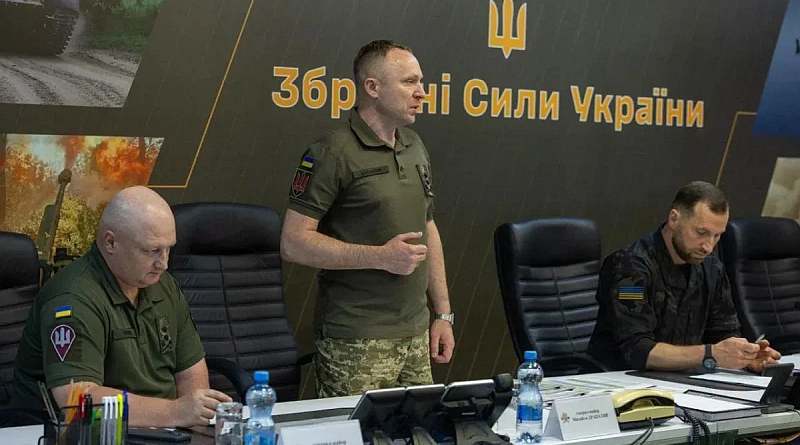
Featured: Chief of the General Staff Ihor Skybyuk, Commander-in-Chief of the Armed Forces of Ukraine Mykhailo Drapaty, and Defense Minister Yevhenii Khmara (right). Photo: Ministry of Defense of Ukraine
