
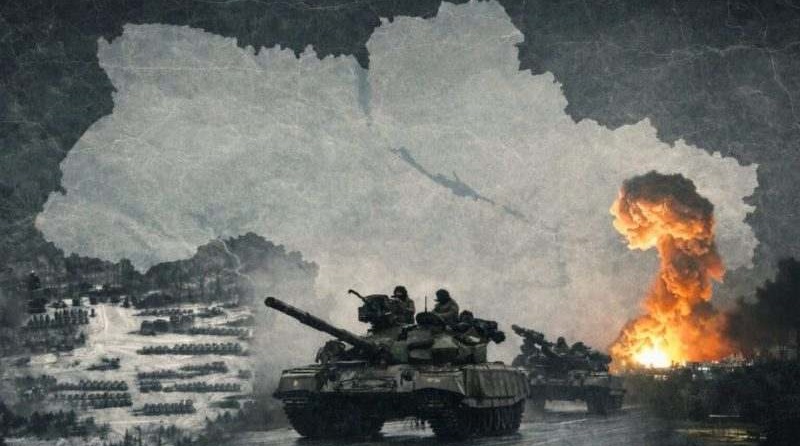
The Russian-Ukrainian war became the first major war on European territory without precedent since World War II and is already part of human history. This is a history not only of events, facts, and the number of casualties.
It is also the history of the people who were behind it and who do not yet know they are there, in history—relentless to human feelings.
However, today this history is only being written. It will be reread and studied much later, in about 50 years, when the last witnesses of all that happened will themselves pass into history, allowing others, with a cold mind, to draw conclusions and never repeat mistakes. To allow entry into history, not to stumble into it.
Since it is precisely those mistakes that led to this war, prevented its timely ending, and most importantly, did not foresee its consequences.
This is not just a war that changed many things. It fundamentally changed the main thing—the world order, under the applause of senselessness and oddity. The world order that our grandfathers built with their own blood more than 80 years ago, and which we, those who still read books, lacked the strength to preserve.
This is a war that, like the Second World War, started due to the cowardice of those who were not being killed at that moment. They thought the best thing was not to disturb the beast.
This is a war that could have ended with much fewer losses, but those same people who feared the beast wouldn’t quench its appetites and might attack them too, pretended those weren’t their red lines. Because the main thing was to avoid a nuclear war.
A war that eventually became a theater of sympathy for the daily murder of an entire nation, suffocating in its own corruption.
And most importantly, this is a war that handed itself over to marketers and businessmen who, through misunderstanding and lack of strategies, only fuel its fire with quick profits, boasting more and more about the rapid development of technological progress.
A war that surprised because progress exists not to form outlines of its ending, but precisely for its continuation. Because for some, it’s the confidence that it doesn’t concern them, and for others, a way of life and earning.
A war where strategy and global decisions remained in history amid its very escalation. And yes, history will not forgive this, because behind all this are people, not machines.
This is what the current war is for the history of humanity.
However, speaking precisely about progress as the path to victory and ending the war, it is necessary to remember: in military affairs, there is a science that has historically been built and continues to be based on patterns, regardless of TikTok content. It’s a pity that the understanding of this is increasingly, due to the same progress, becoming available to a narrow circle of people, and we cannot reach those whose strategy is only views on social networks and another sensational news.
The very end of the Second World War determined two important things that will also be characteristic of the end of this war, which is inexorably gaining momentum.
The end of the Second World War determined the place and time for the next war to begin, as well as the forms and methods by which it would start. While the first is merely a repetition of mistakes by politicians and their voters, the second undeniably belongs to scientific and technological progress, which will inevitably exploit these mistakes.
Thus, the beginning of expansion and the recreation of the Russian empire started as a war, in many ways similar to the great conflicts of the 20th century, relying on the experience of the Second World War. There is nothing surprising or illogical in this, except that it could have been prepared for—if only to avoid it, albeit briefly.
In the summer of 2023, as military operations on Ukrainian territory became massive and required survival on the battlefield, the wheel of progress, which had been stagnant for nearly 80 years, began to turn.
My initial thoughts about this in the fall of 2023 provoked political accusations within Ukraine itself and absolute misunderstanding from representatives of the former leading armies of the world.
Today in Ukraine, it is politically and financially advantageous to move away from trading behind curtains and become representatives of technology. Those who, just three years ago, built their claims against me now assert that technology is their only correct decision.
Every arms exhibition today resembles a scene from science fiction movies and a museum of past wars at the same time. However, back then, everyone thought differently. Except for progress, which was gaining momentum and waiting for a new empire to tame it. Unfortunately, it didn’t happen that way.
Progress became available to our enemies as well, just as it did nearly 100 years ago—from Verdun and the Somme to Robotyne and Bakhmut. There is nothing alarming in drawing this analogy.
As the front stagnated, it rekindled not industrial, but technological horrors.
Once again, nothing surprising happened in the development of military art. It remains surprising only that, like in 2023, using these patterns is still politically disadvantageous for us and financially impossible for the former leading armies of the world.
It was once the case with cavalry and the famous red trousers of soldiers from one army before World War I, which were meant to help against magazine rifles, machine guns, long-range artillery, and the use of smokeless powder, which was invented there as well, and later—against tanks and aviation. How that ended, my generation knows.
And today, the current illusions of collective security, like that soldier over 100 years ago in the dark blue coat and red trousers, despite being an obvious target on the battlefield, are unfortunately almost perceived as a national symbol and national pride.
This war, of course, has changed its forms and methods, but its essence remains unchanged. It is an act of violence, but now violence against an entire country.
Violence that, like in the Second World War, puts an infantryman, who physically can no longer leave his trench, and a newborn baby in another part of the country on equal ground. Because they are both under the constant aim of someone who wants to kill them both.
Today’s war technology is just like that; it turns the entire country into a vast wasteland, sparing no one—neither the one in the trench nor the one in a peaceful place in the supermarket. Everything is as before, but the process of bombing has become different, more efficient, and as a result, excessively cruel.
Do those who move tanks and artillery closer to the crisis area understand this? Probably not. The red pants haven’t taught them anything.
This is no longer a drone war. Someone is off by about three years, thinking about drones. They no longer exist on their own. They have transformed into more familiar types of weapons for us, however, reducing cost, availability, and increasing efficiency.
It is correct to consider that in 2026, there is a war of technologies and not only that. It’s also a war of strategies and doctrines, constantly changing under the pressure of progress.
Therefore, it is a big mistake to focus on specific technologies and their promotion only as weapons that complement Soviet strategy and, of course, require Soviet performers. Weapons that need to be manufactured in time and profitably sold, and even better to deoccupy at least some territory.
The desire to deoccupy territories and hold them with Soviet methods and strategies, just with new weapons, has driven mobilization into a dead end. Mobilization gave only one chance, which fewer and fewer people wanted to take. Because we cannot endure a machine war with a large Soviet country where people are essentially turned into machines and sent to fight against real machines. Damned marketing that kills.
It is necessary to recognize technologies as a new weapon, to recall the patterns of military art development and necessarily form new forms and methods of their application. Only after this can organizational changes be made in the structure of the Armed Forces, which use this new weapon in new forms and methods.
It is precisely here that mobilization is a part of the new strategy, based on new weapons and indeed new, not Soviet, forms and methods of application.
Thus, only in this way can mobilization be improved and, importantly, create systematic pressure and advantage over the enemy. Of course, today this requires time. These changes are absolutely irreversible and concern warfare at all levels: tactical, operational, strategic, as well as the construction of the military-industrial complex.
Logically, all of this inevitably leads to the emergence of a word that seems strange to some today – doctrine.
It is the doctrine that is the basis of systematic influence on the enemy and forms the strategy of vision for future victory.
Who do we see this systematic influence from, and who is closer to their victory today – the question remains politically correct and open. However, it’s quite obvious that this can be assessed in Ukraine through the scale and systematic nature of strikes and the duration of air raid alerts. And the frozen front certainly cannot reassure those who see it only within operational zones.
It’s a shame that many still do not realize (or perhaps do not want to realize) the scale of these changes. But this in no way can stop scientific and technological progress and the evolution of military art.
The old rules no longer apply. This is demonstrated daily by the Russo-Ukrainian war and will inevitably be demonstrated by any new major conflicts that will flare up amid the reformatting of the old world order.
The issue of adapting to new conditions, such as increasing potential and availability of means of destruction, the implementation of robotic systems and artificial intelligence, protecting logistics and ports, effective and continuous communication, space technologies, the digital dimension of security, as well as changing the preparation of personnel in accordance with the requirements and challenges of the new war –
These are problems that no longer stand before the armies of countries, since they must be prepared by default. These are problems for governments and alliances that need to unite around technologies that protect their own future.
Modern warfare requires new doctrines. Observing rapid scientific and technological progress and the inability to create these doctrines is so shortsighted that it is unlikely to allow us to shed the same old red pants and see the future. Some still think they can form a truly effective doctrine for the use of drones and robots, while others think it’s impossible.
Meanwhile, a technology war is already underway, and Ukraine is already feeling the systemic pressure that results from the implementation not only of technologies but also of a new doctrinal approach to their application, including production and research as an integral part of the strategy. This is what gives Russia the right to issue ultimatums to us through well-known intermediaries.
This is directed and can lead to a whole series of crises. Despite the fact that in a warring country some still find it funny, most do not need an explanation of what crises exactly. Let me remind you that a war of attrition is not only about battles but also societal fractures. The main thing is who causes them first.
And if this is obvious, then why do the laws of war again give way to forecasts, and strategy to marketing? Because recording general trends for approximate forecasts is precisely what behind-the-scenes marketing needs.
Quickly and a lot. However, whether this creates systemic pressure on Russia, or increases Russia’s systemic pressure on us, remains unanswered, although the paths to understanding are more than obvious.
Therefore, to find a way out of an absolutely predictable situation, there is a need to understand and implement a truly systemic response to Russia’s pressure. This systemic response should be based on building a strategy where joint production and implementation of new technological solutions become part of systemic steps both for protection and for influencing Russia’s ability to continue the war.
For this, of course, the search for resource and technological alliances capable of ensuring this production remains relevant, including to satisfy their own defense needs. This production must be doctrinally included in the part of the victory strategy, where not a magical sample of weaponry is produced, but the entire necessary new arsenal, including for civilian purposes in accordance with the conditions of progress.
Ukraine and Russia have turned into real-time test grounds. Therefore, analyzing and understanding this new logic of war should help not only to form new doctrines, tactics, and strategies, but above all, to provide a vision of how to maintain peace and calm for people while we pay for it with our blood, we Ukrainians.
