
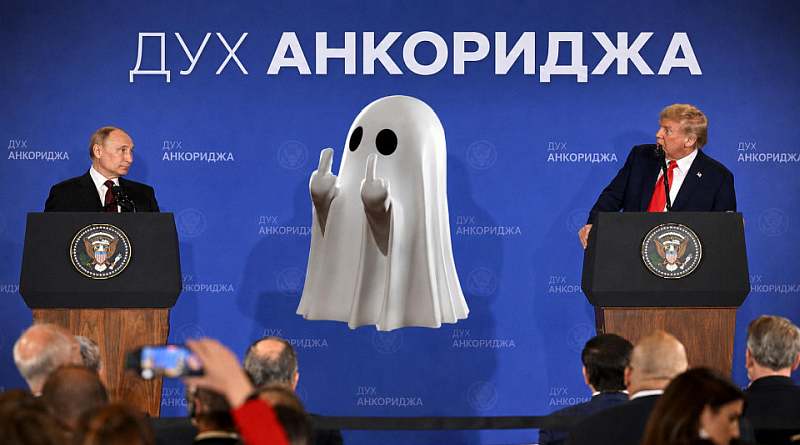
While official Moscow increasingly refers to the “spirit of Anchorage,” claiming that the framework for agreements to end the war in Ukraine already exists, U.S. Secretary of State Marco Rubio categorically refutes these statements. A fierce diplomatic battle has unfolded over what really happened during last year’s summit of U.S. and Russian leaders, Donald Trump and Vladimir Putin, in Alaska, on which so much depended.
Speaking to journalists during a visit to Bahrain, U.S. Secretary of State Marco Rubio directly refuted the coordinated wave of statements by high-ranking Russian officials that an informal agreement on Ukraine was reached at the Anchorage summit (Alaska) in August 2025.
“There was no agreement in Alaska. A proposal was made in Alaska, but there was no agreement,” Marco Rubio told a Radio Svoboda correspondent on June 25. He directly added, “If an agreement existed, the war would already be over.”
This dispute touches on the very essence of Moscow’s current position in the negotiations. For several days, the Kremlin has tried to portray the personal meeting between U.S. President Donald Trump and Russian President Vladimir Putin as a diplomatic turning point.
Rubio’s sharp refutation is the most categorical so far from the U.S. – and carries particular weight since the Secretary of State was personally present in the meeting room with the Russian delegation.
“Awkward” definitions and unwritten “agreement”
Rubio’s account confirms that substantial peace terms were indeed discussed in Alaska. However, the Secretary of State emphasized that they did not result in a bilateral agreement.
When asked about the nature of those negotiations, Rubio pointed to Moscow’s maximalist territorial claims. “Russia wants the entire Donetsk region transferred to them, among several other issues they raised, but there was no agreement,” the Secretary of State said in an interview with Radio Svoboda.
The Kremlin, however, came with its version of events. On June 26, Russian Foreign Minister Sergei Lavrov responded to Marco Rubio, presenting a detailed – and radically different – reconstruction of the summit. According to Lavrov, Vladimir Putin carefully reviewed a series of American proposals that Trump’s envoy Steve Witkoff brought to Moscow a few days before the summit. Lavrov claimed that in Alaska, Putin went through them with Witkoff point by point in the presence of Trump and Rubio, and that Witkoff confirmed them.
“Therefore, when my colleague Marco Rubio says that there were only proposals in Alaska, but no agreement, the question arises of what we actually understand by the word ‘agreement,'” Lavrov said in written responses to the media. “If one side – in this case, the U.S. – brought their settlement proposals for discussion…, and the other side expressed their agreement with these proposals, then claiming there was no agreement seems rather inelegant.”
Diplomats and seasoned observers of the situation in Russia view Lavrov’s rhetorical twists as a classic deception strategy.
Putin Himself Recognized the Russian-Ukrainian Borders of 1991
Daniel Fried, former Assistant Secretary of State for European and Eurasian Affairs who served in seven U.S. administrations, noted that Moscow is attempting to create a diplomatic advantage out of nothing.
“The Kremlin seeks to gain diplomatic benefits at a moment of Ukraine’s military successes by claiming an agreement that apparently was never achieved,” Fried said in an interview with Radio Liberty, praising Rubio for “warding off this blow.”
Fried also pointed out the glaring double standards manifested in Moscow’s sudden reverence for unwritten agreements allegedly reached in Alaska.
“It is amusing that the Kremlin claims a deal without a document. Yet they ignore a document – the Russian-Ukrainian treaty, concluded when Putin was already president, confirming the Russian-Ukrainian borders of 1991. Putin himself signed this treaty,” Fried emphasized.
Chasing Phantoms
The roots of the negotiation failure in Anchorage may lie in the “self-made diplomacy” that preceded the summit.
Glen Howard, an experienced Russia specialist and president of the Saratoga Foundation, suggested that earlier individual meetings in Moscow between Vitkoff and Russian officials, held without U.S.-provided stenographers and translators, gave Putin the false impression that Washington was ready to pressure Kyiv to relinquish Donbas.
Howard stated that, in his opinion, these expectations were shattered in Alaska. “Trump had a prepared lunch, but they couldn’t come to an agreement, and he wasn’t going to betray Ukraine,” Howard said in an interview with Radio Liberty. He cites this detail – the sudden change in the meeting’s agenda – as evidence of how abruptly the summit collapsed.
According to the expert, the meeting in Alaska was significant not for what was allegedly agreed upon, but for what was not. Howard also claims that the White House’s position seems to have changed since then: from territorial concessions by Ukraine to a ceasefire preserving the current front line situation. If true, this would mean a serious strategic shift. Radio Liberty reached out to Steve Vitkoff for comment but received no response by the time of publication.
Washington and Kyiv now maintain a unified stance on a ceasefire with the freezing of the existing line of contact. The issue of the phased withdrawal of Ukrainian troops from the part of Donbas they hold, which Russia insisted upon, has been removed from the agenda.
These stricter diplomatic positions coincide with noticeable changes on the battlefield. Armed with new Western equipment, including F-16 fighters equipped with modern precision-guided bombs, Ukraine is systematically striking Russian defense infrastructure, oil refineries, and vital logistical corridors like the R280 highway, threatening to isolate occupied Crimea.
Ukrainian President Volodymyr Zelensky recently informed Western leaders that strikes deep into the territory are actively shifting the balance of power in the war. This is supported by reports of defensive measures by Moscow’s concerned ally, Belarusian leader Alexander Lukashenko.
In conditions where Russian military logistics face serious problems, Moscow’s insistence on the non-existent “spirit of Anchorage” appears more as a political spectacle for the internal audience rather than an invitation to negotiations.
Paul Goble, former special advisor to the State Department and a CIA analyst, believes that this rhetoric aims to protect the Kremlin from internal discontent caused by the growing number of casualties and drone strikes on Russian cities.
“I think Putin is creating a narrative in which he can claim that Russians need to mobilize because the West has once again betrayed Russia, to defeat Ukraine and be ready for confrontation with the West,” Goble said in an interview with Radio Liberty.
According to him, the Kremlin likely views the period before the upcoming U.S. midterm elections and the State Duma elections as a critically important moment for action.
By rewriting the history of the summit in Alaska, Moscow creates an opportunity to completely shift the blame onto Washington in the event of the final collapse of diplomacy, analysts believe. On the information warfare stage, the battle of interpretations over what happened in Anchorage no longer boils down to diplomatic maneuvers – it’s about creating a foundation for what comes next.
