

Information on current losses of Russia due to sanctions as of 01.10.2026.
1. Russia plans to sharply increase government borrowing to cover the budget deficit and record military expenditures.
– In 2027, the Ministry of Finance intends to issue government bonds worth 7.3 trillion rubles — 2.3 trillion more than stipulated in the current three-year budget.
– The domestic borrowing plan for 2028 is increased by 1.3 trillion rubles — up to 7.4 trillion, and for 2029, 8 trillion rubles is planned. The net debt attraction plan for 2026 is also raised by 1 trillion — up to 5 trillion rubles.
– According to the Ministry of Finance calculations, the national debt of Russia at the end of 2026 will reach 46.1 trillion rubles, or 19.9% of GDP. In 2027, its share will increase to 21.7% of GDP, and by the end of 2029 — to 24.1%. This will be the highest level of Russia’s debt since 2002.
– Since 2024, the national debt has already increased by approximately 19 trillion rubles.
2. Profits of Russian companies in January–July 2026 fell to a minimum since the pandemic.
– According to Rosstat, the total financial result of business amounted to 13 trillion rubles — 15.7% less than the previous year, and considering inflation, real profits decreased by 21%.
– Compared to 2021, the last pre-war year, profits over seven months decreased by 44%. Profits of companies that remained profitable decreased by 5.3% over the year, while losses of unprofitable enterprises increased by 25.6%.
– The share of profitable companies decreased to 66.6%, meaning almost a third of enterprises operate at a loss. The last close indicator was in 2020 — 65.7%.
– Businesses are simultaneously pressured by high inflation, rising costs, expensive loans, high wages, and tax burden. Due to falling profits, companies find it increasingly difficult to finance investments from their own funds, while borrowing remains expensive.
3. Russian grain exports via the Baltic and Arctic remain far less than those via the Black Sea.
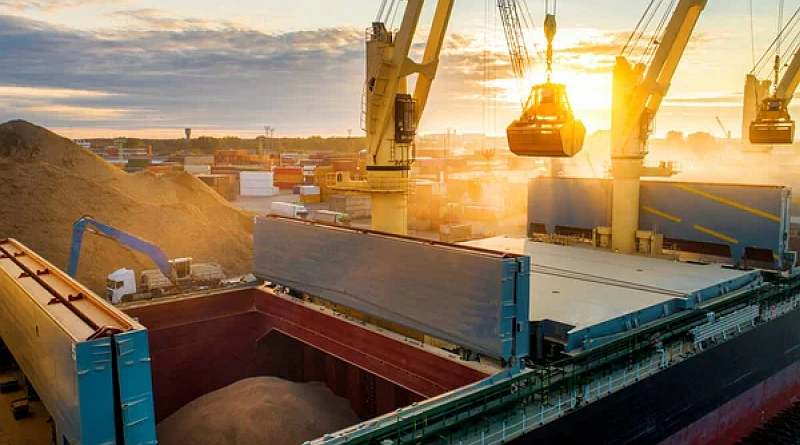
– Russia is attempting to redirect grain exports to ports in the Baltic and Arctic regions after Ukrainian strikes in the Black Sea region, but alternative routes are not yet yielding the expected results.
– Only about a tenth of the volumes that passed through the main Black Sea ports are being shipped through these routes. According to the consulting company Kpler, five main alternative ports increased transshipment of grain and oilseeds to about 1.3 million tons during the peak season from July to September.
– Meanwhile, during the same period, Russia’s main Black Sea ports can handle about 12 million tons. Russia could potentially export up to 3 million tons of grain per month in the second half of 2026, but quickly doubling these volumes through alternative routes is impossible.
– One of the main problems is the high cost of delivering grain from Russia’s southern regions to northern ports. According to two sources, from September 1 to 22, daily volumes of agricultural products loaded from southern Russia to the Baltic ports of Ust-Luga and Vysotsk increased by 465%.
– Black Sea ports have the advantage due to their proximity to major exporters and large buyers of Russian grain in Africa and the Middle East.
– Redirecting cargoes through northern ports or the Far East increases voyage durations and transportation costs. An additional issue is the lack of infrastructure for storing and transshipping grain. From October, Russia plans to use the Arctic port of Murmansk, the fourth largest in the country, for exports. However, Russian exporters believe that additional state subsidies will be required for the economic viability of this route.
– Creating new infrastructure will also require significant costs. In particular, the construction of a new grain terminal in Vladivostok could cost about 25 billion rubles. With winter approaching, urgent construction work will be harder to carry out.
4. Exports of Russian diesel fuel and gas oils through the Black Sea dropped to zero for the first time during the week ending September 24.
– Just a week earlier, 66,000 tons had been shipped from Novorossiysk, and in 2025, Black Sea ports were sending an average of about 200,000 tons of such fuel weekly.
– Total weekly sea shipments nearly halved to 81,000 tons, with all volumes shipped through the Baltic port of Primorsk to Morocco and Venezuela. By this time this month, Russia had exported 448,000 tons compared to 535,000 tons in August and 713,000 tons in July.
– At the same time, for the second consecutive week, Russia imported about 40,000 tons of light oil products from the Moroccan port of Tanger-Med. This indicates increasingly serious problems in the Russian fuel market: a country that was traditionally a major diesel exporter is being forced to increase imports.
5. Exports of Russian goods to Turkey in August collapsed by almost 41% for the month—from $3.23 billion to $1.93 billion.
– This is the lowest indicator since 2022. The decline occurred due to disruptions in the operation of Russian ports in the south after Ukrainian attacks, which sharply reduced Russia’s ability to export goods by sea.
– In August, Russia completely halted grain supplies to Turkey, and coal exports fell from 2.1 million tons in July to 1.5 million tons. Supplies of ferrous metals, copper, and automobile fuel also decreased.
– The flow of goods through southern Russian ports in August “practically fell to zero.” Some shipments in September had to be redirected to longer and more expensive overland routes through the Caucasus or through ports in the northwest of Russia.
– As a result, Russia is losing export revenue, and its companies are forced to bear additional logistics costs. Turkey is one of Russia’s largest trading partners, so the reduction in supplies means direct losses for Russian exporters.
6. Russia sharply increased its use of the Northern Sea Route for transporting oil and liquefied natural gas.
– During two months of the navigation season until mid-September, the Norwegian environmental organization Bellona counted 50 oil tankers and 18 gas carriers that passed along this route. For all of 2025, there were 38 and 13, respectively.
– About three-quarters of these vessels are under sanctions. 26 tankers had an ice class of Ice3 or lower or had no ice class at all, and 33 vessels were at least 15 years old. This increases the risks of accidents and oil spills in the Arctic.
– At least 14 tankers were heading to China and other Asian countries, and at least 11 gas carriers were delivering Russian Arctic gas to Chinese buyers.
– Due to sanctions and complications of traditional routes, Russia is increasingly using the Northern Sea Route to support energy exports and bypass restrictions.
– Meanwhile, since last year, the administration of the Northern Sea Route has stopped publishing reports on incidents involving vessels, complicating the assessment of transportation safety in the region.
7. Estonia has banned the transit of Russian and Belarusian grain through its territory. This was announced on October 1 by Estonia’s Foreign Minister Margus Tsahkna.
– The decision posed an additional problem for Russian exporters, who started reorienting supplies to the Baltic Sea after Ukrainian strikes on ships and grain terminals in the Black and Azov Seas.
– Russia tried to export some grain through the Baltic countries as an alternative route. It is estimated that in September, the transshipment of Russian grain through Baltic ports could have increased to 400,000 tons compared to 250,000 tons in August. Now this route for Russian shipments through Estonia is closed.
– Due to attacks on Russian ports and terminals in the Black and Azov Seas, Russia is seeking alternative routes for grain export. Before the attacks, these ports provided up to 70% of Russia’s grain exports.
8. The UK has imposed new sanctions against Russia and its shadow fleet.
– The United Kingdom has introduced 31 new sanctions against Russia, targeting the shadow fleet, pro-Kremlin disinformation networks, and individuals involved in repressions against Ukrainian civilians and the militarization of children.
– The restrictions apply to 23 individuals and entities and eight vessels. Among them are three shadow fleet vessels, two bunker supply ships, and three Russian ice-class vessels. The British government noted that some of these vessels were acquired by Russia quite recently, in July 2026, in efforts to circumvent sanctions.
– Separate sanctions have been imposed on individuals whom the UK accuses of arbitrary detentions, torture, and mistreatment of Ukrainian civilians in occupied territories, as well as forced ideological indoctrination and militarization of Ukrainian children.
– The list also includes seven individuals, reportedly implicated in pro-Kremlin disinformation according to the UK government, four of whom are citizens of Georgia.
– All 23 individuals and entities are subject to asset freezes and other financial restrictions, along with a travel ban to the UK for individuals. The eight vessels will face navigation and trade restrictions.
9. Swiss bank Julius Baer fined for servicing the Russian elite.
– The Swiss financial regulator FINMA has fined one of the country’s largest private banks, Julius Baer, $300 million due to serious violations of anti-money laundering regulations. The investigation involved the bank’s dealings with clients linked to the Russian political elite and the write-off of $700 million in loans following the bankruptcy of the Austrian group Signa.
– FINMA established that Julius Baer insufficiently verified the origin of assets from clients connected to two Russian politically exposed persons (PEP) over several years, violating anti-money laundering requirements.
– Separately, the regulator examined the bank’s $700 million loan write-off following Signa’s bankruptcy, founded by Austrian billionaire Rene Benko. The investigation concluded with sanctions against Julius Baer for violations of financial control requirements.
– The case pertains to a period when the bank served clients linked to the Russian elite, with insufficient verification of the origin of their assets.
