
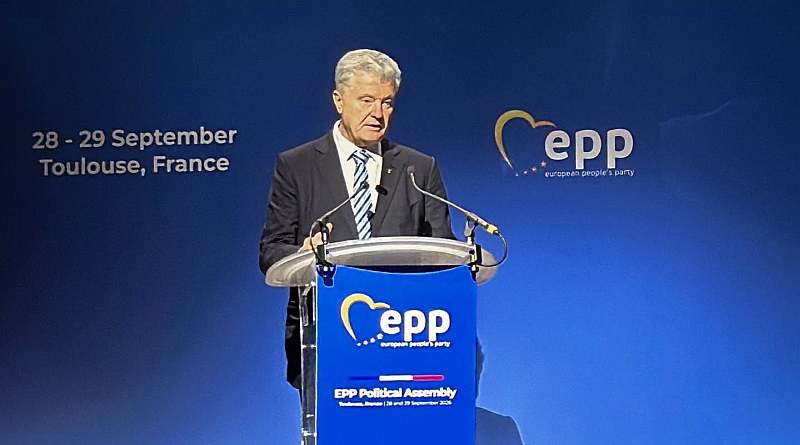
Here in France, it is truly cozy and peaceful. But in Ukraine, we are already forgetting what “peaceful” means. Because over the past month, we have seen strike drones destroying our cities every day. This is how he began his speech at the European People’s Party Assembly in Toulouse.
Europe must prepare its industry for war. Russia has the advantage in the scale of military production. It can produce thousands of strike drones and hundreds of missiles. Now that the so-called “elections” in Russia are over, expect even more production buildup. And expect mobilization. The evidence is there: it is reported that Russia has ordered over half a million helmets and hundreds of armored vehicles.
Ukraine has learned to adapt quickly and invent rapidly. Therefore, the question is not just whose technology is better. The question is who can scale up production. To defeat Russia, it is not enough to simply survive. We must remember that we must surpass it in production. And this task is not only for Ukraine. It is Europe’s task. Your task.
Industrial advantage gives us the opportunity to win. And I cannot understand one thing: how is Europe, which is so much larger, richer, and more innovative than Russia, still lagging behind in Russian military production?
Besides this, I see four priorities within which Europe must act:
First — stronger European unity. We need the unity of Europe around common industrial efforts.
Second — stronger transatlantic unity. We need to combine American technologies, European industrial capacity, and Ukrainian combat experience. Together we can create a defense-industrial base with which Russia simply cannot compete.
Third — a weaker Russia. We must weaken its military and economic potential. Stronger sanctions. Less money for Russia’s military machine. The goal is simple: Russia must not be able to outpace us in production. Unfortunately, the latest EU sanctions decision brought what no one wanted to see: relief for some wealthy Russians close to Putin. We are very disappointed. This should not be. Neither now nor in the future.
Fourth — a stronger Ukraine at the negotiating table. The best way to strengthen Ukraine’s negotiating position is to strengthen Ukraine itself. For negotiations with Russia, we have one of the best diplomats in the world. The name of this diplomat is the Armed Forces of Ukraine. Because Putin only understands the language of force. And our Armed Forces have learned to speak to Putin in that very language.
Peace is not created just through international contacts. And not only through large-scale actions in Europe. It is also created by building a stronger European Ukraine.
* * *
A friendly meeting in Toulouse with the President of the European People’s Party, Manfred Weber.
The Russians continue to escalate terror, shelling Ukrainian cities every day. Today there were strikes in the center of Kyiv — terrible devastation, casualties, a blow to Ukrainian science…
I called on European partners for a decisive and strong response. Ukraine needs to strengthen its air defense, primarily by transferring interceptors for the Patriot systems, as well as support in developing measures to counter jet drones.
We also discussed strengthening the sanctions pressure on Russia and its allies. I believe it was a mistake to lift sanctions from several Russian oligarchs for internal political reasons.
We discussed the full confiscation of frozen Russian assets and redirecting them to Ukraine’s needs in this fight.
I also urged our political family to support the fastest possible opening of all negotiation clusters regarding Ukraine’s accession to the EU. Special attention should be paid to reforms in the areas of democracy and the rule of law, combating corruption, and political pluralism.
Thank you to Manfred Weber for consistent support and understanding that the security of Ukraine is the security of all of Europe.

* * *
Ukraine must not only achieve peace but also preserve the state. These two tasks are indivisible. This was discussed at the European People’s Party Assembly in France. And there are only five principles that Ukraine must follow to achieve this goal.
Democracy during war is not a luxury but a value and a source of our strength. This is what distinguishes us from Russia.
Reforms during the war and fighting corruption are not a burden. They are a powerful impetus for resilience, especially in a war of attrition. According to a survey, almost half of Ukrainians believe the country is moving in the wrong direction. And over 50% say that corruption in power poses a greater threat to the country than Russian military aggression.
Unity in war is as important as weapons. We proved this in 2022 and must prove it again, right now. Ukraine needs a coalition and a government of national unity. The nation must be united, which means taking effective steps against corruption, against encroachment on the opposition, and against encroachment on democracy.
The rule of law should not be just a slogan. It must be an obligatory requirement, especially for a country at war. Sanctions against political opponents without any legal grounds are unconstitutional, illegal, and extrajudicial. They are incompatible with the rule of law.
And finally, Ukraine’s movement toward EU membership. Our accession should accelerate but be based on real merits. We need to obtain not just a date of entry but a European Ukraine. The European Union with Ukraine will undoubtedly become stronger due to our implementation of reforms and the building of strong institutions.
The conditions for a fair and lasting peace are created not only on the battlefield. It must all start with a complete, unconditional ceasefire. Stopping the killing of people is our categorical demand to Putin.
The European People’s Party is doing tremendous work helping us build Europe in Ukraine and Ukraine in Europe. This is important today and for future development.

* * *
While working here, things are uneasy again in Kyiv. Ukrainians were shaken by explosions all night. Shaheds and ballistic missiles are still attacking the capital and other Ukrainian cities… Russians are continuously striking all over Ukraine, and I emphasize this to our partners in every conversation.
Thanked the PACE President for the consistent and principled support of Ukraine and her personal involvement in promoting mechanisms for holding Russia accountable for the crime of aggression, including the Special Tribunal, international compensation mechanism, and the return of deported Ukrainian children.
Welcomed PACE’s high attention to Ukrainian veterans and servicemen who were wounded and disabled as a result of Russian aggression, and emphasized that supporting Ukrainian veterans is a shared European responsibility. It is important that PACE recently considered a package of decisions for forming a systematic veteran policy in Europe and supporting Ukrainian soldiers with disabilities.
Also raised the issue of Ukrainian prisoners of war, civilian hostages and support for their families, particularly emphasizing the need to maintain international pressure on Russia for the release of all Ukrainians from Russian captivity, ensuring international humanitarian organizations access to their places of detention, and bringing to justice those responsible for torture and abuse.
I fully share the position of the PACE President that a strong democracy is impossible without a strong opposition. In this regard, I drew attention of Petra Bayr to the continuation by the Ukrainian authorities of the practice of illegal unconstitutional personal sanctions against political opponents and restrictions for members of the Verkhovna Rada of Ukraine in conducting parliamentary diplomacy.
During the meeting, special attention was paid to strengthening Ukraine’s democratic resilience in the conditions of war. In the context of preparing the new Council of Europe Action Plan for the Security of Democracy in Ukraine for 2027-2030, I emphasized the need to prioritize strengthening democratic institutions, independent justice, combating corruption, effective parliamentary control, political pluralism, and media freedom, as well as creating conditions for free and fair post-war elections in Ukraine.

* * *
The war has become completely different and the threat to our peaceful cities has increased. This is evidenced by the recent Russian attacks on Kyiv and the region, Dnipro, Kharkiv, Zaporizhzhia, and other cities. At any moment, the center and west of the country could also be under attack. Now our cities are under constant threat. Every night we see drones and missiles that we fail to intercept or shoot down.
Today I spoke about this to allies in France at the Parliamentary Assembly of the Council of Europe. Everyone must understand that if this is possible in Kyiv today, the Russians could do the same in Europe the next moment.
No one currently has enough weapons alone to counter the new tactics of Russian terror. That’s why effective cooperation in the military-industrial complex is extremely important. Every penny allies invest in the Ukrainian defense industry is not charity. It is an investment in their own security. Advanced innovations and combat experience combined with European industrial capabilities and American technologies can undoubtedly bring the end of the war closer.
The more allies support Ukraine, the weaker Russia will be. The more sanctions they impose, the weaker Russia will be. The more effective funds and weapons they provide Ukraine, the sooner this war will end. Thus, a stronger Ukraine means a stronger Europe.
Ukraine urgently needs air defense, long-range missile technologies, and a rapid buildup of European defense production. I called on allies to achieve stronger and more predictable military support.
There can be no lasting peace without justice and accountability. A special tribunal for the crime of aggression must become a fully functioning body, and the compensation mechanism must move from documenting damages to making real payments.
Democracy during wartime is a resource, not a weakness. War requires strong leadership, but strong leadership does not mean unlimited power. The concentration of power during war should not become a political model for post-war Ukraine. Ukraine needs effective checks and balances, proper parliamentary oversight, genuine political competition, independent anti-corruption institutions, and the rule of law. Elections should be held only when the war ends and when we have a comprehensive, unconditional ceasefire.
Our task is not only to win the war, although that is priority number one. Our task is also to ensure that the Ukraine that emerges after this war is stronger, more democratic, and inherently European.
* * *
One of the main topics of the meeting was the prospects for ending the war and the urgent defense needs of Ukraine on the eve of winter. Emphasized the need for additional air defense systems and missiles, especially interceptors for the “Patriot” and other systems, means of combating drones, as well as the protection of energy and critical infrastructure.
Another important topic was Russia’s responsibility for the crime of aggression, the need for the full launch of the Special Tribunal, the development of an international compensation mechanism, and the execution of the European Court of Human Rights’ decisions regarding Russia.
In the context of discussing the issue of Ukraine’s democratic resilience in wartime conditions, emphasized that democracy, the rule of law, the independence of anti-corruption bodies, effective parliamentary control, ensuring the rights of the opposition, political pluralism, and media freedom are components of national resilience, and martial law must not be used to weaken institutions, pressure political opposition, or limit independent media.
Called on PACE deputies to work more actively with national governments to quickly unblock all clusters within the framework of negotiations for Ukraine’s accession to the EU. Emphasized that the movement towards EU membership will significantly accelerate reforms and strengthen the rule of law and democratic institutions.
Invited representatives of the EPP in PACE to visit Ukraine to personally familiarize themselves with the political and security situation in our country.

* * *
Met with an old friend, Secretary General of the Council of Europe Alain Berset.
Grateful to him for his long-standing and consistent personal support of Ukraine. Especially for his leadership on holding Russia accountable for its aggression against us.
Personally informed Alain about the massive Russian bombings of Ukrainian cities, civilian objects, and critical infrastructure, resulting in the deaths of hundreds of Ukrainian citizens, including children. Obviously, this is absolutely unacceptable. For both of us, holding Russia accountable for its crimes against Ukraine is a fundamental element of any agreement for a just and lasting peace.
The main topic of our conversation was the preparation of a new Council of Europe Action Plan for Ukraine for 2027–2030, “Democratic Security for Ukraine.” Our key task is to withstand this war and emerge as a stronger European democracy. With strong institutions, an independent judiciary, a functioning system of checks and balances, a strong opposition, independent anti-corruption bodies, and real political competition.
That is why I proposed that the new Action Plan must include issues of political pluralism, effective parliamentary control, independence of NABU and SAP, and the completion of judicial and law enforcement reforms.
We separately discussed future elections. My position is clear: elections cannot take place during the war, only after its end. But preparation for free, fair, and safe post-war parliamentary, and subsequently presidential elections should begin now. Adhering to rights, guaranteeing equal political competition, and protection from external interference. The Council of Europe, particularly the Venice Commission, can and should play a leading role in developing the relevant electoral legislation.
It is important to prevent the use of law enforcement and judicial systems for political pressure on opponents. Restrictions on parliamentary diplomacy and unconstitutional personal sanctions against the opposition need to be lifted. War requires strong leadership. But strong leadership does not mean unlimited power and oppression of the opposition and civil society.
I feel very close to Alain Berset’s concept of democratic security. It precisely describes what Ukraine needs: a strong army should rely on strong institutions, the rule of law, and citizen trust.
I highly appreciate the personal contribution of the Secretary General of the Council of Europe in promoting initiatives for the creation of a Special Tribunal on the crime of aggression, the creation of a Damage Register, and in the defense of rights and return of Ukrainian prisoners of war and kidnapped children.
That is why the new Council of Europe Action Plan for Ukraine can become one of the key tools in building a strong, democratic, and European Ukraine.

* * *
| I urged European parliamentarians to quickly initiate debates in the European Parliament on Europe’s readiness for new challenges and large-scale hybrid, drone, missile, and infrastructure warfare from the Russian aggressor in the context of the upcoming winter.
Thanked the European Parliament for urging EU member states to urgently accelerate production and supply to Ukraine of air defense systems, ammunition, drones, and missiles, and to enhance European defense-industrial capabilities. We also talked about Ukraine’s accession to the EU and new formats of our European integration. The negotiation process must move forward, all clusters must open as soon as possible, and the speed of accession should depend on the speed and quality of reforms. |
Convinced that the membership negotiations are one of the most powerful engines of reform in Ukraine.
In this context, we paid great attention to Ukraine’s fulfillment of membership criteria in the areas of democracy, the rule of law, combating corruption, human rights, political pluralism, and free media. Emphasized that democratic resilience is an integral part of our national security, and without a strong opposition, there can be no strong democracy.
* * *
This year, winter started in September. Russia has changed its tactics and now, instead of expensive ballistic missiles, is striking energy with cheap reactive drones. Neither Ukraine nor Europe is ready for this weapon.
The EU’s response to this must be decisive — strengthening the defense industry, weapons for the armed forces and joint investments.

* * *
Next Monday, the European Parliament will discuss the worsening humanitarian situation in Ukraine. I proposed holding this discussion during the morning meeting in the European Parliament, and the MEPs supported me. I thank them for this.
The conversation will address the consequences of massive Russian strikes on critical and civilian infrastructure and the challenges Ukraine faces going into winter. They will separately discuss the humanitarian catastrophe in the occupied Oleshky, as well as how the EU and the international community can further support Ukraine.
Russia is deliberately attempting to weaponize winter against millions of Ukrainians. Therefore, Europe needs to act in advance rather than respond after the fact. This means strengthening humanitarian, energy, and defense aid and helping us protect infrastructure. Then people will have light, heat, and the ability to live normal lives.


