
Lyman Direction
Today’s overview will be more detailed than the one from 16.09.2026. We will add the Borova direction to it.
The scheme is the same:
– Composition of the enemy’s forces and means.
– Current situation.
– Prospects for further development.
1. In this direction, the forces and means of Russia’s “Zapad” military group are active, commonly known as the Moscow Military District (MMD). Specifically, units and formations of the 20th and 25th Combined Arms Armies (CAA). Additionally, part of the forces (troops) of the 1st Tank Army (TA), namely the 4th Tank Division (td), is operating towards Borova, and in the Lyman direction, part of its 2nd Motor Rifle Division (mrd) is likely present — probably units of the 1st and 15th Motor Rifle Regiments (mrr) of this division.
Thus, in the Lyman and Borova directions, the following enemy forces and means are active:
20th CAA:
– 3rd Motor Rifle Division (mrd) — 252nd, 362nd, and 752nd Motor Rifle Regiments (mrr), 237th Tank Regiment (tr), 99th Self-Propelled Artillery Regiment (spar);
– 144th mrd — 254th, 283rd, and 488th mrr, 59th tr, 856th spar.
25th CAA:
– 67th mrd — 31st, 36th, and 37th mrr, 19th tr, 83rd spar;
– 164th Separate Motor Rifle Brigade (smrbr);
– 169th smrbr;
– 11th Separate Tank Brigade (stbn).
1st TA (partial forces):
– 2nd “Taman” mrd — units of the 1st and 15th mrr (Lyman direction);
– 4th “Kantemirov” td — units of the 423rd mrr, and possibly units of the 12th or 13th tr, 275th spar (Borova direction).
Additionally, in this direction, parts and units of the “territorial forces” (TF) of the Russian armed forces and their “mobilization reserve” are quite active. In most cases, they are either integrated into the regular parts and formations of the “Zapad” military group or attached to them as a means of reinforcement. In total, there may be up to 4-5 formations at the “Motor Rifle/Infantry Regiment” level (mrr/ir) and up to 3-4 formations at the “Motor Rifle/Infantry Battalion” level (mrb/ib).
2. Current Situation in the Lyman direction is characterized by the transition of Russian 20th Army troops (forces) to active defense in their sector due to ongoing active counteroffensive actions by the Ukrainian military group operating in this direction, a significant decrease in the intensity of offensive actions by the 25th Russian Army in its sector, and stabilization in the Borivske direction. Specifically:
– In the Boryvska Andriivka — Borova direction, the enemy apparently has not been able to fully take control of Boryvska Andriivka, with their main forward unit occupying advanced positions to the west and northwest less than 1 km from its outskirts.
Meanwhile, rather small enemy infantry groups, which managed to infiltrate from these positions towards Novoplatonivka, apparently control only a narrow strip of forest leading to the road between Borova and Bohuslavka, northeast of Novoplatonivka.
– In the area south of Zelenyi Hai to the village of Nadiya, the Armed Forces of Ukraine (AFU) continue to confidently hold their advanced positions, despite the periodic “intent” of the enemy to advance with the main forces of their forward units towards Stepy — Kopanky. They control the village of Stepy but have not been able to capture the village of Kopanky, located literally nearby (less than 1 km), for quite some time.
– Similarly, Russian troops cannot advance in the directions of Serhiivka — Nadiya and Novoyehorivka — Tverdokhlibove. The AFU continue to hold the territory of both villages (Nadiya and Tverdokhlibove), located within Luhansk Oblast, under their control. However, in the area of Tverdokhlibove, the presence of a single blocked “very small” enemy infantry group is apparently recorded.
– The advanced positions of the Russian troops 3-3.5 km west of the Karmazynivka — Novovodiane line also remain stable, not reaching the administrative border of Kharkiv and Luhansk regions of Ukraine.
– However, further south, apparently, the AFU, after liberating the village of Hrekivka in Luhansk region, managed to push the enemy in the direction of Makiivka by approximately 2 km, and after liberating Novomyhailivka and Katerynivka, the enemy retreated east by 1-1.5 km.
– The AFU also continue tactically successful counterattacking actions along the entire northern face (flank) of the Russian 20th Army’s bridgehead on the Chornyi Zherebets river. They managed to drive the enemy out of the villages of Ridkodub, Nove, and Lypova, as well as reach the northwestern outskirts of the village of Zelena Dolyna and move 2 km south of the village of Nove.
– Also, acting from the line of Serednie — Shandryholove towards Zelena Dolyna, the AFU managed to cross the Nitreus river on a fairly wide front section and advance over 2.5 km to the northeast.
On the very bridgehead, the enemy still holds a number of positions south of Zelena Dolyna and west of the village of Kolodiazi, but considering that on the southern flank of the Russian 20th Army’s bridgehead the AFU have already engaged in battles for the village of Kolodiazi itself, as well as for the village of Myrne, the position of these Russian units remains very vulnerable.
Thus, the distance between the positions of the AFU’s forward units, counterattacking towards each other on the northern and southern faces (flanks) of the Russian 20th Army’s bridgehead on the Chornyi Zherebets river, has decreased from 7-8 km to 5-5.5 km.
– Despite the presence of several residual enemy infantry groups in the Stavky — Kolodyazi — Myrne — Zarichne area (particularly around the village of Stavky), the AFU are already fighting directly in Zarichne around Central Street and a few blocks north of it, having reached the Chornyi Zherebets River north of the village itself.
– South of Zarichne, the enemy continues to hold a significant part of the forest between Yampil and Lyman in their 25th ZVA’s zone. However, not entirely. Apparently, the western part of this forest massif, directly adjacent to Lyman, is not fully controlled by them. Nor is the greater portion of the Lyman-Zakitne road.
Evidently, the main forces of the forward Russian units in this area were forced to retreat from the Dibrova area to the northwest directly into the forest. And now battles are already ongoing along the road from Lyman to the “Patriot” camp beach. Although in the areas of Dibrova itself and the village of Ozerne, some small enemy infantry groups continue to be recorded.
– Regarding the town of Lyman itself, evidently, the AFU have managed to almost completely “clear” it during the reporting period. Except for the eastern outskirts (the intersection of Slobozhanska and Nezalezhnosti streets), where at least one “residual” Russian infantry group (about 5-6 “bodies”) has been recorded in several buildings.
– Fierce battles are ongoing in the 25th ZVA’s zone and in the Yampil settlement area, where the AFU are working to not only hold several positions but also “come from behind” (from the east) on the enemy units operating in the forest between Yampil and Lyman.
These AFU actions are quite logical. The forest area between Yampil and Lyman, mostly under Russian control, serves as a convenient “launching” area for the continued mass infiltration of Russian assault infantry directly into Lyman. By driving the enemy out, the AFU will likely significantly reduce the 25th ZVA’s capabilities in this respect.
3. Regarding future prospects of the situation on the Lyman axis (in an operational-tactical sense), I would highlight two main factors:
– The position of Russian forces on their bridgehead north of Lyman, while “gradually,” is steadily deteriorating. It is evident that the command of the Russian 20th ZVA will have to significantly reduce this bridgehead in the near future. At least due to constant Ukrainian “pressure” on its southern and northern flanks, it will likely be forced to withdraw its forward units east of the Novyi — Stavky road.
– A very noticeable “slowdown” in the assault infiltration of the Russian 25th Army towards Lyman, and in some areas even the retreat of its forward units (for example, southeast of Lyman), could likely significantly impact the situation in the neighboring Russian 3rd ZVA UV “Yug” zone, which is currently trying to break through to the Mykolaivka and Slovyanskaya TPP areas along the southern bank of the Siverskyi Donets.
If the Ukrainian forces manage to completely push the enemy out of the Lyman — Yampil — Ozerne — Dibrova area, the command of the Russian 3rd ZVA will have to deploy part of its right (northern) flank forces west to north to hold the southern bank of the Siverskyi Donets, at least in the Kryva Luka — Zakitne section. This, in turn, cannot fail to impact its ability to continue advancing towards Slovyansk.
Even if the Russian 25th Combined Arms Army does manage to hold a tactical bridgehead west of the Chornyi Zherebets River (for example, from the river itself to the Zarichne – Yampil road), it will still have a “sharply negative” impact on the situation in the zone of the Russian 3rd Combined Arms Army. In this case, Ukrainian forces operating north of the Siverskyi Donets will have an obvious opportunity to counterattack the flank of the 3rd Combined Arms Army, even with very limited forces and resources.
In a broader (operational-strategic) sense, I am referring to the entire Sloviansk-Kramatorsk offensive operation of the enemy. Successful counteroffensive actions of the Armed Forces of Ukraine in the particular Lyman direction do not yet signify its complete and final failure this autumn. The enemy continues to advance on this agglomeration from the east and south (Dobropilskyi, Kramatorsk-Kostiantynivskyi, and Sloviansk directions) quite actively and in some sectors “tactically successfully.” Yes, this is happening quite slowly and with significant losses for them, but they still persist in “creeping forward.”
However, it should be acknowledged that the above-mentioned actions of the Armed Forces of Ukraine in the Lyman direction can evidently create prerequisites for this operational-strategic offensive operation of the Russian troops to “stall,” in addition to the Lyman, at least on one more operational-tactical direction — Sloviansk.
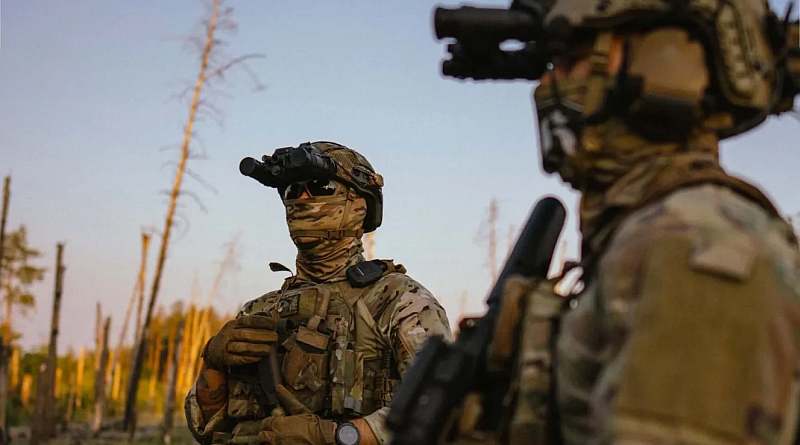
Photo: Third Army Corps
