
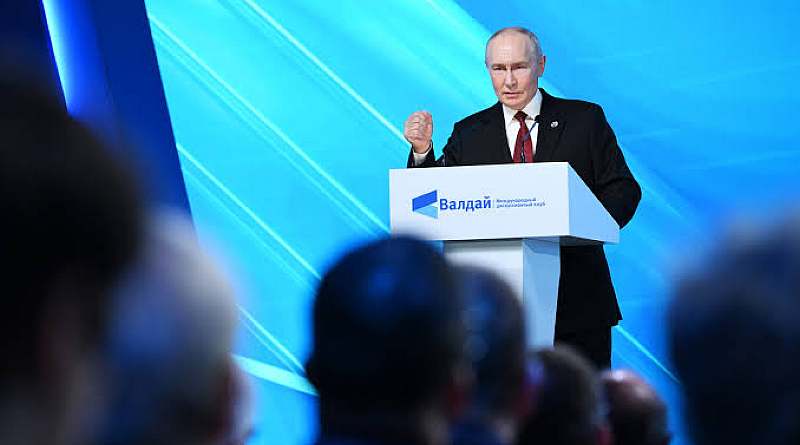

Vladimir Putin’s latest appearance at the Valdai Discussion Club once again demonstrated the deep disconnect of the Kremlin veteran from reality. While the Russian economy steadily sinks into a sea of budget deficits and isolation, and officials boast about a 17% national debt figure, the Kremlin leader continues to broadcast dangerous imperial illusions.
The dictator’s musings on territorial conquests in Ukraine took on a particularly cynical tone, where aggressive appetites are masked by hypocritical statements about the fates of people. As the Russian army wipes Ukrainian cities off the map, an advance of several hundred square kilometers is portrayed as a great achievement, despite being marked only by senseless human casualties and destruction. Assertions about a quick resolution of the Donbas issue reveal an ordinary militaristic psychosis, which has nothing to do with the genuine desire for peace.
The Kremlin’s rhetoric regarding Europe and the U.S. also bristles with cheap manipulations. Gloating over the crisis in the European auto industry and the shift to Chinese cars looks like a blatant attempt to mask its own technological dependence on Beijing, which turns Russia into a raw material appendage of its eastern neighbor. Attempts to accuse Switzerland of losing neutrality only highlight Moscow’s irritation with the civilized world, which unanimously condemned the bloody aggression.
While the Russian leadership continues to issue ultimatums concerning the language policy and religious institutions of a sovereign state, reality relentlessly demonstrates the dead-end nature of the chosen aggressive course. Any attempts by Moscow to dictate the terms of a long-term peace amid ongoing bombings are doomed to failure because the international community no longer believes in the hypocritical promises of Kremlin tribunes.
Additional details of the Valdai declarations reveal another telling feature that Kremlin propaganda diligently tries to obscure with vague discussions of security. When the speaker mentions certain complex decisions by the American administration, which Moscow supposedly considers a step in the right direction, it becomes clear that there is an attempt to bargain for an indulgence for the committed crimes. Such diplomatic maneuvers only confirm the weakness of the aggressor’s position, trying to prolong negotiations for the regrouping of depleted forces.
Attempts to link the cessation of bloodshed with the resolution of issues related to the Russian language and church institutions in a neighboring state are classic interference in the internal affairs of a sovereign country. Such demands serve only as a cynical pretext for continuing armed aggression since the true goal of the Kremlin remains the complete destruction of Ukrainian statehood. While the Russian authorities persistently discuss illusory guarantees, the country’s isolation on the international stage becomes total, and the historical dead end of the Kremlin’s strategy turns into an irreversible process.
