

Information on current Russian losses due to sanctions as of 07.06.2026.
1. On the night of June 7, Ukrainian drones attacked several military and fuel sites in occupied Crimea.
– Two fuel depots in Feodosia and the village of Lenine, as well as a military unit in the village of Sovetsky, were hit. A fire was reported in the area of the Semikolodiazyanska fuel depot in the Lenine district after the attack.
– NASA FIRMS satellite monitoring data indicated the appearance and further expansion of thermal anomalies on the site, which may suggest increased combustion. Reports of explosions also came from the Feodosia fuel depot area.
– Information about the attack was disseminated by Crimean monitoring resources and representatives of the resistance movement “ATESH”. Additionally, according to local sources, a strike was made on a military unit in the village of Sovetsky.
– Details about the extent of damage and possible losses are still unavailable. The fuel depots in occupied Crimea play a crucial role in supplying fuel to Russian military groups in southern Ukraine and on the peninsula itself. Over the past two years, they have repeatedly become targets of Ukrainian attacks.
2. A large fire has broken out at the Tyumen Oil Refinery in Russia.
– A large-scale fire occurred at one of Russia’s largest independent oil refineries. The incident took place on June 6 at the Antipinsky Refinery in Tyumen, which is the largest independent oil processing enterprise in the country and a key fuel supplier for the Urals and Western Siberia.
– According to the official version of the Russian authorities, the fire broke out at a cleaning installation due to a violation of the technological process. The fire may have engulfed a diesel fuel hydrotreating installation with a capacity of 3.6 million tons per year.
– Such installations are critically important for the production of Euro-5 standard diesel produced by the enterprise. Local authorities were quick to dismiss reports of a possible drone attack, emphasizing that the cause of the incident was a technological process violation.
– Meanwhile, the fire occurred amid regular strikes on the Russian oil refining industry and an increasing number of accidents at energy facilities. The Antipinsky Refinery can process about 8 million tons of oil per year and plays an important role in supplying fuel to Russia’s industrial regions.
– Any disruptions in the operation of such an enterprise create additional pressure on the fuel market and force companies to spend resources on restoring production capacities.
3. A personnel deficit in Russia has begun to create problems even for the implementation of energy projects involving Chinese capital.
– Chinese entrepreneurs in Russia identify the shortage of skilled workers as one of the key challenges for foreign investors.
– The issue of recruiting staff, along with tax conditions, remains among the main topics in the dialogue between Chinese business and Russian authorities.
– The problem is particularly acute for the energy sector, which the Kremlin views as one of the priority areas for economic development and export reorientation following the loss of a significant portion of Western markets.
– However, the shortage of workers increasingly limits the possibilities for implementing new projects and expanding production. The shortage of personnel in Russia has been growing since 2022 against the backdrop of mobilization, significant war losses against Ukraine, and the outflow of hundreds of thousands of specialists abroad.
– The fact that representatives of Chinese business openly acknowledge the staffing problem indicates its systemic nature.
– For the Russian economy, this means a further reduction in development potential, as the lack of workers increasingly becomes an obstacle not only for domestic companies but also for the implementation of projects involving one of Moscow’s main economic partners.
4. Russia is increasingly involving teenagers in sabotage and espionage activities abroad, using social networks, messengers, and gaming platforms for recruitment.
– Russian intelligence agencies, along with Iranian structures, use Telegram, TikTok, Snapchat, Facebook, Discord, and online games to find minors, offering them money, often in cryptocurrency, for various tasks.
– Initially, teenagers are assigned relatively simple actions — distributing leaflets, painting graffiti, or photographing objects. Later, tasks may become more complex and include arson, intelligence gathering on military targets, creating explosive devices, and conducting sabotage.
– According to Ukrainian intelligence, in 2025, teenagers accounted for 21% of all those detained for cooperation with Russian intelligence services. This indicates the Kremlin’s systematic use of minors as a tool of hybrid warfare.
– European intelligence services believe that Russia deliberately exploits the generation of so-called “digital natives” who spend a significant amount of time in the online environment.
– Europol has identified the use of minors for sabotage as one of the fastest-growing security threats in Europe. Russia increasingly combines traditional intelligence methods with digital influence tools, involving youth in illegal activities through popular online platforms.
– The emergence of such schemes demonstrates that the Kremlin is expanding its arsenal of hybrid warfare methods, using social networks and digital services not only for propaganda but also for preparing sabotage operations outside Russia.
5. The Irish government is investigating the export of alumina to Russia.
– Ireland has begun an investigation into the export of alumina from the Aughinish Alumina plant, owned by Russia’s Rusal, following information about a possible connection between the supplies and the Russian military-industrial complex.
– The investigation was based on reports by the Irish Times and OCCRP, which traced the supply chains of alumina to Russian enterprises linked to arms production.
– Although alumina itself is not currently under European Union sanctions, there are increasing calls in Brussels to restrict or completely ban its export to Russia.
– Additional attention was drawn to the situation by Russian customs data, which indicated that one of the largest recipients of Irish alumina is Rusal’s plant in Krasnoyarsk. The aluminum produced there reaches companies supplying products for the Russian defense industry through intermediaries.
– Aluminum is a critically important material for the production of tanks, armored vehicles, aircraft, missiles, and drones. Specifically, high-quality aluminum alloys are used in the production of long-range strike drones that Russia actively uses in the war against Ukraine.
– The Irish government is under political pressure. Members of the European Parliament and representatives of political parties are calling on the European Commission to consider sanctions against the enterprise if its products are proven to be used in the production of Russian weapons.
– The scandal surrounding Aughinish Alumina poses additional risks for Russia. If new restrictions are imposed, the Kremlin may lose another important source of raw materials for the aluminum industry, which plays a significant role in meeting the needs of the Russian military-industrial complex.
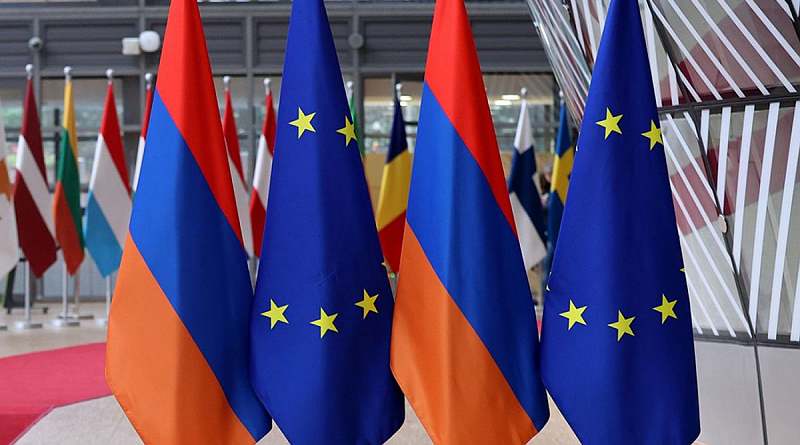
6. The European Union is preparing an economic aid package for Armenia worth 50 million euros amid trade pressure from Russia and deteriorating relations between Moscow and Yerevan.
– This was announced by President Ursula von der Leyen. According to her, the decision was made after talks with Prime Minister Nikol Pashinyan.
– Brussels states that Russia uses trade restrictions as an instrument of political pressure. In recent months, Moscow has imposed a series of bans on the import of Armenian products, including fruits, vegetables, flowers, fish, and mineral water.
– At the same time, Russian officials have publicly criticized Armenia’s course of rapprochement with the European Union and deepening cooperation with the West. Ursula von der Leyen called such actions “economic coercion” and emphasized that the EU does not consider the use of trade as a political weapon acceptable. She stated that Europe intends to support Armenia under increasing external pressure.
– The new aid is another signal of the gradual strengthening of ties between the EU and Armenia. Following the loss of Russia’s influence in the South Caucasus and the deterioration of Moscow’s reputation as a security guarantor in the region, Yerevan is increasingly diversifying its foreign policy and economic connections.
