
Edward Lucas, The Times / Translation by iPress
In the British newspaper The Times, Edward Lucas argues that Putin’s military and economic troubles – disrupted logistics, Ukraine’s successes on the front, the isolation of Crimea, and the combination of recession, inflation, and budget crisis – will eventually lead to a real political crisis in Russia. Lucas warns that the Kremlin’s likely reaction to its own weakness will not be direct escalation but a “below-threshold” hybrid war – diversions, cyberattacks, and bribed agents aimed at splitting and scaring Ukraine’s Western allies, while Western societies themselves are completely unprepared for this. He notes that a recurrence of Russia’s historic “Time of Troubles” is approaching, the consequences of which the countries closest to Russia already fear, and more distant ones still underestimate.
Putin is in trouble. As Russian logistics strain, the initiative on most of the front is passing to Ukrainian forces. The blockade of supply routes to occupied Crimea turns the peninsula – a former trophy for Putin – into a hostage: it is almost devoid of air defense and suffers from a fuel deficit. The tourism business there is in ruins, and local morale is at a low.
Ukrainian drones and missiles reach targets deep in Russia: no place, however protected it is considered, is safe anymore. Humiliating strikes for Putin occurred even during his showcase international summit in St. Petersburg, and this week a refinery near Moscow caught fire.
Added to this are other troubles: despite a surge in oil prices due to the war in the Persian Gulf, the government is shackled by a trio of problems – recession, inflation, and budget crisis. Experienced head of Russia’s central bank, Elvira Nabiullina, has not appeared publicly for three weeks – rumored to be as a result of issuing Putin an ultimatum to not escalate the war machine further. And another alarming news for the Kremlin: Armenia, a former compliant post-Soviet satellite, confirmed its pro-Western course convincingly in elections this month.
Yet, it is not 1917, when hungry, exhausted, and unpaid Russian soldiers simply went home. Ukraine’s defense industry, gaining momentum, is still not capable of producing enough weapons with the necessary range, precision, and striking power. Air defense – especially against ballistic missiles – often lags behind. To the dead in ravaged Ukrainian cities, losses of irreplaceable cultural assets are added, such as the national collection of film props and costumes.
Weary, sleep-deprived Ukrainians emerge from shelters to bury their dead. And sometimes – to mock their tormentors: the legendary Kyiv McDonald’s was shelled for the sixth time, most recently with a million-dollar missile, yet the establishment is still operational.
Ukraine’s advantage may once again prove temporary: Russia is quite successfully finding new ways to attack and defend. A new generation of Chinese-made jet-engine drones will be even harder to intercept, potentially repeating last winter’s disaster of cold and darkness. However, the overall picture remains unchanged: Ukraine has taken heavy blows but has not broken, while Russia’s problems are accumulating without an obvious solution.
When this news finally breaks through Putin’s information bubble, he will be left with options—all bad. He may escalate the war: scouring the country for cannon fodder (and bringing it in from abroad), begging China for more support, drawing Belarus into the fight, using even more destructive weapons, and ordering total attacks on civilian targets in Ukraine. Each of these steps is a risk: economic collapse, public discontent, elite rebellion in Minsk and Moscow, and international condemnation, primarily a Chinese veto in the Security Council.
The other path is more likely: using words and actions to distract, divide, and intimidate Ukraine’s European allies. A recent example was in Britain: a court found two arsonists guilty of attacking property linked to the Prime Minister. Such “below-threshold attacks” are typically executed by proxies—hired by pro-Russian criminal groups, businessmen, and other intermediaries. Anyone can cause harm: a phone, messenger, and a few thousand pounds in cryptocurrency, and it’s done.
The public only vaguely perceives the scale and intensity of such operations—from physical sabotage and assassinations to cyberattacks and political interference; if they knew everything, they would be even more alarmed. Russia researcher Keir Giles says the goal of these attacks is also to test how truly vulnerable we are: what are we capable of stopping? To whom can we confidently attribute this? Whom will we punish for it? The answer in all three cases is almost no one.
These “metadata,” which our reaction to attacks reveals to the Kremlin, will help Russia understand how to paralyze us in the event of a sharper confrontation. Imagine, for example, that Russia tries something on the demilitarized Norwegian Svalbard. Theoretically, we should order our armed forces (don’t laugh) to immediately come to Norway’s aid. But imagine that at the same moment hired thugs (this time by the dozens) set fire to the homes of our politicians, a cyberattack paralyzes the healthcare system, and drones (again) halt the operations of major airports. Add to this another nerve agent poisoning of a Kremlin critic, this time with public panic and even the threat of nuclear escalation. Ukraine is used to fighting amid such storms. We are not. The combination of bravado and minor harassment is capable of compensating Russia for its fundamental weakness.
Ukraine itself faces a dilemma: negotiate while it has the advantage, or push further. Continuing the fight means more pain and danger, but a simple truce will give Russia a respite to regain control over Crimea and return for a “second serving” later. Opinions on this are sharply divided both within Ukraine and among its allies.
Even the end of the war will not return the deceptively calm times of 2014. It is much more likely that peace will provoke a political crisis within Russia itself: either the security forces will marginalize a feeble Putin, or pseudo-liberals will propose a false “reset.” Neither of these options signifies stability either at home or abroad. Russians will blame us (the West) for this for an entire generation—and they have many ways to express their anger.
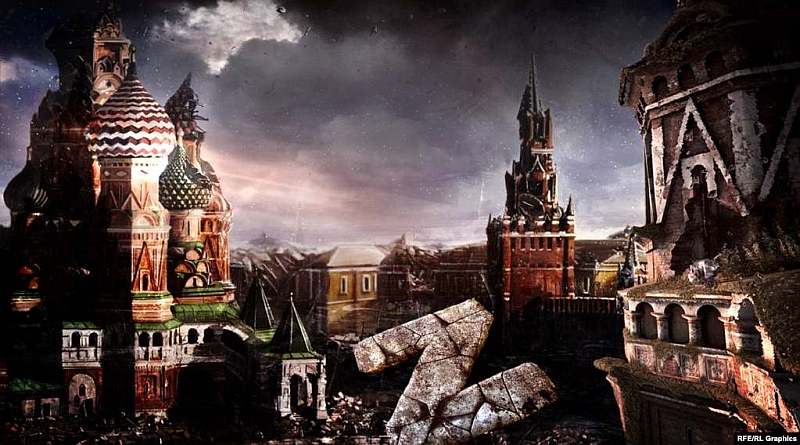
A “smuta” looms—a Russian word denoting a “time of troubles,” when the country falls apart, as happened in 1598 and lasted 15 years. This trauma echoed in the collapses of 1917 and 1991. Countries closest to Russia, from Finland to Poland, perceive such a prospect as quite real and are anxiously preparing for the consequences: streams of refugees, the power of warlords, economic chaos, and nuclear weapons falling out of control. Those further away would prefer to do everything to avoid it. And the British are not prepared for any of these scenarios.
Illustration: Radio Liberty
Copyright © 2021 RFE/RL, Inc. Reprinted with permission of Radio Free Europe/Radio Liberty
