
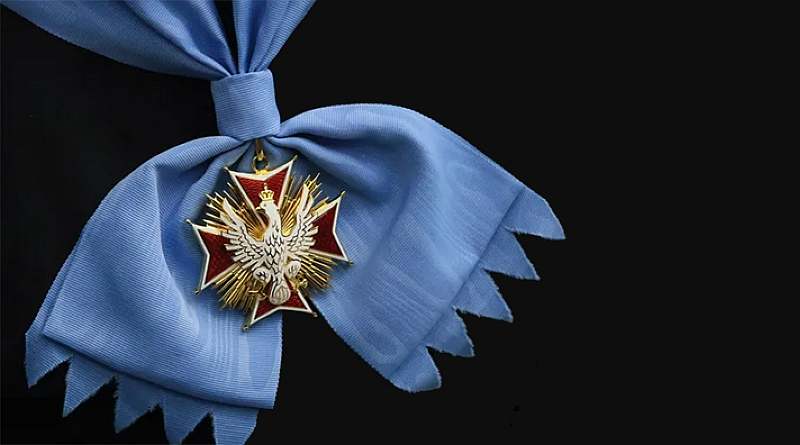
A scandal is brewing in the Polish internet over the fact that the President of Ukraine awarded the honorary name “Heroes of the UPA” to the Separate Special Operations Center “North.” Karol Nawrocki’s reaction to revoke the Order of the White Eagle from Zelensky is somewhat amusing, considering that Gerhard Schröder, a lover of Kremlin caviar, is still a knight of this order.
If we are to be consistent, then we should also revoke this order from Viktor Yushchenko, who awarded Stepan Bandera the title of Hero of Ukraine. And why stop there? What about Benito Mussolini? And another ally of Hitler – Miklós Horthy? And collaborator Philippe Pétain? And the commander of the Kriegsmarine, Erich Raeder, who was sentenced to life imprisonment at the Nuremberg Trials?
From the contemporary perspective, did they deserve these orders?
The Poles have long been nervous about the red and black flag, considering it Banderite, although it is also Cossack, as seen in Repin’s painting. It’s like the swastika. Even though it originates from ancient times, its perversion by the Nazis has led to its ban.
Could the Order of the White Eagle be pristine and immaculate? No, because after Poland’s annexation to the Russian Empire, the order remained in Russia’s award system. It was distributed to Russian landowners, politicians, and even generals who suppressed Polish uprisings. For instance, it was awarded to Mikhail Muravyov, the “Hangman,” who crushed the January Uprising of 1863–1864.
In 1898, a monument to Muravyov was erected in Vilnius, and after Poland declared independence, the Polish authorities demolished the monument and built public toilets in its place.
Yet, the order has still not been revoked. Alas!
Judging by the reaction of ordinary Poles, it seems as though “Heroes of the UPA” has been named for half of our army units, and monuments to Bandera stand in nearly every city. In reality, no such monument exists in any of the five largest cities. They are all concentrated in Galicia. The same goes for streets named after him: 90% are in Galicia.
On the internet, you can read incredible nonsense. “Ukrainians murdered a million Poles!” To the remark that there weren’t that many Poles in Volyn, a phenomenal response comes: “Because the census didn’t count the children.” Further revelations include: “Kuchma confessed to 600 thousand,” “Leonid Kravchuk spoke of 500 thousand, and since children weren’t counted, it should be multiplied by several.” They’ve even concocted some “hellish slogan” by Bandera, who allegedly believed Ukraine should be “clean as a glass of water.” Shukhevych is attributed with the idea of ethnic cleansing against Poles, and about Volyn, it’s written that “it’s a genocide far worse than Auschwitz!”
And, of course, demands are already sounding to “close the border!” “close the airport in Jasionka!”, meaning Rzeszów. This is akin to spite the neighbor by shooting oneself in the ear. Because Rzeszów has become enormously wealthy thanks to the constant transport of Western aid.
What amused me the most was the idea “we should have taken our part of Ukraine, as the Russians proposed.”
I take a Polish encyclopedia from 1932. In 1921, the Volhynian Voivodeship had 1,569,559 inhabitants, of whom 16.8% were Poles, but Roman Catholics accounted for 11.6%, Ruthenians for 68.4%, Jews for 10.6%, Germans for 1.7%, and Czechs for 1.8%. Indeed, 74.2% were Orthodox, which also included “locals” and Russians who fled from the Bolsheviks.
In 1931, it had 2,081,501 inhabitants, of whom Orthodox were 1,455,882 people (69.8%), Roman Catholics were 327,856 (15.7%), Jews were 207,792 (10%), Evangelicals were 53,400 (2.6%), and Greek Catholics were 11,137 (0.5%).
The 1931 census was the last in pre-war Poland. By 1939, the percentages had not changed, because although thousands of veterans arrived in Volhynia, the Ukrainian population significantly prevailed.
Modern Poles do not want to hear about what really happened in Volhynia, the total Polonization that took place. If in 1925 there were 500 Ukrainian schools, then in ten years there were only four left. A third of school-aged children did not study at all. This led to mass illiteracy. In 1931, in Volhynia, 47.8% of the population could neither write nor read.
My grandmother and her sister from the village of Mali Filvarky near Kremenets were illiterate. And my mother finished a Polish school without learning the Ukrainian language.
We should also not forget the violent conversion of Orthodox to Catholics. The Border Protection Corps did this very brutally. The events in the village of Hrynky in the Kremenets area caused a great scandal, where almost all residents were deceitfully forced to convert to the Roman Catholic faith. The case was heard in the Sejm, and even Polish newspapers condemned this action. The Polish writer Maria Dąbrowska was outraged by “the army acting as Polish crusaders converting Orthodox to Catholicism. Morally – repulsion, politically – clinical madness, a sin for which Poland will pay dearly.”
Unfortunately, her words came true.
And now our government wants to somehow slip out of the unpleasant situation that made the Poles so nervous. But if they cancel the naming in honor of the “UPA Heroes,” it will be foolish and blunt.
But there is an option.
There were three UPA. Two of them – Bulba-Borovets* and Melnyk – had no connection to the Volhynian events. Moreover, they also suffered from Bandera’s men, who shot more than one Melnyk commander who did not want to join them. Including Andriy Yavorenko, in whose detachment my father fought. And my father disliked Bandera’s people about as much as the Poles did. So forgive me.
My father did not want to join them, surrendered his weapons, and to avoid being taken to the Reich by the Germans, he entered an agricultural school.
The Melnykites hate the Banderites so much that they even lie separately in cemeteries. But as for Bandera himself, he cannot be blamed for anything because he did not participate in the Volhynian events and did not give orders to disarm the Bulba and Melnyk troops, sitting in a concentration camp. The Poles murdered his two brothers, so it can be considered that they settled the score.
Thus, by clarifying which insurgent army we are talking about, the scandal can be resolved. And another path can be taken by listing Polish military formations named after the AK units (Home Army – Editor’s note), demanding symmetrical actions. And, of course, return the Order of the White Eagle, not wanting to share this distinction with the fascist Mussolini and the Nazi Raeder.
Or do nothing, because that won’t help either. The jackal express is already gaining speed and cannot be stopped.
____________
* In 1945, Taras Bulba-Borovets was detained in the British occupation zone on charges of committing crimes against the Polish civilian population. The investigation concluded that the units under his command did not participate in such actions.
Collage: Zbruc
