
Novopavlivka direction.
The enemy command (Russian forces) in this direction continues stabilization measures to prevent further advancement of the forward units of the Armed Forces of Ukraine (AFU) in the directions of Havrylivka — Komar, Novopavlivka — Bohatyr, and Novoselivka — Shevchenko. They are executing this through active (maneuverable) defense in the sectors of the 29th Combined Arms Army (CAA) and the 90th Tank Division (td) as part of the “Vostok” group of forces. In this context, the enemy tries to engage in stubborn counter-fighting for every tactically advantageous position, stronghold, and line almost across the entire direction, and in certain areas, attempts to actively counterattack the advancing AFU forward units.
However, during the reporting period, they have not fully achieved this goal. It is evident that the forward parts and units of the AFU operating in this direction have managed to achieve progress in the tactical zone of their forward units in several directions and areas.
1. The enemy operates in this direction with the following composition:
The 90th td operates in the Novopavlivka direction with its main forces:
– 6th Tank Regiment (tr) – partially regrouped into the sector of the 29th CAA;
– 80th tr;
– 239th tr;
– 228th Motor Rifle Regiment (mrr), likely also partially regrouped into the sector of the 29th CAA;
– 428th mrr.
There is also possible presence of several units from the 137th Separate Motor Rifle Brigade (smrb) “Ural” in the sector of this division.
29th CAA:
– 36th smrb;
– 430th mrr.
Moreover, in the sector of this same army, at least two regiments of the 90th Tank Division (6th tr and 228th mrr), and the 120th Marine Division (md), the former 336th Separate Marine Brigade (smrb), as well as the 68th Army Corps (AC) — a composite tactical group (TG) of the 18th Machine Gun Artillery Division (mgad) and the 39th smrb, are apparently operating.
Also, in this direction (in the sectors of the 90th td and the 29th CAA), a number of formations at the level of “motor rifle/rifle regiment” (mrr/rr) and “separate motor rifle/rifle battalion” (smrb/srb) of the territorial troops (TT) and mobilization reserve (MR) category may be operating. It is likely that there may be up to 4 such formations here.
Most likely, to improve the effectiveness of combat management of the troops and their interaction, the Russian command might have transferred the 90th Tank Division from the Central Military District to the Eastern Military District some time ago (possibly subordinating it to the command of the 29th Army). This is indirectly confirmed by the presence of part of its forces in the area of the 29th Army. However, I have not yet found clearly confirmed information about such organizational changes in the Russian forces in open sources.
It seems that, for now, the Russian command does not perceive the actions of the Armed Forces of Ukraine in this direction as a particularly critical threat to their troops. At least in the combat and numerical composition of the forces and means deployed in this direction, there have been no significant changes recently compared to previous actions taken by the Russian command.
2. The current situation in the Novopavlivka direction is characterized by fairly fierce counter-battles in the area of the Russian 90th Tank Division (in the Horikhove – Filiya section) as well as in the area of the Russian 29th Army (on both sides of the N15 Zaporizhzhia – Donetsk road and in the “junction” area of the Dnipropetrovsk, Zaporizhzhia, and Donetsk regions of Ukraine). Specifically:
– The enemy has repeatedly attempted to counterattack the advanced Ukrainian units with its small assault groups in the directions of Horikhove — Novopavlivka, Dachne — Novopavlivka, and Filiya — Novopavlivka, likely trying simultaneously to accomplish two tactical tasks: to hold their own positions in the Filiya area, particularly on the opposite bank of the Solona River, and to prevent further advancement of the Ukrainian forward units south and east of Novopavlivka.
As a result, they apparently managed to hold positions in the Filiya area, but only south of the village. The village itself is presumably located in the so-called “gray zone” and is completely destroyed. The enemy also seemingly failed to stop the advancement of the forward infantry groups of the Armed Forces of Ukraine south of Novopavlivka — counter battles involving them are already noted north of Dachne along sections of the Novopavlivka-Dachne road.
In Novopavlivka itself, the Armed Forces of Ukraine are likely engaged in “clearing” operations against the so-called “residual groups” of Russian assault infantry in its southern part and are repelling periodic counterattacks from the enemy from Horikhove and Kotliarivka against the flank of their units operating south of the village.
– On the Novokhatske — Zirca and Tolstoi — Piddubne directions, the forward assault groups of the Armed Forces of Ukraine have likely also made advances — they have reached the western bank of the Mokri Yaly River and the northern outskirts of Piddubne.
The enemy will likely try shortly to prevent the crossing of the Mokri Yaly River by Ukrainian infantry groups in the direction of Zirca and to obstruct their advance towards Piddubne.
– In the southwest of this area, Ukrainian units have apparently managed to block the advance of several small Russian infantry groups that counterattacked north and south of Oleksandrohrad (either by destroying them or pushing them back towards Myrne).
– Additionally, forward units of the Armed Forces of Ukraine, operating from the Sichenove — Vorone line, have been able to move south of Maliivka along the Vorona River and reach the western outskirts of Voskresenka. It is also evident that Ukrainian infantry groups are already directly present in Maliivka, engaging in battles for its liberation.
Thus, it can be noted that during the reporting period, the Armed Forces of Ukraine were able to achieve certain tactical results in the zones of the Russian 29th Combined Arms Army and the 90th Tank Division, advancing in some areas and directions to a depth of 9-10 km, and also solving several quite important tactical tasks.
For example, they managed to almost completely push Russian forces away from the Solona River and the upper reaches of the Vovcha River, eliminate the immediate threat of a breakthrough by enemy forward units towards Havrylivka and Mezhova (via Novopavlivka), and reach the Mokri Yaly River near the village of Tolstoy. Thus, creating the prerequisites for further successful offensive operations both along road No. 15 (in the general direction of Komar-Bohatyr) and in the southern direction along the Mokri Yaly River, especially considering the fact that advanced Ukrainian assault groups have already advanced in the area of Maliivka and Voskresenka, where their forward positions are located only 8.5 km west of the village of Komar, as well as positions 6 km north of it, advancing in the area of the village of Tolstoy.
3. However, regarding the further prospects for the development of the situation in this direction, they do not look so unambiguous for the Armed Forces of Ukraine as it might seem at first glance.
It is obvious that further offensive operations in this direction by the advanced units and formations of the Armed Forces of Ukraine will be fraught with a number of difficulties. It is already proceeding at a slow pace and quite slowly. Ukrainian units are forced to conduct heavy and fierce battles in the tactical zone to advance a few kilometers, literally “gnawing” their way forward. Moreover, the enemy, having a sufficient amount of assault infantry (and most importantly, the ability to regularly replenish it), tries almost constantly to counterattack Ukrainian forward units, significantly slowing their advance.
At the same time, the Russian command obviously has the ability to provide its forward units in this direction with quite effective air support (guided bombs), to strike at the combat formations of the forward (and not only forward) units and formations of the Armed Forces of Ukraine at tactical and operational-tactical depth with its attack drones and is likely to have an advantage in artillery numbers.
However, in my subjective opinion, in this direction the Armed Forces of Ukraine still have certain chances to develop their offensive into something more than just successes of exclusively tactical scale. Especially considering that the Armed Forces of Ukraine have these not only in the zone of the 29th Combined Arms Army of the enemy but also in the zone of the neighboring 36th Combined Arms Army.
It is obvious that the Russian command has already understood the main operational and tactical meaning of the offensive actions of the Armed Forces of Ukraine on the right flank and in the center of the operational zone of the UAF “Vostok” — the desire to force its command to “deploy” its most powerful army, the 5th Combined Arms Army (or at least part of its forces/forces) front from west to north, creating a threat to its flank and rear. And thus, practically completely slowing down its movement in the direction of Huliaipole — Orikhiv. Various “manipulations” of the local Russian command with the 120th Separate Marine Brigade, part of the forces of the 90th Tank Division, and its operational reserves (for example, with the 69th Separate Cover Brigade) quite eloquently testify to this kind of understanding.
However, this desire of the Ukrainian command might become a reality if the Armed Forces of Ukraine manage to break through to the Uspenivka area via the strip of the 36th Combined Arms Army and reach the distant approaches to Velyka Novosilka, for example, by breaking through the Shevchenko — Temirivka line at the junction of the 29th and 36th Combined Arms Armies.
Additionally, besides these chances, the Armed Forces of Ukraine have a significant chance for a more “modest,” yet important result — to eliminate the enemy’s tactical salient northwest and north of Velyka Novosilka by occupying the Poddubne — Dachne — Bohatyr — Komar area.
Russian troops will likely stubbornly defend with all their might in the interfluve between the Vovcha and Mokri Yaly rivers, trying to prevent this. However, it will be quite difficult for them to do so — the Armed Forces of Ukraine ALREADY have tactical insertions in the Maliivka area, as well as in the Dachne area, that is, on the hypothetical flanks of this salient.
The persistent counterattacks of the enemy in the strip of the 90th Tank Division from the direction of Orikhove, their stubborn resistance in the Filya area, and attempts to push Ukrainian units from the Dachne area to the north indicate that the Russian command does consider the possibility that the Armed Forces of Ukraine might attempt to do just that in the near future.
In this context, the main problem for the Russian command is that it has not yet decided, at least for itself, on which section the Armed Forces of Ukraine will concentrate their main efforts — in the strip of the 29th Combined Arms Army (south of the Zaporizhzhia — Donetsk road, to advance simultaneously on Komar from the southwest and north) or in the strip of the 90th Tank Division (in the area between Dachne and Orikhove, breaking through to Bohatyr from the northwest).
To summarize…
The offensive actions of the Armed Forces of Ukraine in the Novopavlivka and Novooleksandrivka directions (more on that in the next review), although causing some concern to the Russian command, are apparently not too strong. It seems that they believe the Armed Forces of Ukraine simply do not have enough forces and means to achieve something more significant than slow and not too large-scale tactical improvements in the positions of their advanced units and subunits. In my opinion, they have some grounds for this…
However, the existence of chances, although not very significant, for the Armed Forces of Ukraine to achieve a more ambitious result is also quite obvious.
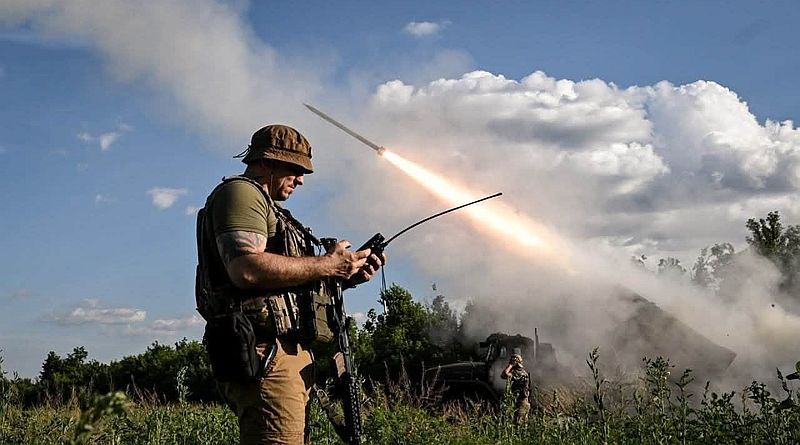
Cover photo: 148th Independent Artillery Brigade of the Zhytomyr Air Assault Forces
