
Olesia Zhihaliuk, BBC News Ukraine
The full-scale war against Ukraine may become for Russia what the Crimean War of the 19th century was for the Russian Empire – the beginning of a long historical decline, according to international commentator Renzo Cianfanelli in an op-ed for La Voce di New York.
This historical parallel is complemented in various aspects by other Western experts.
British-Polish historian Norman Davies talks about Vladimir Putin’s strategic failure and Moscow’s increasing dependence on China.
Meanwhile, the French Le Monde notes that the war is increasingly affecting the Russian economy and undermining the tacit agreement between the Kremlin and society.
The Second Crimean War?
History rarely repeats itself literally, but often unfolds in similar scenarios, as Renzo Cianfanelli points out.
He recalls that the defeat of the Russian Empire in the Crimean War of 1853-1856 marked the beginning of its prolonged weakening.
The war exposed the country’s economic backwardness, its diplomatic isolation, and a crisis of state governance. Alexander II’s reforms only partially modernized the empire but also initiated processes that eventually undermined autocracy.
According to the author, Vladimir Putin’s invasion of Ukraine could also become such a historical turning point. The Kremlin anticipated a quick victory, but instead became embroiled in a grueling and extremely costly war with no obvious chances for decisive success.
Cianfanelli notes that the Russian army has made almost no advances on the front for over a year while suffering significant losses. Meanwhile, Ukraine is expanding the geography of drone strikes deep within Russia – even to Siberia.
The author’s main conclusion is that even if the war does not end in Russia’s formal military defeat, it could nonetheless become the moment when the country permanently loses its status as an independent great power.
The Price of Imperial Ambitions
Similar conclusions are drawn by British-Polish historian Norman Davies. In an interview with TVP World, he stated that Vladimir Putin’s attempt to restore the Russian or Soviet Empire has suffered a strategic defeat.
“Putin’s attempts to restore the Soviet or at least the Russian Empire in a new form have faced a major failure.”
According to the historian, after more than two decades in power, Putin has managed to restore his influence only in parts of the territories that once belonged to the Soviet sphere of influence.
In his view, the war against Ukraine has shown the limits of Russia’s military power.
“This is a demonstration of Russia’s weakness,” the historian notes.
Dependence on China as a New Reality
Renzo Cianfanelli offers a similar assessment. In his view, Putin’s hopes of restoring Russia’s status as an independent world power center have proven illusory.
The author writes that Moscow is increasingly dependent on China in terms of economy, technology, and diplomacy. Although officially the two countries describe their relationship as a partnership of equals, the real balance of power is noticeably shifting in favor of Beijing.
According to Chianfanelli, Russia risks becoming China’s junior strategic partner.
At the same time, the Kremlin’s focus on strengthening internal control instead of reforms may help maintain the current political system but cannot restore the country’s economic stability and strategic independence.
Norman Davies is even more categorical: “Russia is now a vassal of China.”
The historian believes that the Russian Far East might become the region where a new stage of the country’s internal collapse begins. He points out that China already dominates trade there and actively exploits the region’s natural resources.
Davies also does not rule out the possibility that in the long term, Beijing might reclaim Vladivostok. This city in Russia’s Far East was founded as a military post in 1860, after the Russian Empire received the Ussuri region from the Qing Empire under the Treaty of Peking.
In his opinion, the war against Ukraine can accelerate the processes of internal disintegration in Russia.
The war destroys the Kremlin’s tacit agreement with society
The French newspaper Le Monde highlights another dimension of the war—its consequences within Russia itself.
According to the publication, Ukrainian strikes on oil infrastructure and the deteriorating economic situation are gradually destroying the tacit agreement between the Kremlin and society. For many years, it was based on a simple principle: the authorities guarantee stability, and citizens do not question the restrictions on political freedoms.
After Ukrainian drone attacks on oil refineries, Russia faced its most serious fuel crisis in decades. Queues at gas stations, fuel shortages, and rising prices have, according to European Humanities University economist Mykola Kulbaka, exposed one of the country’s key weaknesses—internal logistics.
At the same time, as Le Monde notes, Russia’s economy is increasingly slowing, and the budget deficit is growing.
Despite this, Heli Simola, a leading economist at the Bank of Finland’s Institute for Economies in Transition, believes that Russia still retains the ability to continue the war. However, the cost of this decision will continue to rise.
“Russia will have to make increasingly difficult decisions,” says Simola.
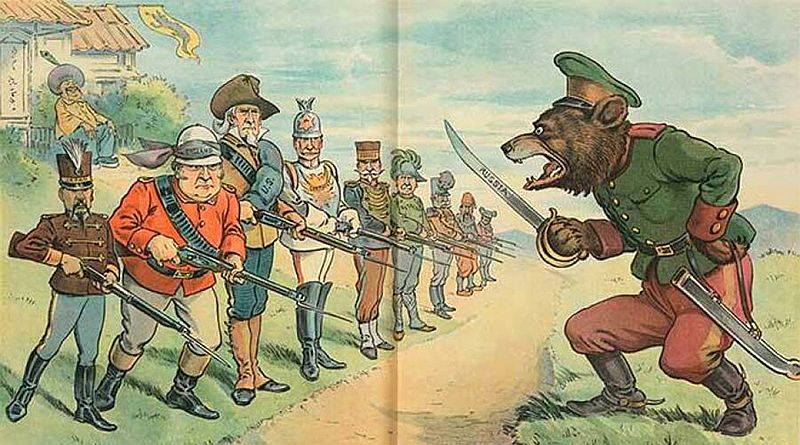
Caricature from the American magazine Puck, 1901
