
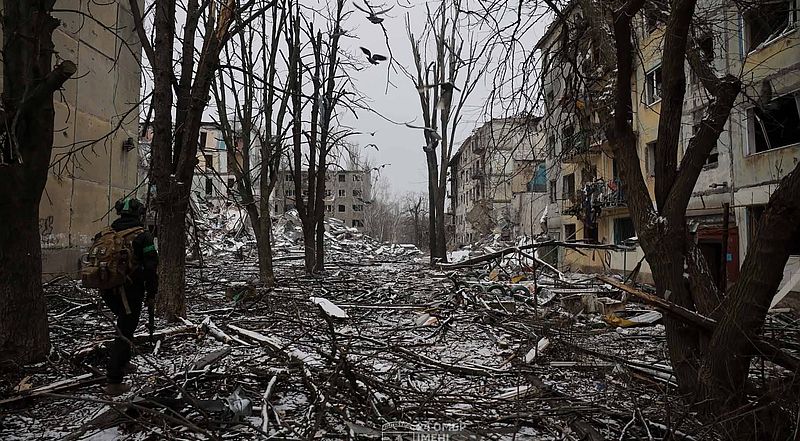

The Kostiantynivka direction and a bit about “holding positions at any cost.”
The enemy (Russian forces) continues to implement the plan to capture the Kostiantynivka and Druzhkivka defense areas of the Armed Forces of Ukraine (AFU) and advance to the outskirts of Kramatorsk from the south and southeast with the main forces of the 8th Combined Arms Army and the 3rd Army Corps of the “South” Grouping of Forces.
At this point, they have managed to significantly advance the first phase of their plan, namely the capture of the Kostiantynivka defense area of the AFU. Specifically, Russian forces have managed to break through to the western, southeastern, and eastern parts of Kostiantynivka. Meanwhile, the AFU continues to defend in the northwestern and central parts of the city. In other words, the enemy has not yet managed to completely eliminate the Kostiantynivka defense area of the AFU, despite a series of high-profile statements from Russian “high officials” about the supposed full capture of the city.
1. During the organization and conduct of the assault on Kostiantynivka, to enhance the level of coordination and combat management of their forces, the Russian command has combined all its forces and resources operating in this direction into two tactical groupings of forces (TGr) — TGr “Dzerzhynsk,” operating in the 8th Combined Arms Army zone, and TGr “Bakhmut,” operating in the 3rd Army Corps zone.
These mainly consist of units and formations of the 8th Combined Arms Army and 3rd Army Corps, respectively. However, both groups are significantly reinforced by forces and resources from combined arms armies and groupings of forces operating in other directions, including:
TGr “Dzerzhynsk” — 8th Combined Arms Army + its reinforcement forces and resources:
– The 4th Separate Motorized Rifle Brigade (SMRB) of the 3rd AC is operating in this direction with its main forces;
– The 103rd Motorized Rifle Regiment (MRR) from the 150th Motorized Rifle Division (MRD) of the 8th AC;
– The 10th Tank Regiment (TR) of the 20th MRD of the 8th AC is apparently operating mainly with infantry (assault) units, rarely using tanks either as individual vehicles or in small groups of 2-3 units;
– The 54th MRR of the 6th MRD of the 3rd AC;
– The 1194th MRR “Territorial Forces” of the 3rd AC;
– The 1219th, 1436th, and 1465th MRR of the Territorial Forces of the 51st AC, together with similar formations of the 3rd AC, are used as the “main source” of assault infantry and “quality reinforcement” for the 103rd MRR and 10th TR of the 8th AC;
– The 20th and 155th MRRs are effectively consolidated rifle regiments, staffed with personnel from several fleets of the “Navy of the Russian Federation Armed Forces.” They are also actively used for conducting offensive/assault actions in this direction;
– The 77th MRR is essentially a consolidated regimental tactical group (TG) of the 7th military base (MB) “RF Armed Forces” from the 49th AC, located in the occupied territory of Georgia (Gudauta). Possibly, part of the 7th MB’s forces is also used in the 58th AC’s Dnepr sector on the Zaporizhzhia front.
TG “Bakhmut” — its main force is essentially the core forces of the 3rd Army Corps:
– The 72nd SMRB of the 3rd AC is operating in this direction with almost its full composition;
– The 6th MRD of the 3rd AC — the 1008th, 1307th, and 1442nd MRRs serve as the main “source” of assault infantry for this TG;
– The 89th TR of the 6th MRD, similarly to the 10th Tank Regiment of the 8th AC, operates primarily with its infantry (assault) units and groups, rarely using tanks and almost always “in dispersion.”
Moreover, it is apparent that in the interests of both Russian TGs directly assaulting the Konstantynivka defense district of the Armed Forces of Ukraine, a number of forces and assets operate that are not part of them, specifically:
– The 70th MRD from the 18th AC Dnepr sector — the 24th, 26th (part of the forces), 28th Motorized Rifle Regiments, the 17th Tank Regiment, and the 81st Self-Propelled Artillery Regiment (part of the forces). It operates under the general direction of Chasiv Yar – Druzhkivka.
– Units and subunits of the 150th and 20th MRDs of the 8th AC, operating in the directions of Sofiivka — Raiske and Rusin Yar — Druzhkivka.
During the reporting period, there have been no significant changes (notable increase/decrease, regrouping) in the combat and numerical composition (CNC) of enemy forces and assets operating in the Konstantynivka direction. It is evident that Russian troops continue to carry out their tasks in the same composition and operational structure as they did previously. However, it is quite possible that in the near future, there is potential for their reinforcement by forces and assets from the Dnepr or Center sectors (specifically the 49th, 51st, or 41st AC).
2. Current situation on the Konstantynivka direction is characterized by a significant intensification of active offensive actions by the enemy in the tactical zone simultaneously on several sections. In fact, the Russian command has initiated the final stage of the assault on the Konstantynivka defense district of the Armed Forces of Ukraine, albeit with an obvious delay, in the context of its overall (operational) offensive operation in the Sloviansk-Kramatorsk direction.
Currently, the following sections and directions where the enemy is demonstrating a high level of activity and achieving certain tactical results are noted:
– Advanced infantry (assault) groups of the Russian 3rd AC have likely managed to advance towards Novodmytrivka — Molocharka and have also secured positions in the eastern part of Kostyantynivka from Teatralna Street to Bulgakov Street along Minsk Street.
– The enemy is also present in blocks along Radishchev and Shanghai Streets, where the Ukrainian Armed Forces periodically counterattack, attempting to push them towards the cemetery and the forest behind Sechkin Street.
– Russian assault groups have apparently also broken through the T-0504 road and occupied an area north of the Kostyantynivka railway station. Battles are already underway near the Metallurg Park and the stadium of the same name. However, Ukrainian units continue to hold the area between Oleksa Tykhoho Street and the Kryvyi Torets River, from Yemelyanova Street to Sechkin Street, though the enemy continues to attack persistently in this area northwest, trying to break through beyond Metallurg Park.
– Intense fighting continues in the western part of the city, where the Ukrainian Armed Forces are still holding a small bridgehead on the Kryvyi Torets River, between the ruins of “Kvartsyt” and the industrial zone of LLC “SP Svynec”. However, advanced enemy assault groups have already reached Yemelyanova Street, near the “Motto” gas station and “City Hospital No.1” (Central District Hospital).
Moreover, it is evident that some small enemy infantry groups have managed to advance along several tree belts between Kostyantynivka and the village of Dovha Balka.
– In the area of Dovha Balka itself and the village of Stepanivka, located to its south, quite intense fighting is ongoing. Advanced units and assault groups of the Russian 8th CAA are attempting to bypass Stepanivka from the east and west, likely to force the Ukrainian Armed Forces units defending here to retreat north. In Dovha Balka, there are reportedly several small enemy infantry groups on the eastern outskirts as well.
Thus, regarding the enemy’s actions in the Kostyantynivka direction, several of their characteristics can be identified:
– The enemy in the Kostyantynivka area acts according to a tactical “pattern” that has been tested, searching for and identifying weak “inter-positional spaces” in the defense system of the Ukrainian Armed Forces’ advanced units, organizing and conducting mass “penetrations” by their numerous small infantry groups into urban areas with dense building, followed by increasing the number of their assault infantry and UAV groups in these areas. Then they advance on the flanks and rear of Ukrainian positions and strongpoints to bypass and eventually block them.
Essentially, the Russian command at the tactical level organizes and conducts combat operations in urban areas with dense building, deliberately “mingling” their advanced units’ combat orders with those of the Ukrainian Armed Forces’ advanced units. This, given their significant numerical superiority in infantry, provides them with a range of tactical advantages. Especially when they do not heavily consider their own losses and effectively wear down the defense of the advanced Ukrainian units with repeated attempts to break through (infiltrate) their forward positions by small (or sometimes large) assault infantry groups nearly daily.
Furthermore, the abundant vegetation and numerous buildings (or their ruins) within the city facilitate the concealment and covert advancement of numerous Russian “infiltration” groups. This significantly reduces the effectiveness of the Ukrainian Armed Forces’ use of UAVs for their timely detection and destruction.
– To this, we must add the very intensive and concentrated use of aviation support by the enemy in the chosen direction (use of KABs), concentration of artillery, and their own UAV groups there. In cases where active and massive “penetration” through the forward positions of the Armed Forces of Ukraine in selected areas is impossible with their numerous small infantry (assault) groups, they literally “punch” the necessary “corridors” and persistently “clear” all supply and evacuation routes of the forward Ukrainian units in the tactical zone.
– Due to a lack of infantry in their forward units, the Ukrainian command at the tactical level simply does not have time to adequately respond to all these numerous “raids” of Russian assault infantry and tightly block the “corridors” of their penetration.
As a result, over time, the number of Russian infantry in the rear and on the flanks of separate positions and strongholds of the Armed Forces of Ukraine in the tactical zone becomes critical, and their further retention, especially against the backdrop of growing difficulties in supplying them with logistics, becomes nearly suicidal.
The situation is further complicated when the higher Ukrainian command demands the tactical and operational-tactical levels to “unconditionally retain” already bypassed and blocked positions and strongholds, and in some cases, to rotate the personnel in them and even reinforce them. In reality, thus simply eliminating the personnel that could have been used more effectively if timely withdrawn from encirclement and utilized in combat formations in tactical depth, particularly to counter those very Russian “penetrations.”
It seems this is happening now in the Kostyantynivka direction. And it appears that in the direction of Dobropillia, in the Lyman area, and on the Sloviansk direction, the situation is exactly the same. “Holding at any cost” on blocked and encircled positions only makes sense with a real prospect of successfully conducting raid-search actions on their flanks and rear by specially designated forces at the brigade-battalion level with mandatory UAV support. If there is no real possibility of such actions, especially when it is physically impossible to supply them with food, water, and ammunition, it is clear that they should not be held there “at any cost,” let alone sending more new people “as reinforcements.” Demanding such actions from commanders under threat of various repressions against them, including various “official investigations for unjustified abandonment of positions,” for the sake of some fool reporting “on the air” that “we are still holding positions in Hulyaipole or Pokrovsk” is the height of cynicism. Let me remind you, especially those who love to “reinforce” blocked and encircled positions with “fresh” personnel, retreat is a form of MANEUVER (a completely “legal” and “legitimate” method of troop action). Moreover, it is one of the most complex. Withdrawing in time, with minimal losses, or even without them, is one of the criteria of a commander’s proficiency in operational art.
In this sense, an appropriate method of countering this tactical maneuver of the enemy should be developed and implemented in practice. To me, “schematically” (i.e., approximately), it should look as follows: timely detection of groups of Russian “infiltrators” — determining their actual route, location, and hideouts — delivering fire engagement on them, including using drones — evaluating the results — and, if necessary, “clearing” by specially designated groups and units for this purpose or repeated engagement with more accurate or more powerful means.
Under conditions where there is no continuous (“classical”) front line, and the “gray” (by “outdated” definition, “neutral”) zone, including “mixed” positions and strong points of the sides, has a stable tendency to expand, overall resilience in the respective sector (in the zone) of defense can be ensured in this way.
A bit off-topic…
3. Finally, a few words on future prospects in the Kostyantynivka direction.
Currently, they don’t seem particularly positive for the Armed Forces of Ukraine. The enemy, in the context of its operational offensive operation towards Sloviansk-Kramatorsk, is evidently very delayed with Kostyantynivka and even more so with Druzhkivka. But this doesn’t mean they can’t “increase” the tempo here. In this regard, there is a certain likelihood of some ADDITIONAL forces and means from the 41st or 51st CAA of the Central Military District appearing in the zones of the 8th CAA and the 3rd AC. The main question is the timing of this appearance.
The Russian command in this direction clearly acts based on its usual desire to “bypass and encircle” the remnants of the Kostyantynivka defense area of the Armed Forces of Ukraine and is focused primarily on advancing “over the dominating” heights. In this sense, the encroachment of Russian assault groups in the direction of Novodmytrivka-Molocharka and in the area between Dovha Balka and Kostyantynivka are very telling. However, the pace of the Russian troops’ advance is not very high.
Therefore, it is obvious that the battles for Kostyantynivka will continue at least until the end of this month, and most likely will extend into August. Only after they are concluded will the Russian troops initially have to “crawl” towards Druzhkivka and attempt to storm it. At the same time, it is likely that the Russian command continues to believe that the forces and means already allocated for capturing Kostyantynivka are quite sufficient.
However, it is clear that between these aforementioned hypothetical events, the Russian command needs to solve at least two more important tactical tasks — to eliminate the Ukrainian tactical salient in the Chasiv Yar area and break through in the Raiiske area. Without this, the advance and subsequent assault on Druzhkivka are simply impossible.
In my view, only “after Kostyantynivka” might additional forces and means from the Central Military District appear in the Druzhkivka direction. Since the Russian 8th CAA and the 3rd AC will clearly be sufficiently exhausted after Kostyantynivka to carry out all this on their own without additional reinforcements. To quickly and with minimal losses “crawl” from the south to Druzhkivka, they will need a pause to strengthen and regroup.
In other words, the longer the Russian troops engage with Kostiantynivka, the more likely it is that they will have to delay strengthening their “South” troop group to break through from the south to the Sloviansk-Kramatorsk agglomeration. Moreover, the 51st and 41st Combined Arms Armies are currently quite actively involved in actions in the Dobropillia direction.
The Russian strategic-level command, of course, to reinforce its troop groups participating in the Sloviansk-Kramatorsk offensive operation, may also “pull” something from the Southern operational zone (for example, a few brigades of the 49th Combined Arms Army). However, this may have unpredictable consequences. I have already written earlier that further weakening of the Russian “Dnepr” troop group may become a very “cruel joke” for the Russian command, considering the extreme events occurring in its operational rear. And the Russian command there, judging by its actions, clearly understands this.
Regarding the Russian “North” and “West” troop groups, it is clear that they are also “occupied to the brim” at the moment. The first is attempting to break through to Zolote Kolodyaz in the Kharkiv region, from the direction of Vovchansk, while also retaining its numerous “buffer” wedges at the border. The second is clearly “up to its neck” concerned with the Kupiansk and Lyman directions.
Thus, the main conclusion regarding the Kostiantynivka defense area of the Armed Forces of Ukraine is currently obvious. The Russian command will try to “deal with Kostiantynivka” as soon as possible. Moreover, it will have to predominantly rely on the forces and means already deployed there.
At the same time, the moment of qualitative strengthening of the Russian troops operating there should be closely monitored. Its onset would signify the beginning of the enemy’s direct preparation for a breakthrough along the Druzhkivka-Kramatorsk axis.
In the foreground: Kostiantynivka, March 2026. Photo: 24th Separate Mechanized Brigade named after King Danylo
