
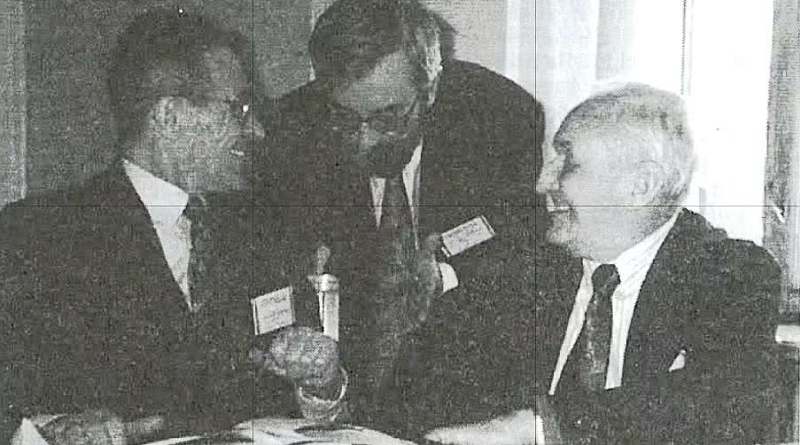
In the photo, there is a meeting between the Chief Commander of the UPA, Vasyl Kuk, and Andrzej Zhupansky, head of the Volyn District of the World Union of Home Army Soldiers (Lutsk, 1996). They were able to meet, talk, and listen to each other.
From a conversation between Vasyl Kuk, Izabella Chruślińska, and Piotr Tyma in 2001:
«– From today’s perspective, how do you evaluate the conflict with the Poles — do you think the conflict, which involved significant forces on both sides, influenced the outcome of the struggle for Ukrainian independence?
– We were aware that Poland would eventually fall prey to the Soviet Union, as our authors tried to write about it. We believed that the Soviet authorities’ goal was to turn Poland into another Soviet republic. Therefore, we hoped for the possibility of creating a united front with the Poles against the Bolsheviks. However, our propaganda activities, flyers, and attempts to negotiate did not yield positive results. The UPA command hoped for the possibility of joint struggle but did not want to abandon the plan to create an independent state on ethnographic Ukrainian lands. The Poles also did not want to give up our lands, and the solutions proposed by the Poles were unacceptable to us.
After the war, the Soviet authorities were the main party interested in the displacement of the Ukrainian population, and the Poles eagerly helped Soviet Russia, hence the resettlement to the USSR and Operation “Vistula.” I believe that the Polish authorities should have the courage to correct the inflicted injustices, condemn this action, and provide assistance to those displaced in Operation “Vistula” who wish to return.
– In Europe, there are cases where former enemies started to talk and reconcile. You were invited to participate in the seminar “Poland — Ukraine: Difficult Issues,” which took place in Lutsk. Your presence in the hall caused protests from veterans of the Home Army. How do you assess the possibility of dialogue between those who were shooting at each other during the war?
– In my speech during one of the sessions, as well as in backstage conversations, I tried to present our arguments, explain why the conflict occurred. The Polish participants, it seemed to me, tended to believe that during the war only the Poles suffered, that only they were the victims. They did not want to consider that in many cases the Poles contributed to such developments.
I tried to emphasize that regardless of what happened, it’s already history, and a more important question arises before us — what next? How to build the future? In my opinion, there is much truth in the statement that a strong Poland cannot exist without a free Ukraine. Empires — Russia and Germany — have benefited and continue to benefit from hostility between our peoples and states.
In this spirit, I tried to speak not only about history but also about the future perspective of Polish-Ukrainian relations. It seemed to me that the Polish side understood my position.
However, understanding remains very difficult, as voices from the Polish side suggest a lack of willingness among Ukrainians to take responsibility for the conflict and the victims in Volyn and Galicia.
In my opinion, anti-Ukrainian sentiments remain strong in Poland. I believe they are often skillfully fueled. Let me remind you of the destruction of plaques in Przemyśl, in the former Greek Catholic cathedral, where the trident — the historical emblem of Ukraine — was placed next to a swastika with an appropriate inscription. In my opinion, only a segment of Polish historians tries to maintain objectivity and show the complexity of past events in Polish-Ukrainian relations and mutual conflicts. Others continue to construct the image of the Ukrainian fascist and collaborator, placing exclusive blame for the Ukrainian-Polish conflict. These biased evaluations aim to discredit the Ukrainian national liberation movement».
From the book by Chruślińska I., Tyma P. Many Faces of Ukraine. Lublin, 2005.
Pictured (from left to right): Andrzej Zhupansky, head of the Association of Soldiers of the 27th Volyn Infantry Division of the Home Army; Jerzy Rejt, head of the Association of Ukrainians in Poland; General Vasyl Kuk, the last commander of the UPA.
(Volyn University, Lutsk, 1996)
