
Putin’s advisor Anton Kobyakov spoke about the “rescue of Ukraine” by resettling Russians onto Ukrainian lands and recalled that Russia had already “saved” Ukraine in this way during the time of Empress Catherine II. A rather frank and shameless acknowledgment of ethnocide as one of the main goals of Putin’s war—without any understanding of the immorality of such theses. Even the Nazis during World War II were afraid to tell the world about the “final solution to the Jewish question” and hid the documents about the Wannsee Conference vote. And here—a clear statement of intentions at an international forum!
For years, when I argue that one of the main goals of Putin’s war with Ukraine is not only to capture territory but also the “final solution to the Ukrainian question,” many consider it an exaggeration and even propaganda. Especially those for whom being Ukrainian is not a matter of identity, but a record in a passport. These people may not be against Ukraine’s existence but are confident that with the occupation of the territory where they live, practically nothing will change for them—except perhaps the supermarket’s name and the color of the flag over the city council. For what reasons should Putin get rid of Ukrainians in the newly occupied territories? After all, in the territories already captured, the locals have remained.
These considerations might seem logical if they concerned only the “old” occupied lands that fell under Russian control in 2014 or 2022, when the residents of Donetsk or Melitopol were not yet faced with the massive terror of the Russian army (the exception is Mariupol, but even there, the planned displacement and replacement of the local population is taking place). The population that has been living under bombardments for five years, people who are losing their relatives and friends at the front or during rear attacks, by definition cannot be loyal and safe for the occupation authorities. Putin does not even try to find a model for creating such loyalty—he thinks about how to destroy and expel everyone.
In fact, there is nothing new in such practices for Moscow; moreover, the destruction, expulsion, and marginalization of the local population have always been the key to strengthening the future empire. It all began when the Moscow Principality only aspired to the role of a new center and began absorbing neighboring lands. It was then that the residents of the Ryazan Principality, who dared to protest with demands to return their own prince to Ryazan, were massively resettled to Moscow lands and replaced by Muscovites. This moment of absorption fully corresponds to Kobyakov’s thesis.
And Russia will continue to engage in persecution based on ethnic, religious, or politico-ethnic criteria. After the conquest of Kazan, Tatars were simply not allowed to settle in cities, transforming them into a marginalized rural population. Ukrainians were denied the right to their native language, and the peoples of the Baltic were denied the right to their own alphabets. After World War II, Stalin decided on his own who to consider a nation of traitors and who not—thus began the mass expulsion of peoples from lands where they had lived for millennia. And by the way, willingness to conform to the prevailing ideology is not a factor that can save. Crimean Tatars or Chechens might remind you that literally everyone was expelled from their native land—enemy of the regime, loyal citizen, and even the party committee secretary, if he was of the wrong origin. Back then, the ability to deport large nations like the Ukrainian was non-existent—the only option was the Holodomor. Newer technologies of war considerably simplify this task. And yes, Putin would indeed like to expel all Ukrainians (and those who cannot be expelled, to intimidate and “re-educate”) and populate Ukrainian lands with his compatriots.
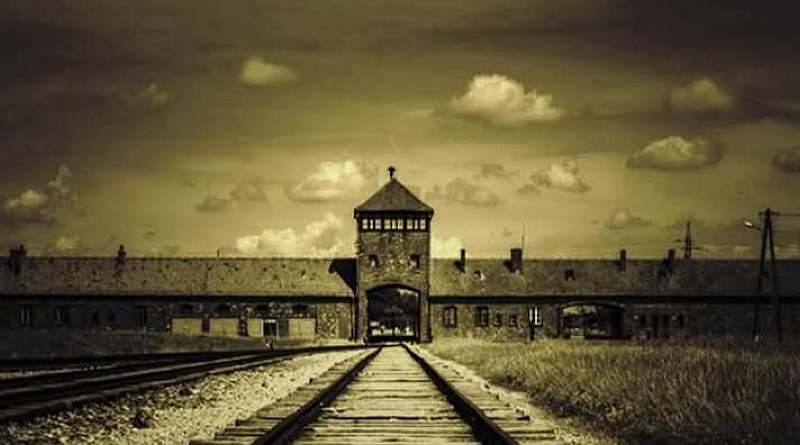
In order to resist these criminal plans, one must at least initially believe in them. “If someone says they want to kill you, believe them. Do not seek rational explanations as to why this supposedly cannot happen, do not think that this is just bluff or politics. Believe immediately,” former Israeli Prime Minister Golda Meir once said, and this is one of the most important lessons from the Holocaust. This conclusion is something very difficult for many Ukrainians to accept and comprehend. But it will have to be made. Putin and his advisors are indeed planning to destroy and expel those who live here. They are not lying to us. That is why it is so important to stop them.
In the foreground: Railway tracks leading to the main gates (“Gate of Death”) of the Auschwitz II (Birkenau) concentration and extermination camp in Poland.
