
Timothy Garton Ash / Translation by iPress
The renowned British historian and publicist Timothy Garton Ash emphasizes that modern Europe relies on two interconnected cores – the EU as an economic-political center and NATO as a military-political core, and it is this dual-core structure that has ensured the continent’s stability for decades. He argues that after Trump’s return to power and the growing threat from Putin’s Russia, Europe’s military core urgently needs restructuring since relying on American security guarantees is no longer feasible. Alongside the long-term Europeanization of NATO, immediate defense planning is needed in case Europe has to contain the Kremlin on its own. Thus, only the resolute political will of European leaders for self-defense can hold back Putin.

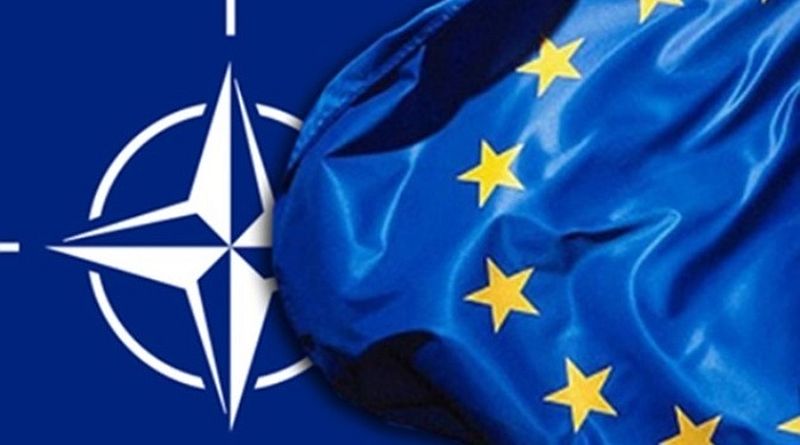
Modern Europe relies on two cores. One of them is the economic and political center in the form of the European Union, the other is the military-political core, which is NATO. Both structures have headquarters in Brussels, yet for decades hardly interacted with each other. However, it is precisely the existence of this dual support that has always been a source of Europe’s strength. At the alliance summit in Ankara, its leaders should admit: the continent’s second core urgently needs rebuilding.
Both organizations have significantly expanded during their existence – today at least 23 European countries are simultaneously members of both the EU and NATO. But while the European Union is characterized by constant change, the alliance, conversely, has been marked by structural stability. Founded in 1949 as a U.S.-dominated hegemonic bloc, it remained so even after expanding to 32 members – until 2025, when Donald Trump’s second presidency called its entire future into question.
For decades, the Washington-led military alliance has protected the peaceful evolution of Europe’s economic and political landscape from potential Soviet, and later Russian, aggression. Less visibly, but no less importantly, it has also safeguarded the continent from a return of old intra-European disputes over military power and leadership.
The external threat has noticeably returned today, and alongside it, the old internal European problem is becoming increasingly apparent. The current concerns of France and Poland about the rapid increase in German defense spending, focused solely within Germany, echo longstanding fears of German military dominance.
After a year and a half of the current Trump administration, it has become clear: Europe can no longer rely on the United States as the guarantor of its security. Could the situation change with the arrival of a new American president in January 2029? It is quite possible. However, Europe would be unwise to count on it. Meanwhile, there is a significant risk that Putin might attack NATO territory before this possibly fortunate day arrives. Knowing that Trump may not be quick to defend Europe, and seeing that the continent is seriously rearming, the cornered Russian dictator might decide this is his last and best chance to prove that NATO has turned into a paper tiger.
Thus, rebuilding the second European core is both an important and urgent task. The EU is called to play a key role in increasing and coordinating funding for European rearmament – something it has already begun through initiatives such as SAFE (Security Action for Europe) and the European Defense Fund. The more funds that can be mobilized, the more effective a catalyst the EU will become. However, it would be a dangerous delusion to think that the EU itself can transform into the military-political core of Europe, and that its mutual defense mechanism – Article 42.7 of the Treaty on European Union – can fulfill the role of NATO’s Article 5. Instead, both Brussels structures should recognize themselves as they were in their best times and as they must become again – two deeply complementary and mutually reinforcing cores.
Regarding the real military defense of Europe, the starting point should be the Europeanization of NATO. This involves two different time horizons – a decade and ten months. Europe and Canada (this great honorary European country) should move, if possible in cooperation with the United States, towards the strategic goal: a Europe that possesses sufficient conventional armed forces, so-called strategic enablers, and later a nuclear deterrent necessary for self-defense.
Meanwhile, NATO needs urgent planning in case Europe must take the lead in its defense, and in the worst scenario – to conduct it alone against potential Russian aggression, whether in the form of sharply intensified hybrid attacks or attempts at direct invasion anywhere from Svalbard to the Black Sea. Especially in the worst-case scenario, the role of rapid-response “minilateral” formations, such as the British-Nordic-Baltic Joint Expeditionary Force, may prove decisive.
No less important is the continued military and economic support for Ukraine, which is currently moving the conflict deeper into Russian territory. Ukraine has shown what fighting spirit and heroic improvisation can achieve even in the most unfavorable circumstances. If properly formulated, such contingency planning should also be supported by the Trump administration.
The details should be worked out through defense planning, preferably in a closed session. However, what should have been publicly and unequivocally demonstrated in Ankara and beyond is the political will of European leaders to respond to both long-term and immediate challenges. Only if Europe shows unwavering resolve to defend itself will it be possible to deter Putin.
