
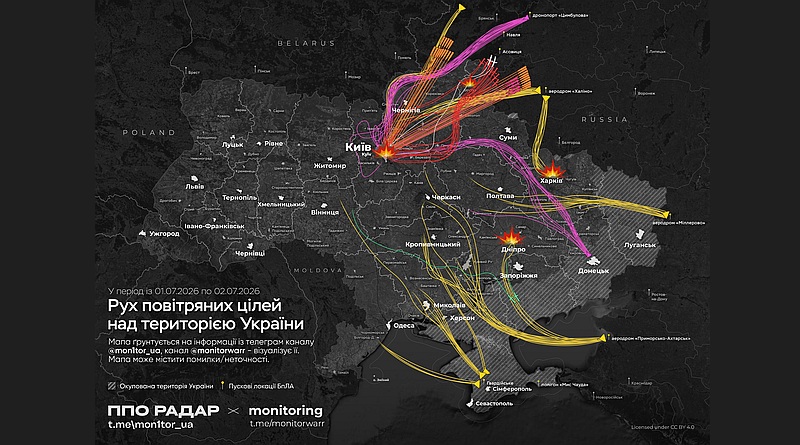

Not unique (in terms of means and strategy), not the largest, but there is a nuance.
Shaheds and cruise missiles were launched and shot down in standard numbers. Shot down 476 out of 494 and 44 out of 46 respectively. Clear interception level of 95%. We have no problems here. Aviation shoots down most, intercept drones as well, everything is in its class of targets.
The problem is with ballistics and Zircons. This time, only 4 out of 24 and none of the four Zircons were shot down.
I repeat, the attack is not unique. There were recently 33 ballistics and 8 Zircons. We’ve shot down much more before. The problem this time is not only the lack of interceptor missiles. I clearly heard, as did many Kyiv residents, the launches of the Pak-3 missiles. There were definitely more than 4 (the number of Iskanders shot down).
The problem with shooting down Zircons is that this time all four were not from Crimea. But from the Bryansk/Kursk region. Because of this, a hypersonic missile flies to Kyiv three times faster than from Crimea. Not 6-8 minutes, but 2! And it doesn’t have as high a ballistic trajectory as the Iskander. The latter reaches 60 km, while the Zircon does not rise above 30-40 km. A very gentle trajectory and very high speed.
As for the ballistic Iskanders, as unfortunate as it is to say, they once again changed algorithms, courses, and flight options. This is not the first time they do this. And that’s why, at night, when I wrote on tg-channel that we have many launches, it’s fine – I firmly believed that one interceptor launch means one shot down. And it was always like that, until this night. They are learning, changing weapon algorithms. Our air defense guys are absolutely great, they can’t do what the missiles aren’t designed for. Not our production, mind you. We need to pass data to the Americans and change something too. And this all takes time.
Honestly, I expected a much larger attack. They prepared for 17 days. They seemed to have lifted up to 10 strategic planes, but a standard number of ~30 cruise missiles arrived. They didn’t even add cruise Iskanders to the wave.
The rocket brigade worked on ballistics again. 24 missiles – that’s 12 launchers. They stood 6 in two regions – Kursk and Bryansk. When the first wave of ballistics from Kursk happened, there were Zircons immediately as well. For the next wave from the Bryansk region, there were no Zircons left. They didn’t recharge the launchers, fired the standard set. So everything points to a lack of resources. Had there been more, they would’ve definitely launched. We are lucky here, and the strikes on all enterprises related to ballistic production will show their results only in the fall. Meanwhile, they change algorithms and force missiles to maneuver against our interceptors. Of course, I won’t detail how this can be done, and they probably do. But for now, we remain vulnerable to ballistics. Hopefully, not for long.
Once again, let me emphasize that our air defense is amazing! They did everything clearly and repelled most of the missiles. Condolences to the families of those who died this night…

Since after every massive attack on Kyiv, members of the drone-interceptor critics club show up, and it frustrates me, I’ll try to provide one answer for everyone.
Each air defense system of Ukraine and Russia has its strengths and weaknesses.
Russia has a strong missile defense; they have been producing missile defense systems for decades. But this system turned out to be weak against drones. That’s why our drones have taken down a lot of various Russian air defenses.
Ukraine has a different situation. We are dependent on the “Patriots,” which are scarce and the only relatively effective weapon against ballistics. Why “relatively”? Because the Russians have long adapted their missiles against the “Patriots,” and the interception rate has significantly decreased.
Looking at the statistics, we see the following numbers (downed/launched):
▪️0/4 3M22 Zircon cruise missiles;
▪️4/24 Iskander-M/S-400 ballistic missiles;
▪️32/34 X-101 cruise missiles;
▪️8/8 Kalibr cruise missiles;
▪️4/4 X-59/69 guided missiles;
▪️476/496 strike UAVs of the Shahed, Herbera, Italmas types, “Banderole” loitering munitions, and “Parody” type imitation drones.
So, it can be said that our system is effective against cruise missiles and drones but fails when it comes to ballistics or Zircons (which are hypersonic, attacking on a final trajectory like ballistics). Cruise missiles are effectively intercepted by aviation and other SAM systems. Ballistics and hypersonics—only by “Patriots.” And we see the result of this scarcity, with only 4 out of 28 such missiles being downed. 24 missiles on the capital. Poor Kyiv.
So how do we counter this?
By doing what is currently being done. Hitting the military-industrial complex targets that are part of the production chain of such missiles. And we are doing this, by the way, with drones and cruise missiles, and even with greater efficiency than Russia.
Yes, I understand, it’s not enough, but every successful attack on a Russian MIC plant is a combined operation using different forces and means, allowing drones and “Scalps,” “Neptunes,” or “Flamingos” to reach the target through Russian air defense. It’s terrible, of course, that expert Facebook forces are not involved in planning such attacks, which would certainly boost the hit efficiency, but what can you do, that’s a drawback of the existing system.
Can we influence the modernization of existing “Patriot” systems and increase their supply? I think so, but very limitedly. Can we quickly build an anti-ballistic shield that can counter such invasions? Let’s be realistic. This is a task for years.
Therefore, we root for the Armed Forces, so they can quickly break the production chains of Russian missiles. In our conditions, this is probably the most effective method of countering combined pro-Russian strikes.
