
Pjotr Sauer, The Guardian / Translation by iPress
The British newspaper The Guardian claims that European countries are increasingly coming around to the idea that a direct dialogue channel with Putin might be necessary, but cannot agree on who should speak on their behalf. A phone conversation between the leaders of Finland and Norway with the Russian president demonstrated how quickly such individual initiatives can spark disputes even among close allies. Some European politicians consider contacts with Moscow a pragmatic necessity, while others fear that it would only weaken pressure on the Kremlin and allow Putin to exploit differences among allies. At the same time, analysts emphasize that Putin’s willingness to talk to Europeans does not indicate his readiness to abandon maximalist goals in the war against Ukraine.
Since there is no single European representative directly negotiating with Moscow, some leaders are establishing their own communication channels; however, the results of such contacts turn out to be controversial, writes the British The Guardian.
Northern European countries rarely engage in public disputes over foreign policy, especially concerning Russia. However, a 90-minute phone conversation this week with Putin, conducted by the leaders of Finland and Norway, elicited an unusually sharp reaction from their Danish and Swedish neighbors.
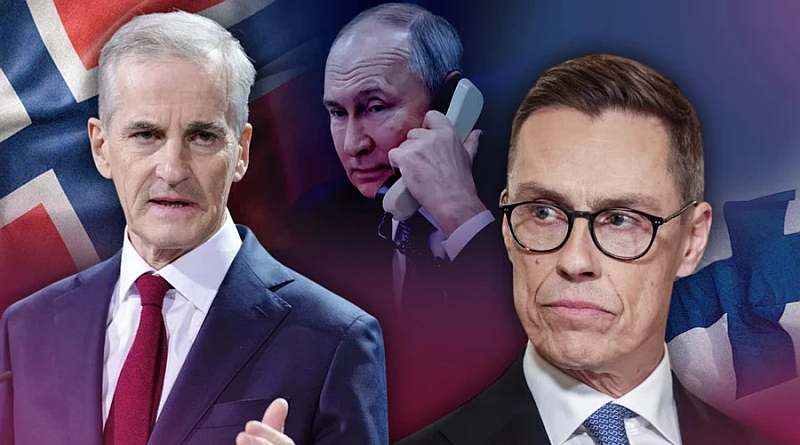
On Tuesday, Finnish President Alexander Stubb and Norwegian Prime Minister Jonas Gahr Støre spoke with Putin—a rare high-level contact between the Russian leader and European allies of Ukraine. Both Northern European leaders emphasized that the conversation was conducted on Ukraine’s behalf and that allies were informed in advance.
This did not convince their neighbors.
“I am very skeptical of this independent initiative by Norway and Finland,” stated Danish Prime Minister Mette Frederiksen, complaining that the call was not coordinated with Copenhagen. “Honestly, I do not understand what they hope to achieve from it,” she added. Swedish Prime Minister Ulf Kristersson also criticized this initiative, stating that he was not informed about it in advance.
These disputes, The Guardian emphasizes, highlighted the differences that could complicate Europe’s attempts to establish its own communication channel with Moscow: governments cannot agree not only on whether to engage in contact with Putin but also on who should speak on their behalf.
“Instead of a tightly knit, homogeneous group, we see a split,” said Arkady Moshes, director of the Russia program at the Finnish Institute of International Affairs. “By Northern European standards, this is quite serious,” he emphasized.
Since the summer, European leaders have been discussing, without much progress, whether to appoint a representative for direct negotiations with Moscow to end the war in Ukraine. The discussion became more urgent after Donald Trump, in The Guardian’s estimation, aligned closely with Moscow in recent weeks—at the expense of Ukraine’s interests.
A new round of peace talks is expected next month in Abu Dhabi, and European governments fear that they may be sidelined in negotiations that could determine the continent’s security for decades.
“Overall there is agreement that we need to talk to Putin, but attempts to establish contact are increasingly turning into chaotic competition,” said a high-ranking European diplomat on condition of anonymity. “Too many leaders believe that they alone can bring Putin to the negotiation table,” he asserted.
Mixed Signals
This year, British, French, and German ambassadors have conducted negotiations with Russian officials, a senior diplomatic adviser to Emmanuel Macron traveled to Moscow, and the office of European Council President António Costa has established its own contacts with the Kremlin.
This sharply contrasts with Putin’s diplomatic isolation after Russia’s full-scale invasion of Ukraine in 2022, when most European leaders avoided direct contact with the Kremlin. Stubb himself stated during the 2024 presidential campaign that he would not pick up the phone if Putin called him.
Analysts this week attributed part of the negative reaction to Stubb and Støre’s call to the conflicting explanations of its purpose. Initially, the conversation was presented as an attempt to convey Ukraine’s position to Putin, but it later became clear that it had broader goals.
Støre later defended Norway’s decision to contact Putin directly, citing the need to regulate the use of shared fish stocks in the Barents Sea and maintain security along the countries’ shared border. Stubb, in turn, stated that the conversation also aimed to prevent misunderstandings between Russia and its Northern European neighbors.
“Stubb and Støre seem unable to reconcile their explanations: whether it was about Ukraine or also about their own security concerns,” said Joel Linnainmäki, former Finnish diplomat and analyst in Helsinki.
“If it looks messy, it probably is,” he added.
This confusion reflects wider differences in Europe regarding how to deal with Putin, even though governments generally maintain unity in supporting Ukraine.
“In essence, the level of unity in Europe is actually quite high, but there are different views on how to interact with Russia, when the right moment will be to resume high-level dialogue, and who exactly should lead it,” explained Kristi Raik, director of the leading Estonian think tank ICDS.
As The Guardian notes, France has long advocated for maintaining an open communication channel with Putin, while Germany and the United Kingdom act more cautiously. The Baltic countries and the head of the EU’s foreign policy service, Kaja Kallas, fear that restoring high-level contacts may weaken pressure on Moscow without securing any concessions.
The publication points out that the question of who should lead any European contacts with Moscow has also proved controversial.
The Foreign Minister of Luxembourg, Xavier Bettel, one of the few European leaders who maintained telephone contact with Putin after the full-scale invasion, mentioned that he faced criticism from European colleagues for his initiative. “Some colleagues told me: who is the Prime Minister of Luxembourg to speak with the President of Russia and the President of Ukraine? You are such a small country,” he said at a conference in Prague in May.
“The problem is also with the approach of some countries that believe only France, Germany, or the USA can conduct such negotiations,” Bettel believes.
No single EU representative
The Guardian emphasizes that currently, no one has a clear mandate to negotiate on behalf of all 27 EU member states. Theoretically, the publication notes, the task of talking to Moscow could fall to Kallas. However, she does not have independent powers to negotiate on behalf of the bloc without a mandate from member states, and in European capitals, there is growing dissatisfaction with the EU diplomatic service she leads.
Kallas, a former Prime Minister of Estonia and one of the harshest critics of the Kremlin in the EU, is also considered by many as an unlikely interlocutor for Putin. Moscow has put her on a wanted list, and Russian officials have made it clear that they have little desire to negotiate with her.
Dutch MEP Reinier van Lanschot called on EU leaders to convene a summit and agree on a single representative for contacts with Putin. He stated: “The EU must speak with one voice, and Ukraine must always be involved. If these two conditions are met, then in my opinion, Europe’s involvement in negotiations is quite logical.” At the same time, he acknowledged that reaching unanimous agreement will be difficult, as any proposed appointment may be blocked by the veto of a single member state.
Meanwhile, the initiative of the Nordic countries this week may encourage other European politicians to create their own channels of communication with Moscow, believes Linnainmäki. “Inevitably, politicians all over Europe will now ask: if Finns and Norwegians are calling Putin, why shouldn’t our country?” he noted.
Putin’s “Plan A”
Beyond the question of who should speak to Putin, there is another, more fundamental one: whether there is any point for Europe to talk to him at all.
Raik warned that Putin might perceive sudden European interest in resuming dialogue as a sign that Ukraine and its allies are becoming desperate amid the difficult winter expected for Kyiv.
“I am concerned that the Kremlin now reads this step as: Europeans have problems, Ukrainians have problems,” she said. “Knowing how Putin views Europe, I think he always seeks to seize opportunities to create divisions or at least the appearance of them.”
The Guardian emphasizes that the Kremlin’s statement about the conversation with the leaders of Finland and Norway showed almost no signs that Putin’s maximalist demands for ending the war have changed.
According to Financial Times, Putin lectured the leaders of the northern countries on medieval Slavic history, repeating pseudo-historical arguments he has long used to question Ukraine’s right to exist as an independent state.
At the same time, Moscow seems to have become more open to Europe’s participation in the diplomatic process after U.S. special envoy Steve Witkoff met with Putin in St. Petersburg last week.
Moshes suggested that Moscow is tiring of Trump’s unpredictability and views Europe as an alternative, given that the midterm elections in the U.S. may politically weaken the president.
However, Moshes warned that Putin’s willingness to answer the phone should not be mistaken for a willingness to compromise. “This does not mean that we are any closer to a ceasefire, let alone peace, as it is clear that Putin’s plan A is the military defeat of Ukraine,” he is convinced.
Collage: UP
