

Information on the current losses of the Russian Federation due to sanctions as of 01.11.2026.
1. Ukrainian drones attacked one of Russia’s largest oil refineries — the “LUKOIL-Nizhegorodnefteorgsintez” plant in Kstovo.
– On the night of November 1, Ukrainian drones attacked the Kstovo oil refinery in the Nizhny Novgorod region of Russia. After the attack, a large fire broke out on the premises. Videos released online show thick smoke over the industrial area.
– This refers to “LUKOIL-Nizhegorodnefteorgsintez,” known as NORSI — one of the largest oil refineries in Russia. Its design capacity is about 17 million tons of oil per year, or approximately 340,000 barrels per day.
– The enterprise produces motor gasoline, diesel and aviation fuel, fuel oil, bitumen, and lubricants. The Kstovo refinery has repeatedly been the target of Ukrainian attacks.
– After the attack in August, the enterprise halted oil processing, and on September 4, the General Staff of the Armed Forces of Ukraine officially confirmed the cessation of its operations.
2. Debts of Russian enterprises for wages increased by almost 19% in a month and exceeded 2.4 billion rubles.
– As of September 1, 2026, the overdue debt of Russian enterprises to employees exceeded 2.4 billion rubles. In August, it increased by 385.3 million rubles, or almost 19%, and over the year it grew by 47.4%. More than half of the debts — 1.31 billion rubles, or 54% of the total amount — accumulated during 2026.
– The main reason given by enterprises for the non-payments is a lack of own funds, meaning businesses increasingly lack the resources for timely settlements with employees.
– The situation in the corporate debt market is also deteriorating. While 11 bond issuer defaults were recorded in Russia in 2024, there were already 24 in 2025. In the incomplete year 2026, their number reached 33. High interest rates on loans and limited access to financing complicate the situation for Russian companies.
– At the same time, significant budgetary expenditures on the war increase pressure on the economy, and enterprises increasingly face a lack of working capital and problems fulfilling financial obligations.
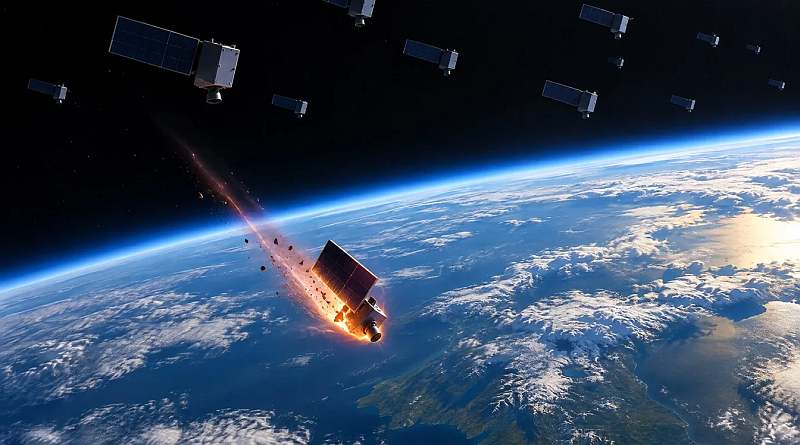
3. The Russian equivalent of Starlink is losing satellites: two more “Rassvet” devices are going off orbit.
– Two more satellites of the Russian “Rassvet” system, which the Kremlin promotes as its own alternative to Elon Musk’s Starlink, are losing altitude and are expected to burn up in the dense layers of the atmosphere. This refers to the Rassvet-30-17 and Rassvet-3-23 devices, which failed to achieve a stable orbit following a group launch in July 2026.
– Of the 17 satellites from the July batch, three did not manage to reach a stable altitude of about 500 km. According to calculations, Rassvet-30-17 was expected to enter the dense layers of the atmosphere on October 31, and Rassvet-3-23 was to deorbit within 78 hours after November 6. Another device that began losing altitude in August only resumed maneuvers to increase it in September. Problems have plagued the project since its initial launches.
– Of the 17 satellites launched into orbit at the end of March, one did not reach the designated altitude and subsequently fell. Another 14 devices formed an orbital group at an altitude slightly over 500 km, significantly lower than the target 800 km specified by the developer, “Bureau 1440”.
– Both group launches of the Russian project were accompanied by problems with bringing the satellites to the calculated orbits. Instead of deploying a full-fledged satellite internet system, which was supposed to be a Russian alternative to Starlink, “Bureau 1440” is facing repeated technical failures at the initial stage of the project.
4. Kallas: invitation of Putin to the G20 summit could legitimize Russia’s war crimes.
– The potential participation of Putin in the “Group of Twenty” (G20) summit, which will take place in December in Florida, could legitimize Russia’s return to international platforms despite the war against Ukraine. This was stated by the high representative of the EU for foreign affairs, Kaja Kallas.
– According to her, Putin’s invitation raises serious concerns as it creates the risk of normalizing the war crimes that Russia continues to commit in Ukraine. Kallas emphasized that if Moscow is truly interested in peace, it should first stop the attacks that result in the deaths of civilians.
– Commenting on the participation of Russian Foreign Minister Sergey Lavrov in the G20 foreign ministers’ meeting in Atlanta, Kallas called his behavior unconstructive. In particular, she criticized the proposal to hold a meeting between Putin and Ukrainian President Volodymyr Zelensky in Moscow, despite the existence of neutral platforms for negotiations.
– At the same time, Kallas noted that Lavrov’s presence allows European representatives to directly refute Russian statements. Kallas also welcomed the US decision to sell Ukraine interceptor missiles for Patriot systems but opposed Washington’s pressure on NATO allies to soften rhetoric about the Russian threat.
– According to her, ignoring this threat will not eliminate it, and Europe should increase defense spending and limit funding to Russia’s military machine. In Kallas’s view, Moscow believes that time works in its favor and is not showing readiness for concessions in negotiations, expecting the West to eventually make them. She also warned against steps that might strengthen the impression of a split between Ukraine’s allies.
5. The US may allow “Belavia” to purchase Boeing parts and aircraft.
– The management of the Belarusian airline “Belavia” announced that it has received permission from the U.S. Department of Commerce to cooperate with the American corporation Boeing.
– According to the carrier’s representatives, this should open up the possibility of directly purchasing spare parts, components, and software for Boeing aircraft already in the company’s fleet. Additionally, “Belavia” will be able to negotiate the acquisition of new aircraft from the American manufacturer.
– At the same time, the text of the new U.S. authorization has not yet been published, so its exact terms and scope are unknown. Specifically, it needs to be clarified which supplies and operations with Boeing will be permitted. In 2021, the European Union imposed sanctions on “Belavia” following the forced landing of a Ryanair plane in Minsk and the detention of opposition activist Roman Protasevich.
– In 2023, the airline was added to the U.S. sanctions list for violating export controls imposed due to Minsk’s support of the Russian invasion of Ukraine.
– In September 2025, Washington lifted American restrictions as part of agreements related to the release of 52 political prisoners. After the sanctions were imposed, foreign lessors withdrew some of the Boeing and Embraer aircraft from “Belavia.” To maintain the airworthiness of the remaining fleet, the company had to supply components through third countries and dismantle old planes for parts.
6. Argentine bank Galicia began blocking the accounts of Russians.
– One of Argentina’s largest private banks, Galicia, began restricting access to the accounts of clients with Russian citizenship at the end of October. The first cases were recorded on October 28–29. The restrictions affected even Russians who had obtained Argentine citizenship, as well as some citizens of Belarus.
– According to clients, accounts were blocked without prior notice. In bank branches, they were reportedly explained that the reason was Russian passports. Meanwhile, cash withdrawals were allowed only in limited amounts.
– Almost 500 bank clients with Russian and Belarusian citizenship are reportedly preparing a collective lawsuit against the financial institution. Argentina did not join the sanctions against Russia and Belarus after the outbreak of full-scale war. However, among the possible reasons for the bank’s actions are concerns about secondary U.S. sanctions. Another assumption is related to the completion of Galicia’s merger with the Argentine division of the international banking group HSBC.
