

It seems that only the lazy haven’t talked about the world experiencing a political leadership crisis. Therefore, it’s worth discussing the reasons for this phenomenon, which is becoming characteristic even of the most developed countries with functioning institutions and quality education.
One reason is that we have unknowingly changed the mechanism by which societies determine their leaders.
A bit of history. Democracy was born in the Agora, where citizens could listen, argue, persuade, and make decisions. Two and a half thousand years later, we have returned… to the Agora. Only now, it is digital.
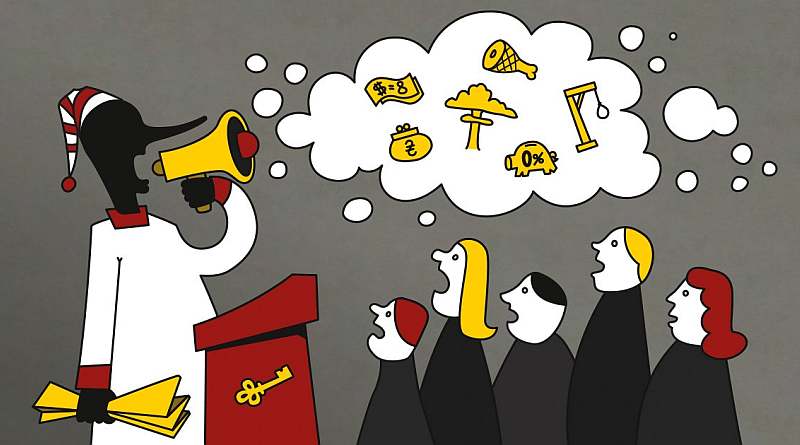
This refers to social media, which has removed the filter of professional journalism from the information societies consume. And in this social media agora, a new principle operates: the winner is not the one who has something to say, but the one who can attract the most attention. Simply put, just like in ancient Greece—the loudest voice wins.
Attention has become the main political currency. And the simplest way to get it is by evoking strong emotion. Fear, outrage, hatred, delight. It doesn’t matter which, as long as the person doesn’t pass by, clicks, comments, or shares.
As far back as 1967, French philosopher Guy Debord in “The Society of the Spectacle” described a world in which images increasingly define our perception of reality. Political action begins to compete with its spectacular representation.
Applying this logic to politics creates a dangerous substitution:
state governance gives way to the demonstration of governance. Political action yields to media image. Real results compete with a convincing picture.
Another media researcher, Neil Postman, in his 1985 book “Amusing Ourselves to Death,” warned that the form of communication not only changes the way information is conveyed but also the very nature of public thinking.
He compared two dystopian fears: Orwell’s, who feared a world where truth would be forbidden, and Huxley’s, who predicted a world where truth would simply drown in an endless stream of entertainment and informational noise. Postman considered the second scenario particularly dangerous for the culture of his time.
Social media algorithms do not distinguish between a statesman and a demagogue based on the quality of their decisions. They optimize user engagement. And herein lies the fundamental problem of modern democracy.
If political success increasingly depends on the ability to evoke emotions, society starts choosing leaders based on qualities that are not necessarily needed for state governance.
The ability to simplify the complex becomes more important than the ability to solve it. Confidence, even if it is as primitive as possible, is more persuasive than competence. An emotional promise is more attractive than a realistic strategy.
And the readiness to tell an unpleasant truth can turn out to be a political weakness. A politician who explains the complexity of a problem loses attention to someone who names a single culprit and offers one simple solution. In general, simple solutions seem best to the masses in times of overly complex global problems.
But the greatest danger is not even that people who are better at grabbing attention than governing may come to power. The main issue is that even competent politicians are forced to adapt to these rules to remain politically competitive.
This changes politics itself. Long-term solutions give way to short-term effects. Complex compromises become a sign of weakness. And political responsibility increasingly loses to political spectacle. Because responsibility is boring, and we want a show, quick dopamine, short but bright phrases.
All this happens at a time when the world needs particularly complex decisions regarding war and peace, the future of democracies, artificial intelligence, climate change, and global security.
Perhaps the greatest paradox of our time is that the more complex the world becomes, the simpler the answers we demand from our leaders. And the more chances those who are ready to promise these answers get.
From this arises many phenomena in modern politics that we often wonder: how was this even possible? From Trump’s tweets to the rising popularity of populist parties in Germany, France, and even the cradle of the Anglo-Saxon world — Great Britain. And Ukraine is no exception.
A strategic leader must sometimes say what society does not want to hear. Make decisions whose results will not be seen before the next elections. And take responsibility for consequences that will manifest in decades.
We are creating an informational and political environment where strategic leadership becomes a competitive disadvantage…
Perhaps the main crisis of XXI century democracy is not that it lacks strategic leaders. But that it is gradually losing the ability to elect them.
Therefore, one of the crucial tasks is to build a system whose future will not depend on the accidental emergence of a great leader. Because a truly strong democracy is not one that is lucky with a leader. But one that can think strategically even when it is not. And this is about functioning institutions that are independent of personalities.
P. S. I will illustrate the text with this message. Because algorithms still need visualization, and this very morning picture definitely evoked a lot of emotions and these thoughts in me).

