
Timothy Snyder / Translation by iPress
Renowned American historian and publicist Timothy Snyder argues that the main lesson of the September 11 attacks lies not only in the tragedy itself but in how a state reacts to provocation. In his opinion, the US, after 2001, acted many times in exactly the way terrorists wanted: expanding the policy of fear, starting the war in Iraq, and undermining trust in international law and its own institutions. He connects these decisions with the further strengthening of authoritarian tendencies in the US and a more favorable environment for Russian aggression against Ukraine. Writing from a shelter in Kharkiv, Snyder calls not to let terror, external or internal, dictate policy and not to abandon independent thinking.
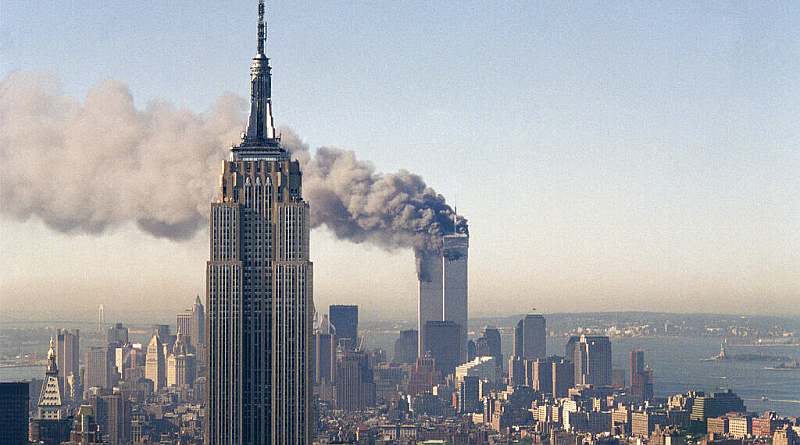
On September 11, 2001, in the second week after I became a professor at Yale University, I already knew what the next class would be about: the history of provocation. Terrorists directed two passenger planes into the twin towers and a third into the Pentagon; heroic passengers and crew members of the fourth plane sacrificed themselves to prevent another strike on the nation’s capital.
When a large-scale terrorist attack occurs, you have to think even when you are suffering. Your suffering, although desired by those who caused it, is not the terrorists’ ultimate goal. They are trying to push you into a certain psychological state so that you do even more harm to yourself. History is full of acts of terror.
The real question, I told the students, is what you will do next.
You cannot prevent every terrible event. But your freedom begins with your response.
Unfortunately, Americans in power reacted as the terrorists wanted; moreover, we exceeded their expectations by making the world much worse for ourselves and everyone else.
Americans allowed the terrorists to define the rules of the game: their violence and our violence. We had the opportunity to deeply reflect on September 11 and respond in a way that would create a safer world for many future generations. But we did not take this opportunity.
The main political response of America to September 11 should have been freeing itself from dependency on fossil fuels. Without our dependence on oil, we would never have been so involved in Middle Eastern affairs. Most of the September 11 terrorists were Saudis – citizens of the oil kingdom we helped build, our “ally.” The correct response in September 2001, as I then wrote to an acquaintance in the White House, should have been to finance nuclear fusion and other sources of clean energy. If we had done that, we could have curbed global warming, prevented new wars in the Middle East, and ultimately prevented the emergence of Vladimir Putin’s hydrocarbon oligarchy and his invasions of Ukraine.
Today we are faced with the reality of rising ocean levels, massive fires, and resource conflicts. We were given the chance to stop all this.
But we did not use it. George W. Bush became President of the United States, although he likely lost the election to Albert Gore after the Supreme Court stopped the ballot counting in Florida. Gore was an environmental advocate deeply concerned about global warming. Had 9/11 occurred during Gore’s presidency, he would have intensified the search for safe energy sources. Gore was also more experienced and competent than Bush, who came from a political family connected to the oil industry and had not achieved anything particularly remarkable before. If Gore had been president, 9/11 might not have happened. But it occurred during the tenure of an inexperienced oilman. Bush’s White House never intended to link the attack to its root causes.
We didn’t do what we should have done. Instead, those in power in America did exactly what the terrorists wanted. They attacked us, said President Bush, because they “hate freedom.” And his response in domestic policy was to use our own government’s tools to limit our own freedom.
A telling example was the creation of the Department of Homeland Security. It brought together a motley collection of agencies under one leadership, turning all their work, such as border management, into a matter of “security.” Yes, the terrorists’ luggage should have been checked more thoroughly. Yes, international terrorism, which killed about 3,000 people that day, was a threat to be taken seriously. But there were other things that made us less secure: by comparison, that year about 17,000 Americans died from handguns, about 19,000 died from drug overdoses, and approximately 21,000 – due to lack of access to healthcare. When the concept of “security” was tied only to one type of threat, all other problems only worsened.
But security is just one aspect of border management. Borders are also places where we trade and become wealthier, meet friends, and build relationships. Defining the border solely as a security issue laid the groundwork for the domestic policies we have now: our leaders tell us that we will be safe when we divide the people living in America into “legal” and “illegal,” into “us” and “them,” and build ever more detention camps for “them.”
The very concept of Homeland – “homeland,” which echoes the Nazi obsession with Heimat, was no less dangerous. At that time, it was an unusual name for a government agency that did not quite fit American English or American institutional traditions. But since then, the word “homeland” has normalized – in its essentially fascist meaning. Under the current administration, we are being conditioned to think of a vulnerable “homeland” threatened by some of the people living on it.
The current Minister of Defense, Pete Hegseth, is turning the armed forces into an arena of cultural wars—“us” versus “them,” men versus women, whites versus Blacks—while telling us that the future mission of the military will be “homeland defense.” The implication is that the armed forces should become nothing more than the ruler’s personal militia, used to suppress resistance against Donald Trump. He hasn’t reached that point yet, but it’s clear that’s what he’s thinking about.
Of course, it took more than turning everything into a security issue and a fascist takeover of the “homeland” to bring us to a situation where figures like Trump and Hegseth came to power. One of the main reasons for their rise was the second war in Iraq—our invasion of that country in 2003, which we chose as a foreign policy response to 9/11.
And this self-chosen war was exactly what the terrorists would have wanted. It was the worst possible response to their provocation. It traumatized us and made us vulnerable to politicians like Hegseth, Trump, and J.D. Vance, who used the trauma of war to come to power—only to bring us new wars and make us even more susceptible to terrorism. Meanwhile, this war entrenched us in a political economy whose main components became military spending and debt. In the early 2000s, we still had a good chance to deal with issues of wealth inequality, lack of social mobility, and family insecurity, which only worsened over the next two decades. Instead, we chose to pour not only blood, mostly someone else’s, but also wealth into the sand. Although Bush was losing the war in Iraq in 2004, he managed to turn it into an argument for a second presidential term, making the first decade of the 21st century a time of the death of the American dream.
Americans believed, because they were told to believe, that Iraq was somehow connected to 9/11, and thus, as a nation, they did the one thing you should never do: they followed the psychological script written by the terrorists themselves. But the situation was unfortunately even worse. In 2002, our elected officials became co-authors of this psychological script. The Bush administration deliberately fabricated links between Iraq and the predominantly Saudi terrorists who attacked us on 9/11. The scale of this lie was itself problematic because it caused Americans to distrust their government and enabled the rise of Trump and those like him. But it also had consequences for the entire world. These fabricated reasons became the justification for an action that violated the most fundamental principle of international law—the prohibition of unprovoked aggressive wars.
The Iraq war, and especially the lies surrounding it, sharply reduced the chances of the emergence of anything like a global legal order where democracies could thrive together.
At the beginning of the 21st century, it seemed that an era of democracy was opening. If we count approximately twelve years back from September 11, we will see the revolutions of 1989, the end of communism in Eastern Europe, the reunification of Germany in 1990, and the collapse of the Soviet Union in 1991. These revolutions not only increased the number of democracies in the world; they brought new ideas about freedom, associated with truth and solidarity. During the preparation to invade Iraq, Americans used arguments about democracy: if liberation was possible in Eastern Europe, it was possible in the Middle East too. But the situation, of course, was entirely different: it’s one thing to oppose a dictatorship with the forces of civil society, as in Eastern Europe, and quite another when a dictatorship is overthrown by means of a foreign invasion, as in Iraq. Moreover, Eastern Europeans had an idea of what would come next; Americans in Iraq did not, they imagined that it was enough to simply destroy one regime for another to arise in its place.
However, many of the most interesting Eastern European dissidents, such as Václav Havel in Czechoslovakia, had one vulnerability: they trusted the Americans. So, they were drawn into a propaganda campaign of big lies, which, if they had not been so pro-American, they might have recognized from their own experience. The consequence, unfortunately, was the loss of trust by Eastern Europeans in their own ideas of liberation.
If we count approximately twelve years forward from September 11, we see the first Russian invasion of Ukraine. Indeed, the American invasion of Iraq in 2003 and the first Russian invasion of Ukraine in 2014 are now closer in time to each other—eleven years—than the first Russian invasion of Ukraine is to the present—twelve years. Russia invaded Ukraine in 2014 for internal reasons: a corrupt hydrocarbon regime could not provide order and prosperity, so instead offered an external war intended to unite Russians around a vision of past and future glory. It would be incorrect to say that the American invasion of Iraq caused the Russian invasion of Ukraine. The Russians themselves must bear responsibility for their own crimes. But the American war certainly made life easier for Putin.
In 2013 and early 2014, I warned that Russia might invade Ukraine and seize Crimea, which indeed happened. One reason for my concern was the surreal propaganda in Russian media. Although it was much wilder than American propaganda in 2002 and early 2003, they had something in common: it was senseless and self-contradictory. Americans claimed they wanted to fight terrorism by overthrowing the Iraqi regime, which, though terrible, suppressed Islamism, the force behind September 11. They argued that the army could bring democracy by simply toppling the regime. Even then, it was clear that this was not just a mistake: there was a perverse enjoyment in the aggressive absurdity. The Russians took this to the point of absurdity: Ukrainians were simultaneously all gay, all Nazis, and all Jews. Moscow claimed that their state did not exist, but at the same time that it oppressed Russians. Being an authoritarian regime itself, Russia claimed it would bring democracy to Ukraine, which was already a democracy. And so on.
In Moscow, Putin concluded that great powers do precisely this: invade other countries under the cover of blatant lies. And the fact that the United States indeed did so complicated both the accurate description of Russia’s actions and the response to them.
In Ukraine, where I arrived shortly after the war began to hold a major international conference, it was not difficult to understand what was happening: one country had invaded another. Shortly after the invasion started, I participated in a public discussion in Prague. Emotions were strong; people in the crowd wore t-shirts with Russian fascist slogans. One of them took the microphone and asked: why should Russia follow any rules if the Americans didn’t follow them in Iraq in 2003? I replied that rules are rules and that the American invasion was also illegal; one violation does not justify another.
The question from this young man was indicative of the Russian approach: there is no truth, no right or wrong, no rules. This approach emerged in Russia and stemmed from the internal logic of the oligarchic regime. But we made it easier to use such arguments. In 2014, the American reaction to the Russian invasion of Ukraine was lukewarm. President Barack Obama had inherited the wars in Iraq and Afghanistan. Europe seemed like just a distraction.
At the end of 2021 and the beginning of 2022, when Russia was preparing for a second invasion of Ukraine, the shadow of Iraq still loomed over the situation. Two decades earlier, the Americans had used their intelligence services to lie about the reasons for their own invasion of Iraq. Now they used their intelligence services to reveal the truth about Russia’s invasion plans in Ukraine. In general, they were not believed, even though the facts were clearly on their side. And, of course, they were right: on February 24, 2022, Russia launched a full-scale invasion of Ukraine. Undoubtedly, this distrust also had psychological reasons: it is hard to believe something so horrific, especially if it requires responsible decisions from those in power. But in 2022, it was easier to doubt the American truth because of the American lies of 2002. Since we had put so much effort into misleading people about Iraq, it was easier for them to doubt us when it came to Ukraine. As a result, everyone was less prepared than they could have been when the big war, as the Ukrainians call it, began.
We are marking a quarter of a century since September 11. On the eve of it, I was in New York, and early in the morning, I returned to New Haven; when I found out what happened, I went back to the station and tried to return to the city, but the station had already closed. I went into a pizzeria and thought about what to say to the students in the next class. I was supposed to teach them about the history of Eastern Europe—that was my job. I didn’t want to cancel the class; I wanted to somehow respond to what had just happened. So I told them about how provocation works.
In Russian and Eastern European history, this is one of the key themes; at that time, I was writing a book about some of these operations. The Russian imperial intelligence services, and later the Soviet intelligence services, perfected this art: not acting directly, but provoking the other side, making it do what you want, so that it believes it is acting of its own volition. To strike in such a way that the blow is accompanied by manipulation; to steer the adversary where you need them to go and make them harm themselves. This is still largely how the Russian intelligence services operate. They supported Trump in all elections, because through him, Americans could harm and weaken themselves as much as possible.
I said to an audience in September 2001, twenty-five years ago, that terrorism can also work as a provocation. The provocateur doesn’t necessarily have to be a state; it can also be terrorists acting against a state, trying to make it do something that harms its own citizens. The weaker side can hit the vulnerabilities of the stronger. It can compel the stronger to act against its own interests.
Our inability to see this, of course, is the story of these twenty-five years. We were provoked, and we did what the terrorists wanted. Together with them, we created a world in which terrorism became so common that we almost don’t know when it’s appropriate to use the word; it turned into a propaganda cliché used by state terrorists like Putin and Trump to label their enemies. And they themselves are, of course, state terrorists. The phenomenon of Trump cannot be imagined without 9/11 and the invasion of Iraq. He was also aided by Russian support on social media. Then Trump himself normalized terrorism by trying to stay in power through force in January 2021.
Putin’s war in Ukraine is clearly a criminal war of aggression; the rape of women and the abduction of children are obvious war crimes, as are the mass executions of activists in occupied territories. All of this can be considered terrorism, although other definitions also apply to these actions. But the most obvious manifestation of terror is the daily launches of drones and missiles at the civilian population of Ukraine.
I write this underground in Kharkiv, Ukraine, and tonight the air raid sirens have gone off for the third time. Far removed from us, the Russians launch deadly munitions at Ukrainian cities, violating all laws and norms of warfare and fundamental norms of humanity.
Ukrainians will shoot down most drones, but missiles simply fall, explode, and kill—Ukraine now has very few missile defense systems. This is because the Americans decided not to provide them with missiles for the Patriot systems. Partly, this is the solidarity of terrorists: Trump sympathizes with Putin, his envoys have just been in Moscow praising Putin’s “goals.” Partly, it’s a side effect of our own last war: the anniversary of 9/11 in the United States coincides with yet another illegal and senseless war in the Middle East—this time a doomed war consciously chosen by Trump against Iran.
This war, like the 2003 war, made no sense from the start and has already produced many of the same consequences—in just a few weeks, not years. It also means that the United States has senselessly, and sometimes lethally, used ammunition in the Middle East that could have saved lives in Ukraine.
Trump’s war against Iran makes Putin’s war against Ukraine easier. Terrorists are in power—and they stick together.
So why are the United States still fighting against Iran? The war is lost, and it is very unpopular. Why does Trump, knowing all of this, continue it with only a few weeks left before the US midterm elections? He constantly worries aloud that his power will be limited if his party loses.
So how can this war help him at all?
One possibility is that he hopes for a “second 9/11”: if he continues to launch missiles at Iran, the Iranian regime will do him a favor by resorting to deadly violence on US soil. Then he could try to suspend the elections, deploy even more American troops in an even greater number of American cities, or stay in power indefinitely. Many American agencies, which should have prevented terrorist attacks, are now headed by people without proper experience, who are not just incompetent but somewhat worse. This is how one could actually want the terrorists to win: start another major war in the Middle East, weaken your own defense, and hope for the worst. Iran may resort to this; or, under the guise of war, Trump could claim that Iran did it. His Hungarian friend Viktor Orbán used exactly such a tactic in the last elections in Hungary.
After all the provocations, lies, and terror that happened after 9/11, it would be unwise not to be psychologically prepared for such circumstances.
And the answer then, as now, is the same: you cannot prevent every horrible event. But you can choose how to react to it. Your freedom begins with your reaction.
Whether we are preparing for some new terrorist attack or just making sense of the last twenty-five years, the lesson is the same: do not do what the terrorist wants you to do. Think about what exactly the terrorist wants you to do, and do something else.
Right now, I am underground, in a real basement, while real shells fly through the air; but in a broader historical sense, I am trapped in a cage we created for ourselves and chose to enter over the last twenty-five years. Too many of us, especially those in power, acted as if they wanted the terrorists to win, and some even became terrorists themselves.
From here, where I sit with my back against the wall, the terror is obvious and audible—Russian terror. And yet, in these dark pre-dawn hours, I smile. I remember the Ukrainians I’ve met in recent days and nights here in Kharkiv: families bringing their dogs to an underground bar to listen to a lecture; a drone operator shyly reading her own poems; former businessmen in bunkers explaining their command principles. I think about people who don’t do what the terrorists want, in truly difficult circumstances, when terror comes almost daily; about people who don’t give up or go with the flow but think independently about the future.
This is what I think we, Americans, should do today, on these terrible anniversaries. The Trump regime will tell us that the lesson of 9/11 is to obey authority, to allow terrorism to dictate self-destructive policy, and then to equate patriotism with self-destruction. Instead, we should learn from the past, from the history of terrorism in general, from the experience of those terrible days, but also from our own failures over the last quarter-century.
Don’t let terrorists holding state power tell you how to respond to terrorism.
Don’t fall for provocations, don’t adopt the mindset of the terrorist—external or internal; think independently. And think about the future: not as a reaction to some orchestrated nightmare—theirs, ours, or anyone else’s; not in sweet nostalgia where we were always right because only others could be wrong; but with hope that the next quarter-century can be better than the last.
Anniversaries are a rare opportunity for reflection. Americans in power will try to use this anniversary to convince us that everything happened exactly as it had to, and that we should bow our heads instead of using them to think.
Twenty-five years ago, we followed a dictated script. We must not do so again. By reflecting on the last quarter-century, we can choose a different way of thinking.
And what we didn’t do then, we can do now. We can consider our security a part of freedom—just like education, health, and the ability to realize the best in ourselves. We can move away from energy sources that kill in favor of those that give life. We can love our country, but acknowledge that our only homeland is shared by all: the Earth itself.
