
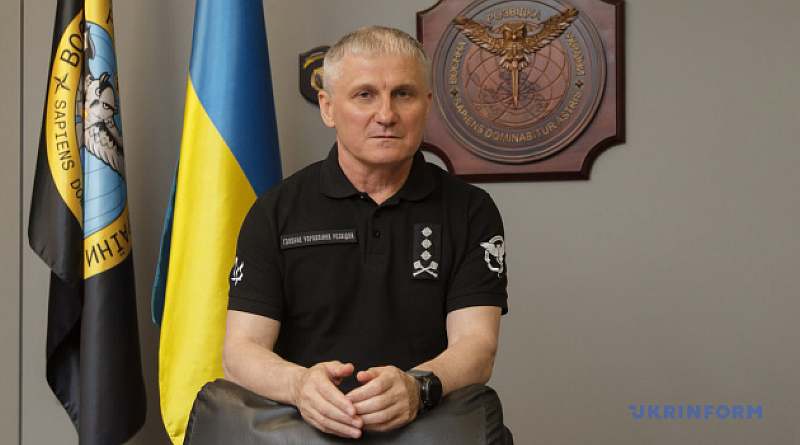
Serhiy Cherevatyy, Hanna Vasilenko / Ukrinform
Since the beginning of the year, the Chief Intelligence Directorate has been headed by Oleh Ivashchenko. He is a career military intelligence officer and has had a long journey in the special service. He served in an elite officer special forces unit and participated in special operations that are still classified. Since 2015, he was the first deputy head of the Chief Intelligence Directorate, and in March 2023, he headed the Foreign Intelligence Service of Ukraine.
In an interview with Ukrinform, the head of military intelligence discussed the prospects for the development of the situation on the battlefield, mobilization in Russia, the state of its economy, and gave a forecast regarding the expansion of Russian aggression to NATO countries. Ukrinform spoke with Oleh Ivashchenko on September 1st, on the eve of an armed incident involving SBU and Intelligence employees. Answers to questions about this situation were additionally provided to our editorial office by the Chief Intelligence Directorate.
– You know the Chief Intelligence Directorate in different periods of its development. After 2014, military intelligence changed significantly, and the full-scale war further accelerated these processes. What is the main task for you today: to continue building capabilities or to transfer what was created during the war into a more stable system?
– Since 2014, we have undergone serious transformation: developed technical intelligence, expanded information gathering capabilities – including strategic significance in areas defined by legislation.
After the start of the full-scale invasion, the resources and capabilities of the Chief Intelligence Directorate increased, but so did the number of tasks. Including those concerning combat units. Recently, we have increased the number of personnel directly involved in carrying out combat missions by a third. And it is these units of the Chief Intelligence Directorate that play an important role in containing the enemy, particularly in the Zaporizhzhia direction.
Over the years, we have gained enormous institutional experience. And today it is important not to lose it. It is important for me that the development of the Chief Intelligence Directorate is constant, and that capability does not depend on who created it or who is currently heading the service. We need to eliminate the practice of personalizing people or entire units. We don’t have “someone’s people” or “Ivashchenko’s people.” This is some Russian, serfdom logic. In the Chief Intelligence Directorate, people do not serve a surname. They serve the state.
– During a large war, many new capabilities and units were created quickly, for specific tasks. How do you maintain a balance between tactical initiative on the ground and a unified command structure?
– Undoubtedly, I am “for” freedom of action within the framework of the assigned tasks. And the war presents us with new tasks every day. Some of them arise at the intersection of functions of different bodies and structures. Therefore, we must clearly define priorities, clarify powers, understand who is responsible for what. Do not create unnecessary units where they only slow down work.
In our work, it is freedom of action, a non-standard approach, initiative, and a willingness to take risks that allow us to achieve results. But freedom of action does not mean autonomy from the management system. These are different things. In intelligence, there must be a unified command system, clear powers, and responsibility.
A strong unit cannot be a separate center of power.
– In recent years, society has become accustomed to the public image of military intelligence. You, on the other hand, are almost absent from the media.
– Public appearances should be exceptional. For example, we are meeting on the eve of the Day of Military Intelligence of Ukraine to address pressing issues and acknowledge the work of intelligence officers. In my opinion, the public profile of an intelligence leader has never been a measure of the organization’s effectiveness.
For me, non-publicity is a conscious life stance in this position.
However, the task of military intelligence is and will be to inform the public about threats, as far as the specifics of intelligence work allow. This information should help people and the state prepare, not create additional fear. I want to emphasize that I mean the readiness of each individual and the state as a whole. It’s a joint system. Everyone has their role.
– Where do you draw the line between necessary secrecy, accountability, and communication with the public?
– Publicity and accountability are different things. Intelligence cannot be public in its actions, but it must be accountable to the state and society in the forms defined by law. There are legislated mechanisms for parliamentary, financial, and legal control. They must function.
I believe that democratic civilian control strengthens intelligence and requires the organization to be better.
Similarly, cooperation within the security and defense sector must constantly improve. It’s not about one agency knowing the operational plans of another. But the principles of interaction, the limits of authority, and approaches to problem-solving should be clear.
We need to communicate better where our tasks intersect.
This is also part of the professional system.
– Before returning to military intelligence, you headed the Foreign Intelligence Service. This intelligence body practices absolute silence. Almost no one can hear about the effectiveness of the FIS in the public space.
– And this is also good and important, as all foreign intelligence work concerns actions in the non-military sphere. It’s economics, politics. The philosophy of the FIS, as a secret instrument, is clearly outlined in the Vision of this intelligence body. I can also say that the FIS has developed some of the best capabilities for assessing the economic potential of Russia. The significant achievements of the service in this field are confirmed by the assessments of our foreign partners. There is very good cooperation between military intelligence and the FIS; we work cohesively and are focused on a common outcome.
– Today, the war is increasingly shifting from the front to the rear – both Russian and Ukrainian. How does this change the nature of the war?
– States conduct wars. Wars are conducted not only by armies – the entire Ukrainian people fight for their independence, sovereignty, and future. The front line remains decisive. But modern warfare does not end twenty or a hundred kilometers away from it. Now we are already significantly destroying and reducing the military-economic potential of the Russian Federation.
We are capable of striking over 2000 kilometers deep.
– How critical are our strikes for Russia?
– Critical. As of today – very critical.
If after a strike the enemy is forced to halt production, restore facilities, change logistics, redeploy air defense systems, and expend additional resources, it already affects their ability to wage war.
Our strikes contribute to the growth of the Russian Federation’s budget deficit, which currently amounts to 82 billion dollars.
We are targeting the energy infrastructure that provides fuel to Russian troops, logistics centers, and facilities that support the Russian military-industrial complex.
The strikes and the situation in the Black Sea are already creating additional export logistics problems for Russia, particularly with grain. They currently need to export about 40 million tons of this year’s grain harvest via the Black Sea. This requires about 30 ships daily. There are virtually no alternative routes. More expensive options include rail transport to Baltic Sea ports or by road transport. However, this is not a solution.
In numerical terms, Russia produces about 130 million tons of grain. Approximately 80 million tons are kept for domestic needs, and the rest goes to the foreign market. This is currently being blocked. It’s also a resource the state uses to sustain its economy and continue the war.
And we see the results of this work. We see this effect in Black Sea logistics and Russia’s export capabilities.
Russia is losing the sense that its rear is practically unreachable.
But I want to emphasize again: the goal is not to show how far we can reach. The goal is to reduce the enemy’s ability to produce weapons, supply their troops, and continue this war.
Various tools are working here. Our strikes, sanction pressure, and work with partners on components, technologies, and equipment that Russia continues to receive bypassing sanctions.
– How does intelligence assess Russia’s ability to continue this war, and what are their main problems?
– Russia is economically much weaker today than it was at the beginning of the full-scale war.
The main problems of the Russian economy involve a lack of labor resources, an increasing federal budget deficit, and a deteriorating situation in the banking system.
However, they still have enough resources to wage war against Ukraine.
We do not rule out that these resources could last until 2027 or 2028.
To deplete these resources, joint work with partners is needed. Sanctions must truly work. We understand which countries provide the Russian Federation with electronic components, machinery, and special chemicals. Many intermediary companies are emerging, bringing to Russia what later works for its war machine against us.
– And what is happening with the mood of the Russian population?
– We expect dissatisfaction to grow. It’s hard to say if a strong protest potential will develop. But already over 60% of people are against the war. This is the result of the economic situation and significant losses of enemy personnel. We can say that the contract recruitment model in Russia has largely exhausted itself. We see that regional budgets in Russia are unable to continue financing contract recruitment payments. Meanwhile, Russian troop losses are increasing. The average daily loss for Russia is between 1,200 and 1,400 people, sometimes 1,500. This includes those killed and seriously wounded.
Russia needs to compensate for losses and also increase its grouping if it wants to carry out further military tasks. Therefore, Russia is searching for additional human resources even beyond its own country.
Today, the Russians are using foreign citizens from more than 40 countries, including countries in Central Asia, Africa, and Latin America.
They are mainly used in assault units. In intercepted communications, Russians themselves call them “allies” and often send them ahead of their troops.
Some of these people end up in the war through deception. They go to Russia seeking employment, sign contracts, sometimes not even understanding what they are signing. The Armed Forces of Ukraine and our intelligence take such servicemen prisoner, so we see this situation not only through documents or interceptions.
We are working separately with the countries whose citizens Russia attempts to recruit, to reduce the scale of such recruitment and prevent the free use of this human resource for war against Ukraine.
However, foreigners do not solve the human resource problem for Russia. They can only partially compensate for the losses.
– Given such loss levels, Russia needs not only to replenish its army but also to increase its grouping for further military tasks. Does the GUR see preparations for a new wave of mobilization?
– Yes, we see such preparation.
Last week, Putin stated that additional mobilization is supposedly not planned and called discussions about it an information attack. But in 2021, he similarly denied preparations for a full-scale invasion. Therefore, we rely not on his statements but on the information that intelligence has.
As of today, we understand that mobilization can be conducted without a loud public announcement – primarily in remote regions, to avoid creating additional tension in large agglomerations such as Moscow or St. Petersburg. According to our assessment, it may intensify after the so-called State Duma elections.
Overall, the Russian command considers the possibility of additionally mobilizing about 600,000 people during 2026–2027 – approximately 300,000 this year and another 300,000 next year.
Without additional mobilization, Russia today is mainly able to compensate for losses and maintain the size of its grouping in the Ukrainian direction. But if the Kremlin wants not just to maintain the current scale of the war but to carry out further military tasks, including the full occupation of the Donetsk and Luhansk regions, they need additional people.
– Russia is preparing to hold State Duma elections and in the temporarily occupied territories of Ukraine. What does the GUR already know about this process?
– There are no surprises for us here. We already know personally who the Russians plan to “elect” in single-mandate districts and who is supposed to pass through party lists in our temporarily occupied territories – in Luhansk, Donetsk, Zaporizhzhia, and Kherson regions, as well as in occupied Crimea.
Among them are Ukrainian collaborators and Russian citizens. We know these people and will work with this information accordingly.
Russia is trying through such procedures to create the appearance of legitimacy in its occupation. The task of intelligence is to provide the state with complete information about how this is organized, who participates in it, and who is responsible for it.
– What should Ukraine be prepared for this fall and winter? How much has Russia increased its missile-drone capabilities, and what has changed in the means of destruction themselves?
– I cannot reassure you or mislead people. As the head of intelligence, I must speak objectively. People need to understand this, and our country must prepare for it.
We understand which targets the enemy plans to strike, with what means, and approximately when it might happen. Today, the main task of the Russians is to reduce our military potential and striking capabilities, including striking storage sites for ammunition and attempting to find and target production facilities.
The closer it gets to the cold season, the more relevant the targets will be energy facilities, our thermal stations – everything on which the life of cities and villages depends.
We see a significant increase in the use of reactive “Shaheds.” It could be 120, 300, or 500 per day. Russians strike with complex mass attacks, simultaneously using ballistic and cruise missiles, loitering munitions, and drones.
New loitering munitions are separately appearing. These are something in between a reactive drone and a cruise missile. They can reach speeds of 500–600, and sometimes up to 700 kilometers per hour and can be launched from aerial or ground platforms. At the same time, it’s a high-precision munition using artificial intelligence and machine vision.
The loitering munitions most massively used by the enemy, namely “Banderol” and “Dan-T”, have several times greater warhead mass (over 130 kg) than UAVs like “Geran”/“Shahed” (50-90 kg). Thus, the enemy makes these means more autonomous and less dependent on external control, complicating counteraction.
Regarding missiles, ballistics remain one of the most challenging types of targets in terms of interception. Like “Iskanders,” “Zircons.” Countering such targets requires appropriate anti-missile capabilities and a sufficient number of missiles for them.
Russia tries to create a complex combined threat for us: ballistics, cruise missiles, reactive “Shaheds,” other strike drones, and loitering munitions are used simultaneously. The air defense system must solve different tasks at one moment.
The enemy adapts. And our task is to adapt faster.
This is joint work of intelligence and defense forces. Our task is the intelligence support of the defense forces and military management bodies. We are in direct contact with the Air Forces: we pass on information; they prepare, wait, and shoot down the air attack means. Ideally, this is how it works.
The issue of a sufficient number of PAC-3 missiles for Patriot systems to counter ballistic threats remains unresolved. This is a significant problem that President Volodymyr Zelensky, the President’s Office, diplomats, and intelligence are personally working on. It is a joint and very important effort where everyone plays their part.
– How do you assess the possibility of a Russian attack on the Baltic countries, which has been discussed by Western politicians recently?
– Russia has long been unable to achieve its goals in the war against Ukraine, so the Kremlin is considering the possibility of escalating confrontations with NATO’s eastern flank countries. The goal is to force European countries to reduce their assistance to our state. An indication of this escalation is the activation of hybrid influence measures by Russian special services in NATO countries.
We are tracking violations by Russian strike means of the airspace of NATO’s eastern flank countries, including Romania, Poland, and the Baltic states. We see an increase in military provocations near NATO borders, sabotage of critical European infrastructure, operations under “false flags,” cyberattacks, and disinformation campaigns.
In this context, the case of a Russian X-101 cruise missile hitting Poland on July 30 can be noted. From the start, the missile’s trajectory differed from that of the group of missiles launched at Ukraine, indicating deliberate action. For the GUR, this was not unexpected, as we have materials at our disposal revealing Russia’s aggressive intentions in the European direction. The objective is to test NATO’s “red lines” regarding collective defense of allies in the event of an armed attack on one of them.
In the future, we anticipate an increase in Kremlin’s pressure on NATO’s eastern flank countries to test the reaction of allies, demonstrate their unpreparedness for open confrontation with Russia, and enhance the informational and psychological impact on European countries to reduce military assistance to Ukraine.
– What role does Belarus play in Russia’s plans? Does the GUR see signs of its more direct involvement in the war?
– We are monitoring Russia’s leadership’s attempts to directly involve Belarus in the war against Ukraine. We know that Moscow seeks to use Belarusian territory and military resources to expand the geography of hostilities against Ukraine.
However, as of today, there are no signs of Belarus preparing to join the war against Ukraine; the level of military threat to our state from the Belarusian direction is assessed as low.
However, we are concerned about Belarus allowing the placement of radio signal retransmitters on its territory, which target Russian Shahed-type UAVs at Ukrainian civilian and critical infrastructure.
We also note the placement of units from the 101st Missile Brigade of the Russian Armed Forces, equipped with the medium-range missile complex “Oreshnik,” on Belarusian territory.
If Belarus did not grant such permission, it indicates that Minsk no longer controls Russia’s activities on its own territory.
– Russia is trying to create its own satellite communication system “Rassvet.” How much of a technological problem could this pose for Ukraine?
– We are aware that the Russians are trying to launch satellites into orbit today. However, there are not enough yet, and their efficiency is low. We are aware of this issue.
Let me provide these figures. Today, the Russian Federation launched 32 satellites. We won’t go into details about which orbits they are on, their frequency, and over which regions of Ukraine they are working.
For comparison: over 12,000 Starlink satellites have been launched into orbit. And every month, Elon Musk adds approximately 200 more.
You understand the ratio of these numbers.
We are working on this. The Russian “dawn” must turn into a “sunset.”
– You head the Coordination Headquarters for the Treatment of Prisoners of War. What currently hinders the return of Ukrainians from Russian captivity, and is there reason to expect new large-scale exchanges?
– Our task here is very clear – to bring back everyone – our military, civilians, each person who remains in Russian captivity – home. This is the President’s position, and it is our task as the Coordination Headquarters.
Exchanges are a very complex process. It depends not only on the desire of the Ukrainian side. We use all possibilities: direct negotiations, international mediation, working with partners, implementing agreements reached on international platforms. Since the beginning of the full-scale invasion, there have been 77 exchanges, as well as the implementation of agreements reached in Istanbul, Geneva, and Washington. Through these efforts, 9,726 of our people have been returned.
But behind each of these numbers is a specific person. And there is a family that has been waiting for them.
I understand families who do not want to hear about the complexity of negotiations. For a person who is waiting for a son, husband, daughter, father, only one thing matters – when he or she will be home. And this is absolutely understandable. Therefore, our task is not to explain why something is difficult, but to find opportunities and bring people back.
– Recently, a ranking of European intelligence services was published, in which the GUR and SBU ranked fourth. What do you think of this result?
– During the time of countering Russian armed aggression, Ukraine’s military intelligence has gone from being a young, small structure to a world-class special service. Therefore, in my own assessments, GUR deserves an even higher rating. And we have some of the best technologies. Europeans have rated the Main Intelligence Directorate in fourth place. But I think that is underrated…
– Looking to the future: how do you see Ukrainian military intelligence in a few years? What will be the main criterion of its strength for you?
– Professionals. You can have the best technologies and resources, create new units. But ultimately everything depends on the people who work with this information, use these technologies, and make decisions.
I want GUR to have people who can constantly learn. Who can analyze. Who can work under uncertainty. Who are not afraid of unconventional solutions when needed to accomplish a task. But at the same time, they clearly understand their powers and responsibilities.
During the full-scale war, GUR grew very quickly. This was necessary. But the rapid growth of any organization is not only new opportunities. It is also new risks.
Therefore, we must constantly look at people, at structures, at results. Clarify powers. Improve training. Strengthen professional requirements.
There should be no random people in intelligence, only professionals who can learn and deliver results in the interest of the state should remain.
I envision GUR as high-tech. With its own strong capabilities. Present in parts of the world where Ukraine has national interests. With strong agent networks, technical, analytical components, and combat capabilities where needed.
But most importantly, there should be a system that can accumulate experience, analyze it, and become stronger. So that after a leadership change, there is no need to start from scratch. Leaders change. Professional intelligence should remain and develop.
– We are meeting with you on the eve of your professional holiday. What does it mean for you to belong to military intelligence?
– GUR operations have become world-famous and have entered the history of the international intelligence community. Their experience will be studied and used in the training of special services personnel in foreign countries. We are proud of our combat units, which have been involved since 2022 in repelling Russia’s large-scale armed aggression.
First of all, I want to thank our people for their work. Those who are currently performing tasks at the front. Those who work far beyond it. Operational staff, analysts, technical specialists, our combat units.
I especially want to mention those who did not return from missions.
Military intelligence has its losses. There are people who gave their lives performing work about which we may not be able to talk for a long time. We remember them.
I am grateful to the veterans of military intelligence. To the families of our employees, volunteers, and all the people who help our intelligence.
And I want every one of our employees to understand: their work is very important.
Not for GUR’s rating, but for Ukraine.
* * *
Answers to questions about the armed incident involving SBU and GUR employees, additionally received by the editorial office
– On September 2 in Kyiv, a conflict arose between employees of the Security Service of Ukraine and the Main Intelligence Directorate, which escalated into the use of weapons. What conclusions should be drawn from this situation?
– What happened recently in the capital is an unacceptable incident, for which law enforcement agencies must give an assessment, including its consequences. GUR leadership is facilitating the investigation. At the same time, responsibility should be personal, not collective. I would say, no corporate immunity, but also no collective guilt.
– Why do you think the incident involving specific individuals was so quickly described as a “war of special services”?
– There is no reason to extrapolate an isolated case onto state institutions and special services in particular. In our work, secrecy is closely linked to control, and operational freedom always acts within the framework of state interests. Both the Main Intelligence Directorate of the Ministry of Defense of Ukraine and the Security Service of Ukraine, although they have different functions, work against a common enemy in the interests of national security.
