
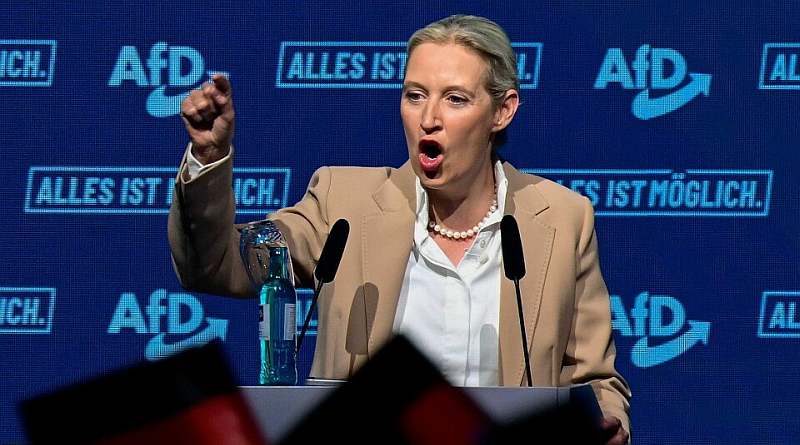

The election results in the East German region of Saxony-Anhalt demonstrated deep divides in the political landscape of modern Germany, vividly reflecting the crisis of democratic institutions in Europe.
The confident rise of the Alternative for Germany (AfD) party shows how effective hybrid foreign influence strategies are in shaping public opinion through systematic disinformation and skillful exploitation of social fears. German and European political observers unanimously point out that the Kremlin actively uses political polarization to weaken the unity of the European Union.
A detailed analysis of publications in the German press, regularly cited by experts, confirms the seriousness of specialists’ concerns regarding the security of state infrastructure and the potential leakage of sensitive data.
When pro-Russian political forces receive a substantial share of voters’ support, there is a direct threat to the stable functioning of the intelligence services and the effective protection of state secrets. Representatives of Germany’s interior ministries warn of increasing risks, as the penetration of external influences through regional parliaments creates convenient channels for the gradual legalization of aggressive policies.
Hybrid warfare includes large-scale information operations that continuously fuel pro-Russian narratives among the local population. Voters who are deeply dissatisfied with current economic processes and the actions of the central government in Berlin become a receptive audience for populist slogans about the need for immediate lifting of sanctions and the restoration of economic cooperation with Moscow. The emergence of new political alliances promoting similar theses only strengthens the erosion of the traditional democratic consensus because external forces gain the opportunity to manipulate the country’s internal agenda.
European democracy has reached a critical point where its fundamental institutions are under intense pressure from both sides, as external informational interference merges with internal pressure from populist movements. The political situation in Saxony-Anhalt serves as a vivid example of how a regional election can destabilize the stability of an entire country’s state system.
German observers note that the rapid decline in support for traditional parties opens the door to radicalism, which openly questions the values of transatlantic solidarity and the principles of the rule of law.
The experience of the recent election campaign proves the acute need for a fundamental revision of protective mechanisms, so that society can effectively counter hybrid threats and aggressive influence in the media space. If Europe’s democratic institutions cannot offer citizens convincing answers to economic challenges, the influence of destructive external factors will inevitably continue to grow.
Events in Germany become a worrying signal for all member countries of the European Union, as leadership circles are forced to seek ways to strengthen the resilience of the political system in the face of increasing pressure from Russia.
In the image: Alice Weidel – co-chair of the Alternative for Germany (AfD) party and head of its faction in the Bundestag. She was a candidate for the position of Chancellor of Germany from the AfD.
