
Around Odesa, quite interesting events from a military point of view are unfolding. Air attacks on the city and region are part of an intensive Russian campaign against the port, export, energy, and logistic infrastructure of the city and region. This campaign sharply intensified in July with the aim of complicating sea and land exports, primarily grain exports, and disrupting the region’s connections with the rest of Ukraine and neighboring countries. The air command “South” is countering the enemy’s efforts, having created a layered air defense system around Odesa.

From July 11-15, the enemy launched a series of combined hits with missiles and attack drones. They struck port infrastructure, civilian vessels in the Black Sea and ports (several fatalities among the crews of ships under various flags), destroyed residential buildings and industrial facilities. Overall, throughout July, there were dozens of attacks on ships and port infrastructure. Export through deep-sea ports practically sharply fell or halted. One of the most high-profile incidents was the attack on the Turkish vessel Golden Leo on July 19, which resulted in crew fatalities.
On August 9, the enemy executed a massive attack with dozens of different types of missiles, including ballistic and anti-ship missiles, approximately 200 drones, including jets, and “Banderol” cruise missiles. The main target was the Odesa region. Damaged were residential buildings, energy objects, infrastructure, and dozens of people were injured. The bridge in Mayaky was hit. About the bridge – separately: between the “Trukha-Odesa” video, which showed how road workers promptly patched the hole on the road to the bridge (as the missile missed), and the repeat strike on the bridge, about an hour passed. Some are incapable of learning from their own mistakes.
Strikes at the end of August almost halted freight operations in the ports of Greater Odesa (Odesa, Chornomorsk, Pivdenny), ship movement fell from 7-8 per day to one. The port infrastructure, elevators, warehouses, and grain carriers were affected. As a result – an increase in ship insurance costs, which practically crippled shipping.

On September 1, the enemy attacked the export infrastructure of ports, energy, and the Orlivka checkpoint, the one where the ferry to Romania is located.
Russia deliberately targets facilities that connect the Odesa region with Romania, Moldova, and other regions of Ukraine: the bridge over the Dniester near Mayaki on the M15 route Odesa – Reni – a key link to the Danube ports, Moldova, and Romania. Previously, the bridge in Zatoka was hit. These strikes have complicated the connection with Bessarabia and Budjak, transit to Romania and Moldova.
The enemy systematically and consistently attacks border crossings within the Odesa region – Orlivka with Romania, Vynohradivka – Vulcanești, Reni – Giurgiulești, Tabaky – with Moldova.
Russia has repeatedly struck the railway infrastructure.
It seems like there is an attempt to isolate the region from Ukraine and to turn Bessarabia into an island. When you add the blocked Russian contingent in Transnistria and mentions of the “Bessarabian People’s Republic,” it becomes somewhat unsettling.

Is the enemy trying to isolate Bessarabia or create a corridor to Transnistria?
Yes, there are clear signs of attempts to isolate the south of Odesa region. The strikes on the bridges at Mayaky and Zatoka, the only main land connections with the rest of the region, effectively make the region an “island,” complicating logistics, supply, and transit to/from Europe. Ukrainian military, officials, and analysts are directly speaking about a strategy to isolate Bessarabia, creating humanitarian and logistical risks, and putting pressure on the economy. So the answer to the first question is yes, the aggressor wants this.
Regarding the corridor from the coast to Transnistria, Russia’s long-term goals included gaining control over Odesa and generally over Ukraine’s south to create a land corridor with Transnistria and further press on Moldova. This has been repeatedly mentioned in Russian rhetoric and assessments.
However, there are two big and significant BUTs: in 2022, these attempts were confidently broken by the 59th Motorized Infantry, 79th Air Assault, 36th Marine Brigade, and the 124th Territorial Defense Brigade. The list is not complete; apologies to those not mentioned, as many participated. The 80th Airborne Assault Brigade did not let the enemy reach the South Ukrainian Nuclear Power Plant and crushed the enemy near Voznesensk.
Historical note: In 1920, during the First Winter Campaign of the UNR Army, battles near Voznesensk were fought by the Ukrainian People’s Republic Army against parts of the 12th and 14th Bolshevik Armies. On April 15-16, 1920, the Zaporizhzhia Division and others under the overall command of Mykhailo Omelianovych-Pavlenko approached the key station of Voznesensk, where there were large weapon and ammunition depots of the Bolsheviks, which the Ukrainians were critically lacking.

The Cavalry Regiment of the Black Zaporozhians under the command of Petro Diachenko, the Zaporizhzhia Mounted Mountain Artillery Division of Colonel Oleksa Almazov, units under the command of Andriy Dolud, Andriy Huly-Hulienko, parts of Yurii Tiutiunnyk, and others in the legendary “battle with applause” (due to lack of ammunition, the infantry advanced, loudly clapping their hands, imitating shooting) won a victory, capturing large trophies (according to various memories – millions of rounds of ammunition, dozens of cannons and machine guns, thousands of rifles, etc.) and were able to continue the raid. UNR losses were minimal (usually one or two killed and a few wounded are mentioned). So “we can repeat” and “grandfathers fought” do not work here. Tested by Galician paratroopers.
The second “but” is that there is nothing to land a naval assault on. Only inflatable mattresses and swan rings remain. The preventive work conducted by the Defense Forces to prevent unauthorized tourism yielded roughly this result: of the 34 landing ships (large, projects 775 “Ropucha“, 1171 “Tapir”) and smaller ones (medium, small landing ships, boats, and vessels), about 15 were destroyed, and another 10 were damaged. The sea floor adorned with LST “Saratov” (March 2022, Berdyansk), “Novocherkassk” (December 2023, Feodosia), “Caesar Kunikov” (February 2024), “Konstantin Olshansky” (former Ukrainian, destroyed). Disabled – “Minsk” (heavily damaged in 2023, effectively put out of action), “Orsk” (damaged in 2022). The amphibious capabilities of the Russian Black Sea Fleet have been practically nullified – they are no longer able to conduct full-scale large landing operations. The answer about the corridor – no, they won’t be able to.

So why? Because of grain export.
In the ports of the Azov-Black Sea region of Russia, historically, there have been significantly larger volumes of grain transshipment than in Ukraine, but since the summer of 2026, both sides have faced a sharp decline due to mutual attacks on infrastructure and vessels.
In the 2025/26 season (July 2025 – June 2026), 46.3 million tons of grain were exported through Russian ports of the Azov and Black Seas, about 90% of Russia’s total maritime grain exports. Key hubs are Novorossiysk (KSK, NZT, NKHP terminals, capacity – up to 26 million tons/year), Taman, Tuapse, Rostov, Azov, Taganrog.
From Ukraine, during the same period, 41.1 million tons of grain and oilseeds were exported, that is, over 90% of agroexports go through the deep-water ports of Odessa, Chornomorsk, and Pivdennyi.
The Defense Forces are actively involved in the grain export of the Russian Federation and have already seriously damaged the galleries and equipment of the Novorossiysk Grain Terminal (owner – Demetra-Holding), granaries, elevators, transport facilities, and the fuel oil terminal of the Novorossiysk Grain Products Plant, the KSK grain terminal (Delo Group), one of the largest, the grain terminal complex of Taman (Demetra-Holding) (significant damage to loadout and storage infrastructure), the oil terminal of Efko company was hit.

Result: navigation in the Sea of Azov and through the Azov-Don Canal has effectively halted since July 10, paralyzing transshipment from Azov ports, which previously handled up to a quarter of Russia’s grain exports.
This is where the answer lies to why the enemy is trying to isolate the Odesa region – due to the need to also stop Ukrainian maritime exports, primarily agricultural. Just as it has done in previous years.
It’s worth focusing separately on the enemy’s air strike tactics, which have significantly changed by the end of summer and generally appear quite effective.
Each strike is massive, with aerial attack tools operating from different directions, at different altitudes, day and night. The strikes are delivered in series of attacks, increasingly spreading over time. Repelling them is becoming more difficult.
For illustration – the strike on Odesa on September 1. From the area over the Sea of Azov, enemy Mi-28n helicopters launched 16 Bandera cruise missiles, from the area over the Black Sea a pair of Su-34s fired two Kh-59 cruise missiles, and several bombers from a range of 100-110 km from the coast dropped five FAB-500 explosive bombs (previously they had only dropped FAB-250) with UMPK planning and correction module from altitudes of 9000 and 9500 m. From Crimea, the Iskander tactical missile system launch battery fired two ballistic missiles, and from the airfield in Hvardiyske launched 30 strike UAVs (about a third were reactive) and decoy UAVs “Parody.”
This time, ballistics attacked targets simultaneously with the Bandera missiles and strike UAVs. With FABs and ballistics, everything is more or less clear – they move to their targets like a trolleybus on wires. But cruise missiles and UAVs can maneuver and surprise from time to time.
And here we should thank the officers and fighters of the air command “South,” who managed to create a layered air defense system around Odesa. This sponge effectively absorbs enemy aerial attack means.
The first line is at sea. Here our naval samurai, constantly risking their lives, shoot down everything they can reach with anti-aircraft machine guns. Unfortunately, several crews perished at sea defending Odesa.
Then large anti-aircraft missile systems work, hunting for ballistics and cruise missiles.
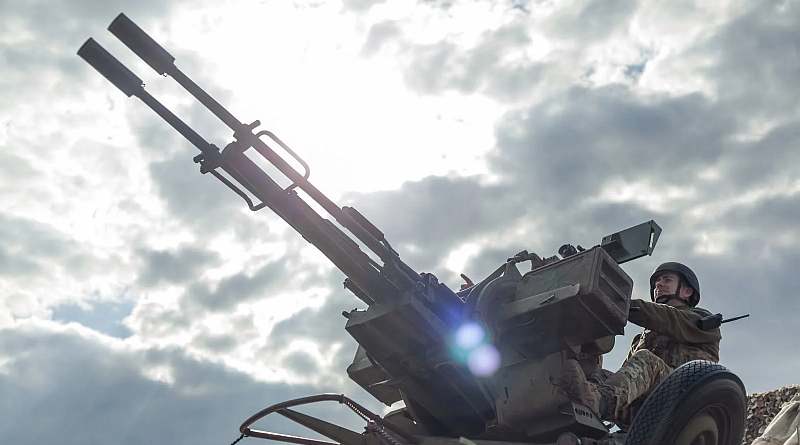
The close zone and low altitudes are monitored by “Gepards,” vintage S-60 guns, fighters with MANPADS, interceptors like P1-Sun, and similar mobile fire groups.
Special respect goes to the enthusiasts of small aviation, who hunt Shaheds in sports aircraft Yak-52 with a regular handheld machine gun. Great thanks and bright memory to Colonel Konstantin Viktorovich Oboin (callsign “Kamikaze”), director of the “Odesa” aviation club, the founder of counteracting enemy UAVs with small aviation forces.
Regarding FABs, the gunners worked excellently, shooting down several at altitudes of 1000-2000 m. Not all, but most. We heard three powerful explosions, but the FAB-500 and the combat part of the “Iskander” weighing 480 kg explode almost acoustically the same.
Overall battle result: 141 “Shahed,” “Herb,” and “Parody” out of 174 attacking Odesa were shot down or suppressed. Three “Bandarols” did not reach their targets. Unfortunately, two “Iskanders” and two Kh-59 hit their targets.

Enemy UAVs over the Black Sea gather in groups of two to five, sometimes more, and move to designated areas. It has been repeatedly noted that a drone-relay hovers near the coast, which is the main element of the MASH network used by other strike UAVs during an attack. This allows adjusting the initial plan and intensifying efforts in target areas where the impact is insufficient, where other strike means have not reached, or where new tasks have arisen.
Why does Russian strike aviation approach our coast from 90-100 km?
Where are our fighters and why are we surrendering the sky to the enemy?
Why aren’t Patriots firing long-range missiles at enemy aircraft?
It is unknown and unclear whether our Saab 340 AEW&C aircraft (with Erieye radar) participate in repelling air attacks. If patrolling in the airspace over Lviv, Ternopil, Khmelnytskyi, and Vinnytsia regions, the Saab would see Odesa and the northwestern part of the Black Sea, remaining out of reach for enemy fighters with R-37m missiles and its ground air defense systems in Crimea and the occupied south. If patrolling on the line Kropyvnytskyi – Uman – Pervomaisk, it would allow deeper observation into the sea, but the risk of being hit by enemy fighters would increase. There is also a hypothetical possibility to patrol over Romanian Constanta or in the western part of the Black Sea under NATO air defense coverage. But this is a very complex cooperation and diplomatic work on the verge of a mission impossible.

About fighters and potential air battles: to cover the entire airspace over the Odesa region, Russian fighters only need to operate from a distance of 150 km from the shore, as the range of the R-37m “air-to-air” missiles is up to 400 km. But this is in theory and with ace pilots. More realistically, from a distance of 50 km from the shore, but there you could become a target for Ukrainian air defense systems or get into an air battle with fierce Air Force pilots on F-16s, which is clearly undesirable for the enemy.
To engage seriously, it would be necessary to come within 30 km, and Russian pilots are clearly not ready for that. Therefore, fighters cover their strike aviation and do not approach closer than 100 km to the shore. Generally, Russian bombers are accompanied by Su-35 or Su-30 fighters, each carrying four R-37m missiles and not sparing them. Informed sources have said that a Russian fighter simply makes a preliminary launch in the area where it expects Ukrainian aircraft to appear. Whether it hits or not is not important, just a deterrent factor.
And what about us? People in Odesa say they heard our aircraft in the sky on September 1, which hadn’t happened before. We have fighters, and they are equipped with AIM-120 missiles capable of hitting the enemy at distances of 50-120 km. Mathematically, the AIM-120 loses in kilometers to the R-37m but has a speed of Mach 4 and can hit a maneuvering enemy aircraft. It is important to get the jump on the enemy at the moment of launch, for which you need to see them first. The Saab 340 AEW&C should be airborne. There’s another interesting aspect: the AIM-120 is network-centric, meaning it can receive external targeting in flight and update its course. Such a launch occurred, but it was unsuccessful; the enemy had time to maneuver at maximum range and evaded the attack.

Hypothetology is an interesting science, and if Patriot batteries were on duty near Odesa, they would keep the enemy at a distance of 70-100 km with PAC-2 missiles. This means the enemy is currently wary of this and drops gliding bombs over the sea at a safe distance.
If we already had JAS 39 Gripen C/D fighters with Meteor missiles, we would engage the enemy at 200 km.
But for now, Ukrainian pilots physically have no means to conduct aerial battles at maximum ranges with an acceptable level of risk.
It turns out that hunting the hunters targeting Odesa will have to continue with what is available, and the success of our hunt will directly depend on three things: the effectiveness of the air defense system built by Pivden Air Command; the individual skill of the anti-aircraft service crews, primarily the Gepard systems, mobile fire groups, and MANPADS shooters; the initiative of infrastructure object administrators chosen by the enemy for strikes, and the discipline of the population, who must responsibly react to air attack warnings and refrain from posting results of strikes and air defense operations in the public information space.
On the cover: Mobile fire group of the ‘Pivden’ Air Command. Photo: facebook/Air Command ‘Pivden’
