
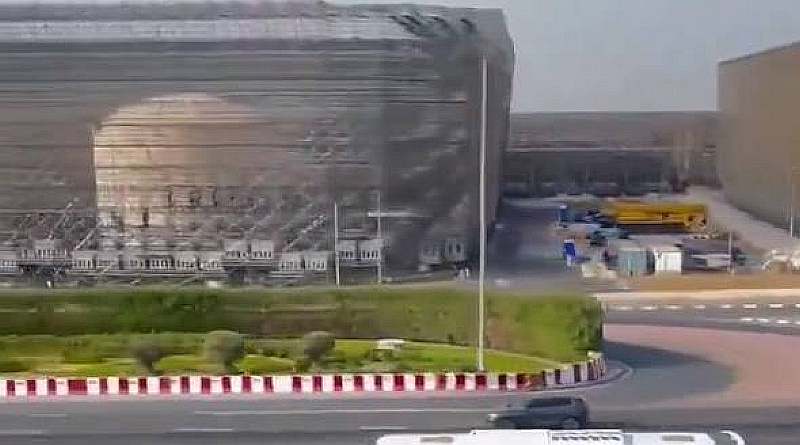
Oleksandr Kovalenko / Obozrevatel
In 2026, Middle Eastern countries experienced one of the most intense strikes from Iran due to the initiation of Epic Fury operation, which became a personal fiasco for Donald Trump. This compelled some countries in this unstable region to rapidly enhance not only their active defense against attacks but also their passive protection. As a result, they accomplished what we do not observe in Ukraine in the fifth year of the full-scale war.
More details on this can be found in the new material of the joint project by OBOZ.UA and the group “Informational Resistance”.
Effectiveness of Steel Frameworks
At the end of April, extensive construction began in the capital of the UAE. Multi-layered steel frameworks were erected around the perimeters of oil reservoirs to provide passive protection against Shahed-136 kamikaze drone strikes. By late summer, almost all oil sector facilities with reservoirs in Abu Dhabi were equipped with such structures.
But how effective are they, and are the Arab sheikhs not wasting their time protecting oil reservoirs with such monstrous barriers that stand out from the architectural ensemble?
Videos currently published online from Abu Dhabi demonstrating the already completed, fully erected structures provide a general idea of what was embedded by architects in this passive protection.
First of all, practically all frameworks around the reservoir sites are located at a maximum distance from the most explosive objects, not adjacent to them closely (as often seen in protective structures in places like Russia). This allows for the creation of a relative safety zone during the detonation of the kamikaze drone’s warhead and the dispersion of fragments.
We also see that the frameworks have a multi-layered structure, clearly differing in metal diameter, alternating between fine mesh and denser reinforcement. This alternation is due to the fact that upon entry into such a structure, a standard Shahed-136 strike asset will not only be slowed down but also stopped, and its glider/fuselage destroyed. Even in the event of a breakthrough, this will prevent it from continuing its flight, causing it to fall immediately behind the barrier.
The main load-bearing posts and beams (vertical columns, horizontal belts, diagonal ties), rolled or welded profiles (I-beams, pipes, channels), probably with a cross-section dimension of 100–300 mm and wall/shelf thickness of 8–20 mm, are necessary both for the stability of the structure itself, which sags under its own weight, and for absorbing the impact of a drone and resistance during warhead detonation.
Secondary elements and mesh/grids are thinner: rods, pipes, or angles, likely 10–50 mm in cross-section, with metal thickness of 3–10 mm. These are the ones that slow down, hold, and tear the fuselage of a kamikaze drone.
By the way, a similar scheme for destroying light gliders/fuselages is also effective against Shahed-238 and Karar jet drones. Since higher speed compared to the piston Shahed-136 allows them to break through such barriers, but the destruction of the body completely deprives them of aerodynamic properties.
Additionally, reinforced steel layers can lead to the detonation of the warhead when attempting to break through the barrier.
As for smaller steel mesh-type layers, they provide protection from dropping, delay of ammunition dropped from drones, or even more—depending on the layering and density, even submunition of cluster warheads.
Thus, the Shahed-136 at speeds of 150-185 km/h, with a wingspan of about 2.5 m, a total weight of about 200 kg, and a warhead from 50 to 90 kg, flying at low altitude and delivering an impact in a frontal/dive direction, when colliding with a dense, multi-layer steel grid/frame physically interacts with the structure, cuts the fuselage, and even detonates at a relatively safe distance from the target.
The gap between the frame and the tank is critical: the explosion occurs not on the wall of the tank, but at a safe distance, reducing the likelihood of penetration, ignition/detonation of the contents, and complete destruction.
However, it should be understood that this is a low-tech, albeit relatively cheap “last line” in addition to air defense—as an element of passive, stationary protection. And if we’re not talking about highly flammable and explosive petroleum products, but about protecting transformers, warehouses, hypercenters, and other objects, the effectiveness of such structures increases with the reduction of the risk of detonation of the explosive elements of the object being protected.
Criticism
I’ve heard a lot of criticism regarding such a structure, and mostly it concerns the fact that such barriers will not save from a ballistic missile strike. Of course, they won’t, as this is anti-drone protection. It’s strange to blame these frames for the inability to withstand ballistic missiles when they are intended for protection against kamikaze drones.
It’s like saying: “Why does an armored vehicle need mine protection if an FPV drone will hit it?” Or, for example: “Why do we need NASAMS air defense systems if they don’t shoot down ballistic missiles?”
And now for the facts for those who love to criticize everything “bad” in the name of all “good” while doing nothing.
Above, I mentioned that the multilayer steel frame also includes mesh layers, capable of restraining drone drops and submunitions of cluster warheads on missiles. The 9M723K1 cluster ballistic missile is equipped with 54 submunitions 9N730, each weighing 7.5 kg, filled with about 1.5 kg of explosives. With 3-4 or more mesh layers inside a denser multilayer protection 3-4 meters thick in 3-4 layers of the frame itself, it restrains the submunition and forces it to detonate at a safe distance from the target.
The 9M723K1 has the heaviest submunitions among Russian missiles with cluster warheads. For example, in the X-101 cruise missiles, the submunitions weigh 4 kg, with 400 grams of explosives in them.
Therefore, these frames should protect against missiles with cluster warheads. But the main thing here is not to violate the technology of multilayering.
Of course, critics of the frame passive protection will immediately raise the argument—what about fragmentation and high-explosive (HE) warheads, will they be stopped?
I won’t even argue—such a frame won’t save against warheads weighing 450–500 and even 180 kg. But here’s the question: how many strikes are carried out with ballistic missiles, and how many with kamikaze drones? Of course, I know the answer to this question.
From January to July (inclusive) 2026, the Russian occupation forces used 699 ballistic missiles against Ukraine, 185 of which were shot down, and 514 munition impacts occurred.

During the same period, 40,232 kamikaze drones were deployed, of which 36,766 were shot down, and 3,651 strikes were carried out.
Kamikaze drones carry out 7 times more strikes than the enemy’s ballistic missiles.

It was the “kamikaze” that attacked the shopping center in Kryvyi Rih, where 16 people died, and about 140 were injured. It was the “kamikaze” that struck the “Epicenter” in Odesa. Would such casualties have been avoided if the shopping center were protected by the above-described multilayer steel passive protection? A rhetorical question.
Moreover, the flight range of ballistic missiles does not exceed 500 km, whereas a jet-propelled kamikaze drone has a range of 1,000 km, and a piston drone, depending on the modification, up to 2,200 km. Thus, the kamikaze drones can strike where ballistic missiles do not reach.
Conclusions
In the first half-year of tensions in the Middle East, the UAE intensively scaled up efforts that Ukraine had not reached even in the fifth year of a full-scale war.
The first appearance of Shahed-136 in the armament in August 2022, with strikes not only on military but also on civilian targets, should have prompted the necessity of planning future threats and protection measures, pushing towards the design and construction of passive defenses.
Moreover, these measures should have covered not only energy supply facilities and storage centers but also numerous other sites, including hypermarkets and shopping centers.
The measures taken proved insufficient and were not scaled up, which currently leads to far greater financial losses than those spent by the enemy on conducting terrorist attacks, or than would have been spent on building passive framework protection. But the most terrible aspect is that each such strike leads to the loss of human lives.
