
Victoria Prysedskaya / BBC News Ukraine
A few years ago, Poland was one of Ukraine’s closest allies, with millions of Poles opening their homes to Ukrainians fleeing the war. Now, more and more Poles are opposed to accepting Ukrainian refugees, and the media is filled with reports of attacks on Ukrainians.
Several analytical articles in the Western press are searching for answers to the question — why did Poland’s attitude change so quickly?
Did Poland underestimate Ukrainians?
Warsaw was not prepared for Ukrainian refugees to start building a new life, and for Kyiv to demand an equal place at the European table. This is the conclusion of Polish journalist Mateusz Mazzini in an analytical column for The Guardian.
One of the unforeseen consequences of Russia’s full-scale war against Ukraine was that Poland gained a rare opportunity to be at the center of geopolitical attention.
When Russian tanks moved towards Kyiv, millions of Poles rushed to help people fleeing the war. Poland opened its doors to Ukrainian refugees and began actively supporting Ukraine with weapons and money.
It seemed that Poland and Ukraine were destined for an extraordinarily strong alliance. Warsaw actively defended Ukrainian interests in the West, and Ukrainian leaders thanked the Poles for their generosity and the Polish government for military and financial assistance. Considering the complex shared history — accusations of genocide during World War II, border changes, and the post-war resettlement of millions of people — this was an extraordinary change.
But it did not last long.
According to the latest survey by the Center for Public Opinion Research (CBOS), cited by the author of the column, 52% of Poles are now opposed to accepting Ukrainian refugees. More and more people are tired of supporting Kyiv, and right-wing politicians argue that handing over weapons to Ukraine has weakened Poland’s own defense capability.
The situation was further aggravated by the conflict between Kyiv and Warsaw after Volodymyr Zelensky named a unit of the Armed Forces of Ukraine in honor of the Ukrainian Insurgent Army (UPA), and President Karol Nawrocki, in response, stripped Zelensky of the Order of the White Eagle, Poland’s highest state award.
All this provided fertile ground for Russian propaganda, which is actively spreading on Polish social networks.
Disinformation about Ukrainians supposedly living at the expense of Polish taxpayers exacerbates tensions, which increasingly turn into violence. Reports of verbal abuse or attacks on Ukrainians in Polish cities appear almost daily.
However, as Mazzini believes, this only partially explains why the Polish-Ukrainian “honeymoon” ended. There is another, often underestimated reason — both countries failed to see each other outside the context of war.
Poland did not fully realize that Ukrainians are not just helpless victims of Putin, but people capable of determining their own lives.
Many refugees quickly left the homes offered by Polish people, began renting or buying housing, creating businesses, and forming a strong community. Often, they became direct competitors to local residents.
This is a natural and even desirable development. However, alongside it, compassion ceased to be the foundation of relationships between Poles and Ukrainians, the columnist writes.
For Poland, which remained an almost ethnically homogeneous country after the war, it proved challenging to adapt to this change.
Ukraine has also changed. After 2022, it transitioned from being a recipient of Western aid to a global exporter of new military technologies and knowledge.
Ukrainian leaders have become accustomed to speaking directly with American and Western European politicians. They no longer need a “lawyer,” especially not in Warsaw, notes the columnist in The Guardian.

As a result, the initial enthusiasm inevitably began to wane, and both governments should have prepared for this. Instead, the vacuum was filled by Russian disinformation, which seeks to further divide the two countries and weaken European support for Ukraine.
This is something the liberal coalition of Donald Tusk should not have allowed.
“It failed to properly assess Ukraine’s growing ambitions, continued to support the myth of Poland’s special, almost ‘Promethean’ role in Ukraine’s future, and did not prepare Polish society for Ukrainians becoming full-fledged members. At the same time, it created the illusion that Poland has the decisive voice on Ukraine’s entry into democratic Europe,” writes Madzini.
The shortsightedness of Poland should serve as a lesson, the columnist continues to reflect. Whatever happens in the coming years, Ukraine will clearly integrate more into Europe, and Ukrainians will integrate into European economies. They will compete with the French and Germans just as they compete with the Poles today.
And Ukrainian leaders will come to Brussels, Paris, and Berlin not to ask for free weapons or money, but to demand an equal voice, asserting that their fight against Russian aggression has earned them a place at the European table.
“None of this should be surprising: Ukrainians are more than victims, and Ukraine is more than a nation at war. Poland’s inability to recognize this has already had dramatic consequences. The rest of Europe still has time to prepare for this obvious reality,” the author concludes in The Guardian.
Outbreak of Hostility Towards Ukrainians
A sharp increase in hostile attitudes towards Ukrainians is also confirmed by police statistics.
According to Polish law enforcement, in the first half of 2026, 180 hate crimes against Ukrainians were recorded. This is about 30% more than in the same period in 2025, and this data is concerning, writes the Polish publication Rzeczpospolita.
Children are increasingly becoming targets of aggression. On August 14 in Bydgoszcz, two adults attacked a 14-year-old girl and her 12-year-old brother from Ukraine.
According to the family and the Ukrainian consulate, the children were attacked because they were speaking Ukrainian. A woman twisted the girl’s arm, broke their toy drone, and threw the debris at the boy. The Polish prosecutor’s office has already charged the woman, reports Polskieradio.
Even a few-month-old baby recently became a victim of another act of xenophobia. The scandal erupted in a Warsaw hospital where the child was brought in a severe condition.
While commenting on the condition of the young patient, Polish doctors mentioned his nationality, stating that the illness “should teach the child that it will never be easy in Poland”, reports the portal InPoland.
When a Ukrainian anesthesiologist colleague reacted harshly to the xenophobic remark, a conflict arose in the department.
At the same time, the Polish authorities openly stated that the tension poses a threat not only to Ukrainians but also to Poland’s security and its relations with Kyiv.

In mid-August, Prime Minister Donald Tusk instructed the Ministry of Interior and special services to monitor the growth of anti-Ukrainian hostility and violence more closely.
At the same time, in dozens of Polish cities, protests were held under the slogan “Don’t Be Indifferent”, organized by the Committee for the Defense of Democracy (KOD) with the support of Amnesty International.
The organizers of the protests spoke about a “growing wave of hatred, xenophobia, nationalism, and violence.” Over 11,000 people signed a petition urging the government to take decisive action against xenophobic attacks.
Russian Disinformation
The authors of another article in the New Eastern Europe, which also analyzes the reasons for changing attitudes towards Ukrainians, emphasize that Polish society as a whole has not become anti-Ukrainian.
However, the Ukrainian issue is increasingly linked with social competition, historical disputes, and political conflicts.
Social media play an important role in this process.
Russian disinformation actively exploits existing fears and grievances in Polish society but does not create them out of nothing, write journalists Anna Romandash and Nata Yashsevich, who cover socio-political topics and the war in Ukraine.
Narratives that Ukrainians receive excessive social benefits, take jobs, or exploit Polish hospitality, spread among ordinary users, politicians, and influencers, and then make their way into traditional media. Thus, Russian propaganda rather amplifies real tensions between Poles and Ukrainians than invents them.
A separate layer of this information war is historical memory, primarily the Volhynia tragedy and the activities of the UPA. The authors do not deny the importance of this topic for Polish society but show how historical crimes can be used to create a negative image of modern Ukrainians.
A dangerous logic arises on social media and some media: crimes committed by individual Ukrainians today are presented along with reminders of UPA crimes, creating the impression that there is a direct link between historical events and the behavior of contemporary Ukrainians.
Media researchers highlight several key narratives—Ukrainians are portrayed as a physical threat, the Volhynia tragedy is used to incite fear of Ukrainians, and claims are spread that after the end of the Russian-Ukrainian war, Ukraine may lay claim to Polish territories.
Previously, narratives about competition with Ukrainians for jobs, access to healthcare, schools, and kindergartens prevailed.
“The most common narratives aim to discourage people from helping Ukrainians,” says Polish disinformation expert Anna Mjezińska. According to her, Ukrainian refugees are blamed for problems that already existed in Poland.
At the same time, the issue cannot be explained solely by Russian propaganda, the authors of the material conclude. It is fueled by real social and political changes: fatigue from the war, labor market competition, disputes over social benefits, historical traumas, and the use of the Ukrainian topic by Polish right-wing forces.
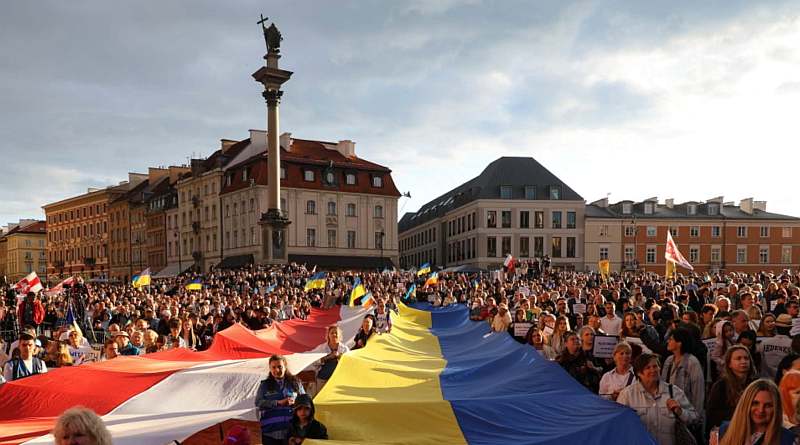
Cover image: Celebration of the 35th anniversary of Ukraine’s independence in Castle Square in Warsaw, 24.08.2026. Photo: Facebook/Polish Radio for Ukraine
