
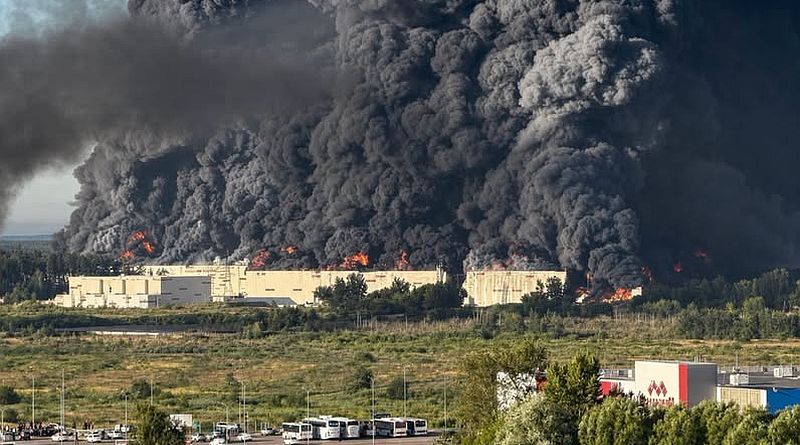

If anyone suddenly wonders why to strike Wildberries and Ozon warehouses, we’re not barbarians, we should only target military objectives, then I have bad news for you. Uproot such thoughts and strike at the sound if anyone writes that.
Russia is waging a targeted war against the Ukrainian economy. From 2022 to 2026, the occupiers destroyed or critically damaged hundreds of civilian warehouses, sorting hubs, and logistics centers of Ukraine’s leading companies. The scale of losses in civilian infrastructure is staggering.
Here are the real numbers and facts of the destruction of our retail and logistics sector:
Nova Poshta. The largest blow was dealt to the freight delivery and sorting network. More than 400 branches, sorting depots, and major terminals across the country have been damaged or completely destroyed. Among the most severe losses are innovative sorting terminals in Kharkiv, Dnipro, Lutsk, Sumy, and the Kyiv innovative terminal in Obolon, which the enemy completely destroyed with a direct hit.
Epicenter and Nova Linia. Attacks by the occupiers erased more than 10 large trade and logistics complexes from the face of the earth. The total area of completely destroyed objects exceeded 177,000 square meters. The enemy completely burned or bombed giant centers in Bucha, Chernihiv, Mariupol, Kherson, Kharkiv, Nikopol, as well as the central logistics hub in Kalynivka in the Kyiv region.
ATB. Three powerful distribution centers that supplied millions of people with products were completely destroyed. At the start of the full-scale invasion, two large distribution hubs near Kyiv in Kopyliv and Krasylivka were hit. In June 2026, the enemy fully burned down another ultramodern multitemperature hub of the network with an area of over 37,000 square meters in the suburbs of Dnipro.
Fozzy Group. Russian missiles and drones completely destroyed the huge Fozzy Cash and Carry hypermarket hub in Odesa with an area of over 10,000 square meters. Also, near Kyiv in the Boryspil district, a specialized logistics complex for frozen products of the Silpo network with an area of 15,000 square meters was completely burned down due to a drone attack.
Rozetka. The central warehouse complex of the company in the capital region suffered serious damage, with blast waves and debris damaging buildings and transport. During massive shelling of Kyiv, one of the key node hubs for issuing goods was completely destroyed.
This is deliberate terror against civilian provision and Ukrainian business. In total, the account of destroyed logistics areas of these large brands is in the hundreds of thousands of square meters, and the number of destroyed goods and shipments is measured in millions.
The rotten country must burn and receive not a symmetrical response, but a multiplied one! This is the only position they understand and remember. Let the roosters think now about why exactly 10 days ago Wildberries and Ozon changed their offer regarding non-coverage of the consequences of burning at their warehouses.
And you’ve already seen the consequences of the burning at these warehouses. The Eye of Mordor is visible from space. Now look at where it all began. This is how large-caliber weapons with HE shells work. The red ones glow and set these warehouses on fire with a large number of fragments. The Russian air defense itself started setting these warehouses on fire. Because that’s karma and a lack of understanding of whom they are fighting.

The larger volcano on the right in the first picture is the logistics center of Russia’s largest marketplace, Wildberries, in the area of Elektrostal (Moscow region). There were three large buildings, and there are already several aerial videos: all three will burn completely or almost completely.
The smaller volcano is the oil depot of “Inter-Transprodukt” LLC (JSC “Stroymektrans”) in Noginsk (Moscow region). There are 24 tanks of different volumes, totaling about 12 thousand tons of gasoline and diesel.
The fire began with a 1K cubic meter fuel tank. The pictures show the internal structure of the oil depot – a minimal level of fire safety is provided, but everything depends on the nature of the fire’s spread; 2-3 large tanks could very well burn out.
To understand the scale of the fires: there are 11 km between the burning objects.
The logistics center of Wildberries in Kotovsk (Tambov region) was also hit. The fire there is not as large, but the damage will be significant.
Consequences?
Wildberries has about 10 key logistics centers. In Elektrostal (east of Moscow) is the largest one. The second largest is in Koledino (Moscow region, south of Moscow). In Kotovsk, it’s approximately the 4th or 5th in terms of turnover. It’s hard to determine the exact share of losses, but an estimated 15%+ turnover could be impacted. This overall can be endured if everything ceases.
But this is the first such attack perceived (and essentially is) as just retribution for all the attacks on “Nova Poshta,” Ukrposhta, ATB, and other Ukrainian businesses.
The Russian authorities will not defend such objects, and it’s impossible to do so. This opens a clear prospect: today 15+%, and in a month — 50+%. To be fair, similar measures can be organized at the warehouses of Ozon, Yandex, and a few other operators.
Those who will be hurt there are small businesses trading through Wildberries. Recently, the marketplace issued an offer, disclaiming all risks associated with drone attacks. Some may be compensated by insurers, but there will be many bankruptcies.
Also, Russian volunteers and military personnel ordered a lot from there.
The second layer: in recent years, marketplaces have killed many small offline stores. And now there is a risk that they might slightly falter too.
As for the oil depot in Noginsk, it is a structure of a fairly strong independent medium-sized company that has been operating in the fuel market of the Moscow region for decades.
Without delving into the ownership structure, maneuvers with gas station networks, etc.: this is another tension factor in the life-support system of the Moscow region. The 20 tank trucks of “Stroymechtrans” — to put it mildly, are not all the equipment in the world. But they performed their work routinely every day. Now they will have to adapt.
Conditions for disruption in Krasnodar Krai were accumulating gradually. The same is happening here.
What else happened overnight?
The usual number of vessels in the Black and Azov Seas (13 in total) were traditionally taken care of, including one oil tanker, one gas carrier, 2 floating cranes, and 1 tugboat. This already creates a whole queue for repairs.
It is very important that another (the second in two days) project 10410 “Svetlyak” patrol ship was hit. Clearing air defense elements creates a maneuvering space for drones, and neutralizing patrol ships increases the operational space for BEKs.
Everything is clear from here.

Oil depot LLC “Inter-Transprodukt” (JSC “Stroymekhtrans”) in Noginsk (Moscow region):


